
Chlorine Dioxide for Vertical Farms: A Suitability Guide for Stacked Canopy Cultivation
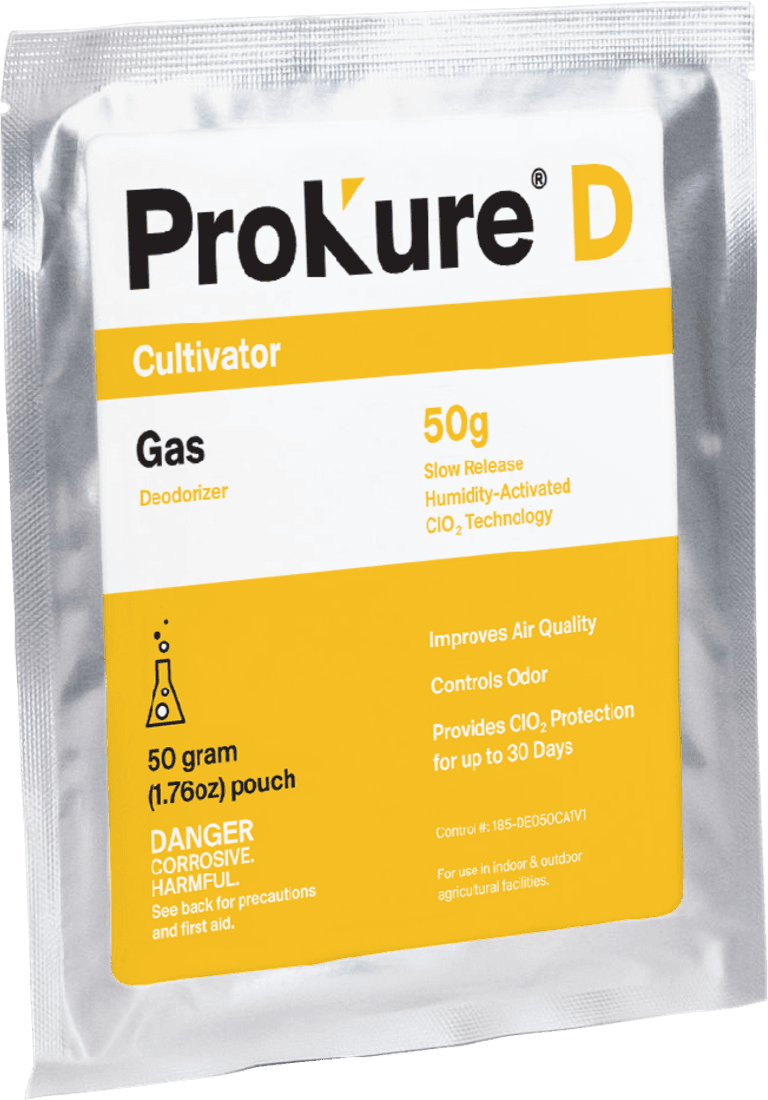
Chlorine dioxide fits a vertical farm, but not for the reason the top search results tell you. Nearly every ranking page frames ClO2 as an irrigation-water story, and water is one of three real jobs: water disinfection, surface sanitation during turnover, and air treatment between and during cycles. In a stacked-canopy grow the air job is the one that decides your harvest, because restricted inter-tier airflow lets mold pressure compound shelf over shelf. ProKure D holds air quality for up to 30 days, ProKure V disinfects hard surfaces, and which format you reach for depends on whether you run cannabis or leafy greens. Here is the suitability read for a tiered operation.
What chlorine dioxide does in a vertical farm
Chlorine dioxide is a selective oxidizer with the formula ClO2, and despite the name it is not chlorine bleach. It targets biological material rather than reacting with everything in sight, which is why it works at low concentrations and is less corrosive than broad oxidizers. In a vertical farm it does three distinct jobs, and conflating them is how operators buy the wrong product.
Water: ClO2 disinfects irrigation water and controls biofilm in recirculating lines. The research base is solid here; a peer-reviewed study on chlorine dioxide disinfection of irrigation water confirms it as a legitimate alternative to sodium hypochlorite. If your only concern is the reservoir and the lines, the water angle is a hydroponics question, and our hydroponics guide covers dosing and residual monitoring in more detail than this page.
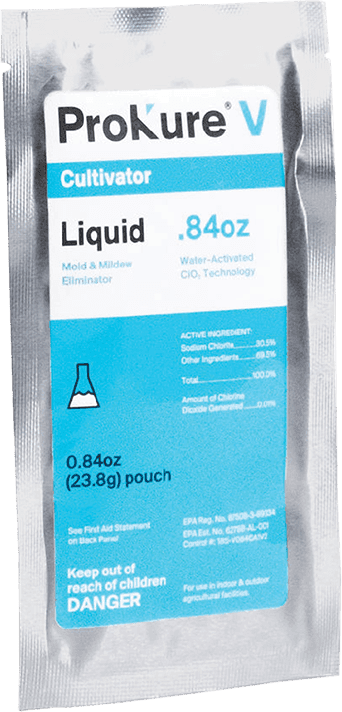
Surface: during turnover, ClO2 as the ProKure V liquid disinfects hard, non-porous surfaces. In a rack system that is not a trivial task, which the next section gets into.
Air: this is where a vertical farm diverges hardest from a flat room, and where ProKure D earns its place. Hold that thought for the application-modes section below.
Why vertical farms are different from single-tier CEA
A single-tier grow and a five-high rack are not the same sanitation problem, and the incumbent content misses this entirely. The number-one ranking page for this query spends its whole length on water; in its own words, it explores the benefits of chlorine dioxide water treatment to vertical farming systems, underscoring its significance in promoting plant health, yield, and overall system efficiency. Air never appears. For a stacked grower that is a hole you can lose a crop through.
Three things change when the canopy goes vertical. First, airflow between shelves is restricted, so warm humid air rises through the rack and the top tiers sit in the exhaust of the bottom tiers. Second, surface area multiplies: a tiered rack carries three to five times the hard-surface footprint per square foot of floor, so a turnover that was a wall-and-floor job is now a shelf-face-by-shelf-face job. Third, disease pressure compounds tier over tier, so a botrytis or powdery-mildew start on tier two seeds tier three and four before you see it at eye level. A single-tier indoor grow does not stack these effects; if that is your setup, the indoor-grow-rooms guide is the better fit.
The practical consequence is that a sanitation plan copied from a flat room underperforms in a rack. A sprayer reaches the floor and the walls and the front face of each shelf, then stops; it does not reach the dead-air pocket between tier three and the shelf above it, which is exactly where humid air stalls and a colony starts. That gap is why the air-phase job is not optional in a vertical grow the way it can be in a wide single-tier room. You are not just treating more surface; you are treating a geometry that traps the very conditions mold wants.
The three application modes for vertical farms
Match the mode to the job and the product choice stops being a guess.
Irrigation water disinfection
ClO2 controls waterborne pathogens and biofilm in the lines that feed every tier. Biofilm in a recirculating vertical system is a real efficiency drag, clogging emitters and fouling sensors. Dose to a residual your crop and label support, monitor it, and keep the water job separate in your logs from the surface and air jobs. For the full dosing-and-monitoring treatment, hand off to the hydroponics sibling rather than duplicating it here.
Surface disinfection during turnover
This is the ProKure V job. ProKure V is an EPA-registered (87508-3-89334) liquid hospital-type disinfectant for hard, non-porous surfaces, used at 100 ppm for a 10-minute contact time, and it leaves no residue. Its label kill list includes Aspergillus niger (ATCC 9642) and Fusarium solani (ATCC 36031), and it is suitable for use with plants in the room because you treat the surface, not the canopy. In a rack system, budget for the surface-area multiplication: every shelf face, tray, and upright is a treated surface, not just the floor and walls.
Air treatment during and between cycles
Here is the mode the SERP ignores and the one a stacked grower needs most. ProKure D is a slow-release ClO2 gas that improves air quality and controls odors, humidity-activated, providing ClO2 protection for up to 30 days. A gas fills the rack volume and reaches the restricted inter-tier pockets a sprayer never touches, and the up-to-30-day window matches a crop cycle without a daily labor task. Note the boundary: ProKure D is not an EPA-registered product and is not labeled for sale as a pesticide under 40 CFR. It is an air-quality and odor product, used in a contained, unoccupied space, not a crop or surface antimicrobial. That boundary is the whole point of the EPA section below.
Cannabis vertical grows versus leafy-greens vertical farms
Vertical-farm operators split into two buyers we serve differently, and the top-10 assumes everyone is growing lettuce.
Cannabis vertical grows
Stacked flower and mother rooms carry state-mandated yeast-and-mold thresholds and pathogenic-Aspergillus testing before sale, and residue on flower is a hard line. The dominant concern is air quality across tiers plus a documented between-cycle reset, which is the ProKure D and ProKure V pairing. For the cannabis-category framing in full, the cannabis suitability guide covers state thresholds.
Leafy-greens and herb vertical farms
Lettuce, basil, and microgreens are consumed raw, so residue tolerance and FDA Produce Safety framing dominate, and irrigation-water disinfection is usually the primary job with surface sanitation during turnover second. The air-odor job is smaller here than in cannabis. Same chemistry, different weighting, which is why one product rarely answers both. A cannabis vertical grow buys D and V first and treats water as secondary; a leafy-greens farm often inverts that, leading with water disinfection and using V at turnover. Getting the weighting wrong, buying a water solution for a mold-pressure problem or vice versa, is the most common mismatch we see, and it is the one the SERP's water-only framing actively pushes a cannabis grower toward.
EPA registration and the plants-crops-feed boundary
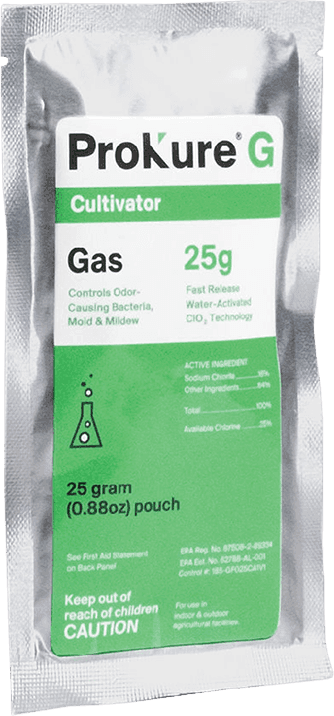
This is the Q40 worry, so state it plainly rather than burying it in a footnote. Which ProKure format carries which label is a compliance fact, not a marketing detail. ProKure V is EPA-registered (87508-3-89334) for hard, non-porous surfaces and is suitable for use with plants in the room. ProKure G is an EPA-registered (87508-2-89334) fast-release gas whose label reads not for use with/on plants/crops/feed, so it runs in an empty room between crops with a one-hour vent before re-entry. ProKure D is not an EPA-registered product and is not labeled for sale as a pesticide under 40 CFR; it is an air-quality and odor product. What that means in practice: no ClO2 format here is applied to the living plant as a pesticide, the surface job is V, the empty-room gas reset is G, and the ongoing air-quality layer is D. Keep each product's EPA number and current SDS on file, and pull the full label PDFs from prokuresolutions.com. Get the label match right and your audit paper trail builds itself.
A between-cycle turnover protocol using ClO2
The between-cycle window is the highest-risk moment in a vertical grow: the rack is not yet proven clean, the room sits humid, and there is usually no data trail for the gap. Treat it as a documented sequence. Strip the room and remove crop debris from every tier. Disinfect hard surfaces, shelf faces, trays, and uprights with ProKure V at 100 ppm for the 10-minute contact time. Run the empty-room air reset with ProKure G, crop and crew out, then vent one hour before re-entry. Install the next cycle, and hang ProKure D to hold air quality across the stacked canopy for up to 30 days. Log every step: product, EPA number where it applies, concentration, contact time, who ran it, and the date. The log is what proves biosecurity to a state inspector, and it is the single thing the incumbent water-only pages never mention. Sequence matters as much as the products: surfaces before air, crop out for the gas step, and the 30-day residual clock started at install, not at some vague point mid-cycle. For a stacked grower this is the standardization an MSO Cultivation Director can roll out identically across every site, which is what turns a one-room habit into a defensible multi-facility SOP that reads the same to an auditor in any state.
Crew safety, ppm limits, and re-entry
ClO2 earns a safety question, and the honest answer beats the bleach it replaces. The OSHA permissible exposure limit for chlorine dioxide is 0.1 ppm as an 8-hour time-weighted average, a published number you can design re-entry around. The gas products run in a contained, unoccupied space, so the operating rule is simple: people out during treatment, ventilate, then re-enter per the label. Compared with a bleach turnover that forces the crew out for the day on fumes and leaves residue, a ClO2 protocol gives you defined windows and, for the V surface job, no residue to rinse. Follow the label for each product's specific re-entry and ventilation timing; it is the authority.
Choosing between an on-site generator and ready-to-use ClO2
The top-ranking vendor sells one answer: a capital generator. In its own framing, the Alpha R generator is renowned for producing Chlorine Dioxide on-site and on-demand, eliminating the need for hazardous chemical storage and ensuring a fresh supply of this potent disinfectant whenever needed. That is a real fit for a large, continuous-dose water system. It is the wrong tool for a small or mid-size vertical grow that wants an event-based, ready-to-use product for surfaces and air rather than a plumbed capex install. Generators are continuous-dose, water-focused, and capital-heavy; ready-to-use ProKure V and ProKure D are event-based, cover the surface and air jobs the generator does not, and fit an operating budget. For the full product-selection matrix across formats, the CEA umbrella guide lays it out. The short version: size drives format. A single rack bank or a small vertical room almost never justifies a plumbed generator; the ready-to-use products cover the real jobs at a fraction of the install cost and with no maintenance tech on payroll. A large multi-bay facility running continuous water treatment may justify a generator for the water line while still reaching for ready-to-use D and V for the air and surface jobs the generator cannot do. Those are not competing choices; they are different layers of the same program.
Conversion follows the same split by operation size. If you run a single or small vertical grow, order ProKure V and ProKure D for your next turnover on shop.groclarity.com; no crew evacuation is needed once the re-entry window passes, and reorder is a click. If you are a Cultivation Director standardizing stacked-canopy sanitation across a multi-state footprint, the move is a quote rather than a cart: request a scoped SOP that respects each state's label restrictions and yeast-and-mold thresholds, so every facility runs the same defensible protocol and procurement stops chasing SDS across suppliers. Either way, educate here, buy on shop.groclarity.com, and pull the EPA labels and SDS from prokuresolutions.com. Built on Science. Backed by Results. Serious Science for Serious Growers.
Related resources
Related resources