
Can You Use Chlorine Dioxide During Flower? Yes, if You Pick the Right Form
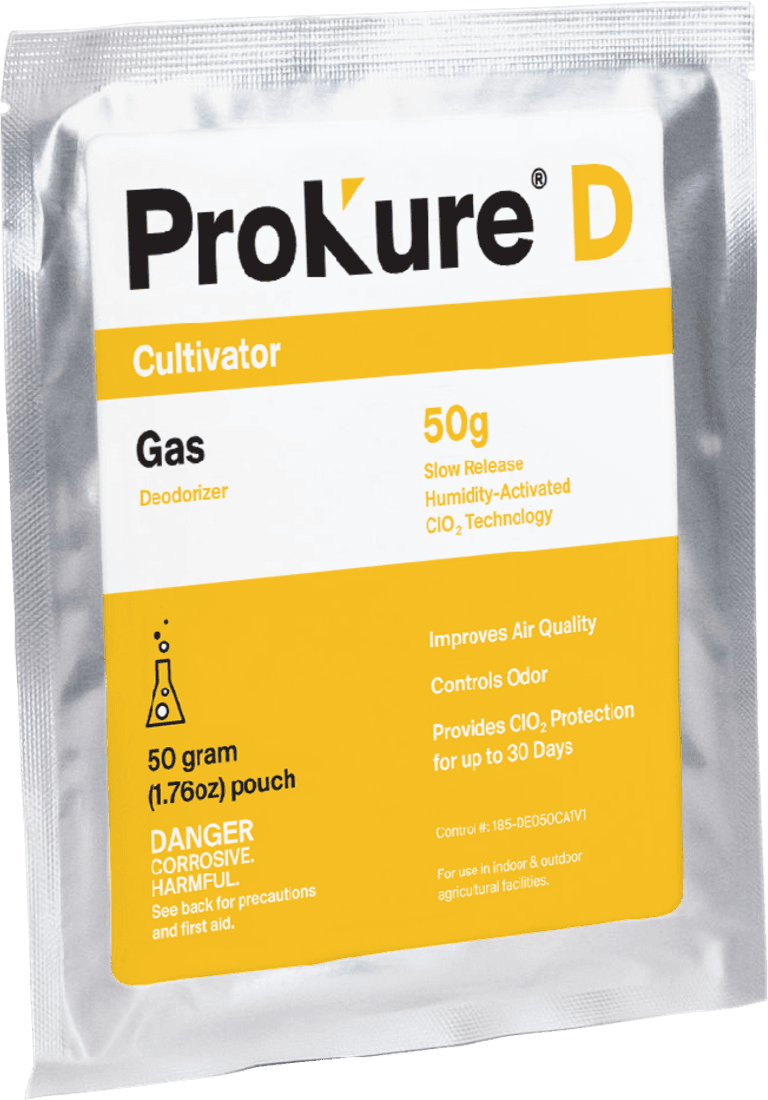
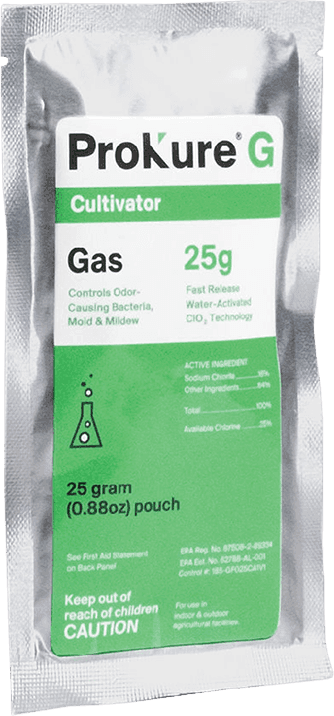
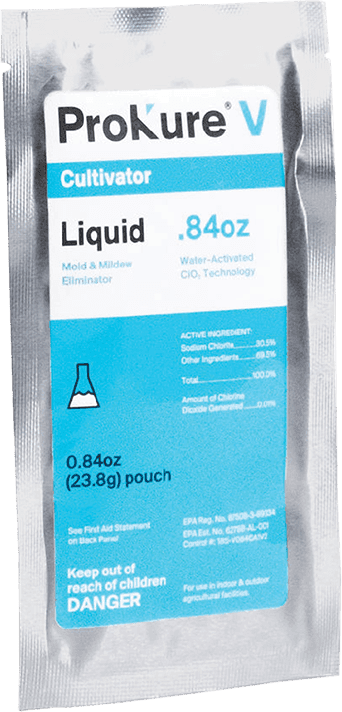
Yes, you can use chlorine dioxide during flower, as long as you match the form to the room. ProKure D, a slow-release ClO2 gas, runs in the room with plants to improve air quality and control odors for up to 30 days. ProKure V, a liquid disinfectant, is suitable for use with plants in the room, applied to hard surfaces like benches, trays, and tools, never to the plants themselves. The one product you do not run during flower is ProKure G, the fast-release gas, because its label states it is not for use with plants, crops, or feed. Form and label class decide the answer, not the chemistry alone.
That is the whole decision in two sentences, but the stakes in week 6 are high enough that the rest of this page walks the why, the how, and the exact label boundaries. You are already in flower. You cannot pull plants. You cannot put anything on the bud that leaves a residue. So the question is not "is chlorine dioxide safe" in the abstract, it is "which ClO2 product is allowed in this room, right now, with these plants in it."
Why the flower stage changes the question
In veg, you have room to maneuver. In flower, you do not. The plants are in the room for the next several weeks, the trichomes are forming, and the pathogens that cause the worst losses show up precisely when you have the least freedom to react.
Botrytis strikes in the flower window
Bud rot is the one that keeps head growers up at night, and it does not wait for a convenient moment. One cannabis cultivation blog puts the timing plainly: it "often strikes during flowering, just weeks before harvest." A dense cola holds humidity in its core, and by late flower that core is the perfect incubator. You need air quality managed during the exact weeks you cannot spray the plants.
Powdery mildew and aspergillus are different problems
Powdery mildew shows up on bracts and sugar leaves right when a foliar spray is off the table. Aspergillus is a pre-sale failure mode, not a plant-health one: it may not hurt the plant at all, but it fails the state yeast and mold panel and costs you the harvest. Those are air and surface problems, which is exactly where an air-quality product and a surface disinfectant earn their place, and where spraying the plant does not.
The trichome constraint
By week 4, what you put in the air matters more than at any other point, because the flower surface is now the product. ProKure D works on the air and the odor load, not on the plant, which is why it fits the flower room. A surface disinfectant like ProKure V goes on benches and tools, not on the buds. Keep that line clean and the trichomes stay out of the equation.
This is also where a lot of growers get burned by advice written for the wrong stage. A protocol that assumes an empty room, or that assumes you are still in veg with the freedom to foliar-spray, does not transfer to a flowering canopy you cannot touch. The reason this page is separate from a general safety guide is that "safe for plants" is not a fixed property of chlorine dioxide. It depends on the form, the concentration, and whether the product is labeled for use with plants in the room. Ask those three questions every time and the answer stops being a guess.
The three ProKure forms and which are flower-safe
Chlorine dioxide can be dispensed as a gas or a liquid, and within the gas form it can be released slowly or quickly. That split is the entire decision, and a competitor blog describes it well: "When released slowly, the concentration of ClO2 is low and not toxic to humans, plants or animals." The three ProKure products map onto that split cleanly.
ProKure D: slow-release gas, in the room during flower
ProKure D is the slow-release ClO2 gas. It improves air quality and controls odors, and it provides ClO2 protection for up to 30 days from a humidity-activated pouch. This is the product that runs with plants in the room through the flower cycle. It is not an EPA-registered product and is not labeled for sale as a pesticide under 40 CFR, which means it is an air-quality and odor product, not a pathogen-kill product. Treat it as the steady baseline, not a spot treatment.
ProKure V: liquid disinfectant, surfaces only
ProKure V is the liquid, EPA Reg. No. 87508-3-89334, a hospital-type disinfectant you activate with water. It is suitable for use with plants in the room, and it leaves no residue, but it is a surface product: benches, trays, tools, grow-room surfaces at 100 ppm with a 10-minute exposure time. You use V to disinfect the hard surfaces around the plants, not to treat the plants. If you need the full surface protocol, the ProKure V liquid surface disinfectant page carries it.
ProKure G: fast-release gas, empty rooms only
ProKure G is the fast-release gas, EPA Reg. No. 87508-2-89334, and it works in 4 to 6 hours. Its label states it is not for use with plants, crops, or feed, so it never runs during flower with plants present. G is the empty-room reset you deploy after harvest, when the room is cleared, for a fast air-and-odor knock-down before the next crop goes in. Confusing G for an in-flower product is the single most common and most dangerous mistake on this topic.
The reason the fast and slow gas forms behave so differently comes down to concentration. The same competitor blog that describes the slow release also describes the fast one: when ClO2 is released quickly, the high concentration is for a sealed, empty space, and "this should be only be administered in a sealed room when there are no humans, plants, or animals present." That is G. The low, continuous release that is not toxic to plants is the territory ProKure D occupies. One product, one concentration curve, two completely different rooms. Match the product to the room and the compliance question answers itself.
What the labels actually say
This is the section the ranking competitors skip, and it is the one that keeps you compliant. None of the top results discloses which product carries which label class, so growers reassure themselves on chemistry and guess on the regulatory line.
ProKure V carries EPA Reg. No. 87508-3-89334 and the "suitable for use with plants in the room" language for hard-surface disinfection. ProKure G carries EPA Reg. No. 87508-2-89334 and the required disclaimer "Not for use with/on plants/crops/feed." ProKure D is not an EPA-registered product and carries the disclaimer "Not an EPA-registered product and not labeled for sale as a pesticide under 40 CFR." That is not a defect in D. It is a statement that D is a deodorizer and air-quality product, not a pesticide, so you do not make or rely on a pathogen-kill claim with it. For the current master labels and SDS on all three, prokuresolutions.com is the authoritative source, and it is where your procurement and QA lead should pull the audit pack.
The plant-in-room use case is not a fringe reading of the label, either. A United States patent filing describes a method for applying gaseous chlorine dioxide "at a level effective to prevent microbial proliferation in a setting containing growing plants," which tells you the regulatory and scientific communities already recognize low-level ClO2 around living plants as a legitimate application pattern. That does not change which SKU you reach for, and it does not turn an air-quality product into a pesticide. It does mean you are not improvising something nobody has done before. You are running a labeled product inside its intended use, which is the whole point of reading the label first.
A week-by-week protocol for flower
Head growers think in weeks, so here is the cycle in weeks. The pattern holds across a standard 9-week photoperiod bloom; adjust for your strain and your auto timeline.
Early flower, weeks 1 to 3
This is the stretch phase, before bracts form. Run ProKure D for continuous in-room air quality and odor control. Use ProKure V on benches, trays, and tools between any plant moves. The focus here is getting ahead of airborne spore load and surface biofilm before the canopy closes and humidity climbs.
Mid flower, weeks 4 to 6
Bracts are forming and trichomes are coming on. Keep ProKure D running for air quality. Hold your surface discipline with ProKure V on the hard surfaces only. The focus shifts to preserving terpene expression, which means keeping anything with residue off the plant and letting the air-quality product do the air-quality job.
Late flower, weeks 7 to 9
Ripening and harvest prep. ProKure D continues for air quality and odor, which matters most now because dense, ripe colas are the botrytis risk. This is vigilance time, not experimentation time. When the room clears at harvest, that is when ProKure G comes out for the empty-room reset, and the ProKure G fast-release gas for empty-room turnover page covers that protocol.
What not to do during flower
You searched this question because you have heard conflicting advice, so here is the negative-space list no vendor likes to publish.
Do not fog hypochlorite or quaternary ammonium with plants in the room. Those leave residue on the flower and have no plant-in-room registration. Do not run a high-concentration ClO2 shock, which is the fast-release gas protocol, with plants present: that is the ProKure G use case, and G is not for use with plants, crops, or feed. Do not ozone-shock a room with plants in it. And do not mix your own unlabeled two-part ClO2 and run it around flowering plants, because you have no label, no registration, and no defensible record if a test comes back dirty. If you have visible mold already, this is a remediation problem, not a maintenance one, and the mold prevention protocols for the flower room page is the better starting point.
The common thread in that list is residue and registration. Anything that lands on the flower and stays there risks showing up on a certificate of analysis, and anything you run without a label gives you nothing to show an inspector. ProKure D stays on the right side of both because it is an air-quality and odor product, not something applied to the plant, and ProKure V stays on the right side because it is a no-residue surface disinfectant used on surfaces, not on buds. The products that get growers in trouble are the ones borrowed from a janitorial closet and pointed at a flowering canopy.
Terpenes, trichomes, HVAC, and the data trail
The second-biggest objection after safety is quality: will this touch my terpenes. The honest answer is that ProKure D works on the air and the odor, not on the flower, so it is not applied to the trichomes at all. A cultivation blog notes that chlorine dioxide at low levels controls odors "without harming the delicate terpene balance present in high-quality cannabis flower," and the byproduct chemistry is reassuring too: another source states "Chlorine dioxide and its primary by-products break down to sodium chloride (also known as table salt)." You are not coating the bud in anything exotic.
On airflow, the rule flips from the shock-dose rule. For a fast-release empty-room shock, you turn circulation off. For continuous low-release air quality with plants in the room, you keep normal grow-room circulation running so the product distributes evenly. Carbon filters and supplemental lighting operate as usual during a continuous in-room deployment.
The part that protects your harvest at audit is the record. Log the SKU, the EPA registration number (or the not-registered status for D), the pouch activation date, the room, the square footage, the application window, and operator initials. A head grower who can hand a state inspector that log has air-test proof, not an anecdote. That documentation trail is a GroClarity emphasis, because air-test proof is what reassures ownership and regulators, and it is the difference between a vendor who sells you pouches and a partner who helps you defend the harvest.
Room-size math, state rules, and picking your product
Sizing follows the D coverage numbers: the 10-gram pouch treats about 1,000 cubic feet, the 50-gram about 4,000, and the 95-gram about 8,000. For a flower room larger than a single pouch's coverage, space pouches equally apart so the gas distributes rather than pooling, and remember ClO2 gas is heavier than air, so place units high. Confirm the current coverage figures against the ProKure cut sheet on prokuresolutions.com before you size a big room.
State rules vary, and that variance is exactly where a multi-site operator pays for standardization. Total yeast and mold thresholds differ by state, and aspergillus speciation panels are required in some and not others. A protocol that passes in one state footprint may be measured against a different threshold a state line away, which is why a single documented SKU set beats a patchwork of local habits.
Picking the product for your situation comes down to the job in front of you. If the job is ongoing air quality and odor in a room with flowering plants, that is ProKure D. If the job is disinfecting the hard surfaces around those plants between moves, that is ProKure V on benches, trays, and tools. If the job is a fast, high-concentration reset and the room is empty, that is ProKure G. Many flower rooms use D and V together through the cycle and bring G in only at turnover.
If you run one site, reorder ProKure D and ProKure V on shop.groclarity.com and keep your log. If you run several sites and need one protocol across every state footprint, request a quote through GroClarity and the commercial-accounts path, and standardize the SKU set and the SOP at once. Educate here, buy on the shop, pull the deep label detail from prokuresolutions.com, and keep the record that proves it worked.
Related resources
Related resources