
ProKure G for Trim Room Turnover: Is the Fast-Release Gas the Right Fit for Your Facility?
ProKure G is the right tool for a trim room turnover when the room is empty, you want the air and odor reset fast, and you need crews back in on the same shift. It is a fast-release chlorine dioxide (ClO2) gas that works in 4 to 6 hours, then needs about an hour of ventilation before re-entry. It is not for use with plants, crops, or feed, so it runs only in a cleared, unoccupied room, which is exactly what a trim room is between cycles. For a facility manager fighting downtime, that is the pitch: a fast air reset that does not force a multi-day evacuation and does not leave the residue bleach does.
This page is written for the facility manager running day-to-day operations, room turnover, and sanitation scheduling, because that is who searches for a trim-room turnover product. If you are a head grower thinking about ongoing air quality with plants in the room, or a procurement lead assembling an audit pack, the answers below still apply, but the turnover job is yours. The question is whether G fits your turnover, and the honest answer is: for the empty-room fast reset, yes, with specific conditions you need to get right.
The trim room turnover problem a facility manager actually has
Trim rooms take a beating. They fill with plant material, trichome dust, and the odor load of fresh-cut flower, and they turn over on a tight schedule because the room is a bottleneck between harvest and packaging. Every day a trim room sits in turnover is a day the room is not producing, and in a facility with a steady harvest cadence, a slow turnover ripples downstream into drying, packaging, and ship dates.
Downtime is the cost that hides
The pain here is not a single dramatic failure. It is the slow bleed of downtime. A turnover that eats three to five days because the room has to air out after a bleach fogging, or because nobody can work in it while it off-gasses, is three to five days of lost throughput every cycle. Multiply that across a year of harvests and the number stops being a rounding error. The facility manager who can compress turnover from days to a single shift is the one who keeps the whole line moving.
It also compounds through the rest of the building. A trim room is rarely the last stop; it feeds packaging, labeling, and shipping, and those stages have their own commitments to distributors and retail buyers. When the trim room is down, the pressure does not stay contained in the trim room. It shows up as a late drop to a dispensary, a rushed packaging shift to catch up, or a backlog of hung biomass waiting for a trim station to open. The schedule is a chain, and the trim room is one of the links that most often becomes the bottleneck, because it is the room that gets the dirtiest and therefore needs the most frequent reset.
The carryover problem nobody logs
There is a quieter cost than downtime, and it is carryover. A trim room that is not fully reset between cycles carries the last cycle's odor load, trichome dust, and microbial pressure into the next run. The crew notices the smell first, but the real issue is that a room that never truly resets accumulates. Each cycle starts a little dirtier than the last, until an odor complaint or a quality note on the flower forces a deep clean that takes far longer than a disciplined reset would have. A fast, thorough turnover is not only about speed, it is about actually clearing the room so the next cycle starts clean rather than inheriting the last one's residue.
Bleach and quats are the habit, not the fit
Most facilities default to bleach or quaternary ammonium compounds because that is what was in the janitorial closet. Both leave residue, both drive crews out of the room with fumes, and both turn a sanitation step into a scheduling problem. Bleach fogging in particular forces an evacuation and a long air-out, which is the opposite of what a bottleneck room needs. The crew leaves, the room sits, and the schedule slips. That habit is the real competitor to a faster method, not another product.
Odor is a compliance surface too
Trim rooms are also the loudest-smelling rooms in the building during an active run, and that odor pushes into shared HVAC, hallways, and sometimes a neighbor's complaint file or a conditional-use permit's odor clause. Resetting the air between cycles is not only about the next crew's comfort. It is about keeping odor off the record in a facility that may be operating under an odor-control condition on its license.
Odor is also a quality signal the crew reads whether or not you intend it to. A trim room that smells of the last cycle tells the incoming crew the room was not really reset, and that perception affects how they treat the space. A room that smells clean reads as a room that is ready. For a facility operating near residential neighbors or under a municipal odor ordinance, the between-cycle reset is part of the odor-management story you may have to demonstrate, and a documented air-reset step is better evidence than a vague assurance that you "clean between runs."
What ProKure G actually is
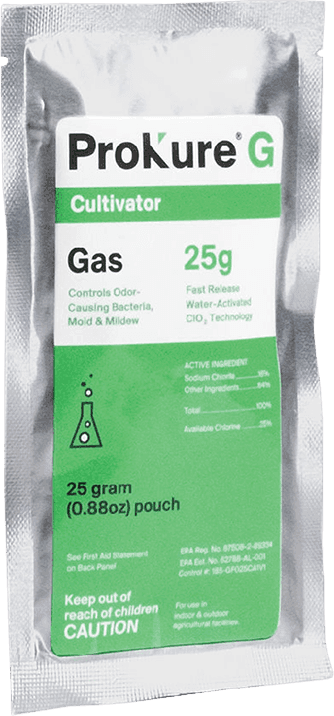
ProKure G is a fast-release ClO2 gas delivered from a humidity-activated pouch. You add water to activate it, place it in the room, and it releases a deep-penetrating ClO2 vapor that reaches into cracks and crevices a sprayed liquid never touches. The manufacturer's approved language is specific and worth keeping exact: G is a deodorizing delivery system that works in 4 to 6 hours and is the solution for mold and mildew, odor-causing bacteria, and chemical odors. It carries EPA Reg. No. 87508-2-89334, and it is made in the USA. As a deodorizing delivery system it is built to clean the air within agricultural facilities and greenhouses, which is the category a trim room falls into between cycles.
The empty-room, unoccupied rule is the whole boundary
Here is the condition you cannot bend. ProKure G is for unoccupied spaces, with no people, no plants, no crops, and no feed in the room during treatment. Its label carries the disclaimer "Not for use with/on plants/crops/feed." A trim room between cycles is the ideal use case precisely because it is empty: the plant material is gone, the crew is out, and the room is cleared for a reset. If there were plants in the room, G would be the wrong product, and you would be looking at the slow-release gas instead. For a turnover, empty is the point, so G fits.
How it runs
You activate the pouch by placing the end with the square indentations into a cup with about 1.5 inches of water, or by saturating a sponge, then set it on a stable, level surface in a central location. Turn off the lights and allow at least 4 to 6 hours, or overnight, for the system to work. Then ventilate and turn the lights on for one hour before re-entry. People and pets must not be in the room during treatment. That is the cycle: activate, leave, let it work, ventilate, re-enter. No wiping, no rinsing afterward, and no residue to manage on the surfaces.
The humidity-activated mechanism is worth understanding because it explains both why G works and why it is predictable. Adding water to the pouch starts a reaction that releases ClO2 gas at a fast rate, which is what separates G from the slow-release product that trickles out trace levels over weeks. The fast release is what lets G reach an effective room concentration in hours rather than days, and it is why the product is matched to a turnover rather than to ongoing maintenance. You are not babysitting a slow trickle; you are running a defined, time-boxed treatment that starts when you add water and finishes within the shift.
Because it is a gas rather than a spray, coverage is a function of room volume, not of how thoroughly someone aimed a sprayer. That is a real operational advantage in a trim room full of equipment and hard-to-reach corners. A person fogging a liquid has to physically reach every surface and still misses the gaps; a gas fills the volume on its own. The flip side is that the room has to be sealed enough to hold the gas, which is why the prep step of closing ducts or setting recirculation matters so much, and why you place the pouch centrally rather than in a corner.
Sizing the room
G comes in two cultivation sizes. The 10-gram pouch covers an area of approximately 1,000 cubic feet for standard odors, or roughly 500 cubic feet for extra-heavy odors. The 25-gram pouch covers about 2,250 cubic feet for standard odors, or about 1,000 cubic feet for extra-heavy odors. The recommended dosage is roughly one gram per 100 cubic feet for everyday smells, stepping up to 2 to 2.5 grams per 100 cubic feet for heavy-duty odors. Use one pouch per area for everyday smells, and when you need multiple pouches for a heavy odor load, place them strategically for even coverage of the room.
To size your own room, measure length by width by height for the cubic footage, then pick the pouch and count from the dosage rate. A trim room that measures 15 by 15 by 10 feet is 2,250 cubic feet, which lines up with a single 25-gram pouch at the standard-odor rate. The same room with a heavy odor load after a dense, resinous cultivar runs closer to the extra-heavy rate, so you would step up the dosage, either a larger effective dose or an additional pouch, to match. The heavy-odor coverage numbers are lower than the standard ones for the same pouch precisely because a heavier load needs more grams per cubic foot, so read your room honestly: a trim room after a pungent harvest is usually a heavy-odor job, not an everyday one. When you run more than one pouch, spread them across the room rather than clustering them, so the gas distributes evenly instead of concentrating near one source, and an air mover running during treatment helps carry the vapor to the far corners.
Why a fast-release gas fits a trim room turnover specifically
A trim room turnover is a fast, empty-room job, and that is the exact profile a fast-release gas is built for. The room is cleared, you want it reset quickly, and you want crews back in on the same shift. A slow, in-room air product is the wrong tool for this because it is designed to run for weeks with plants present, not to knock down an odor and biofilm load in an empty room in an afternoon.
Gas reaches what a sprayer cannot
The reason to use a gas rather than a liquid wipe for the air reset is distribution. A trim room has equipment, benches, drains, and the kind of crevices that collect plant material and odor. A deep-penetrating vapor fills the whole volume evenly and reaches into those gaps, where a sprayed liquid only hits the surfaces you can reach. That does not replace a surface wipe-down, it complements it: you clean the surfaces you can reach, then let the gas handle the volume and the crevices.
Trim rooms are especially full of the geometry that defeats a sprayer. Drain lines, the undersides of trim tables, the gaps behind equipment, HVAC returns, and the texture of the walls and ceiling all collect odor and fine plant debris, and none of them get an even dose from someone with a spray bottle. A gas does not care about line of sight. It diffuses to equalize concentration across the whole sealed volume, which means the crevice behind the bench gets the same treatment as the open floor. For odor specifically, that completeness is what a liquid cannot match, because odor molecules live in exactly the gaps a sprayer misses.
The speed is the point
Four to six hours plus an hour of ventilation is a within-shift reset. Compare that to a bleach fogging that empties the room for a day or more and leaves a residue, and the throughput difference is the whole argument. A facility manager who runs G overnight has a reset room ready for the next crew in the morning, with no multi-day gap in the schedule. Speed is not a nice-to-have in a bottleneck room, it is the metric.
The overnight window is the part that makes this practical rather than theoretical. A trim crew finishes a cycle, clears the room of biomass, wipes the surfaces, activates the pouch, and leaves at end of shift. The treatment runs through the hours the room would have sat empty anyway, overnight, and the ventilation step runs in the first hour of the next morning. By the time the incoming crew is ready to work, the room is reset and safe. You have spent zero productive hours on the air reset, because it ran on time you were not using. That is the difference between a method that costs you room-hours and one that uses hours you already had.
No residue near the next crop
Trim rooms handle flower that is going to market, so residue is not a trivial concern. ProKure G leaves no residue to wipe or rinse after it dissipates, which matters in a room where the next thing to enter is harvested flower and the people handling it. The ClO2 vapor does its work and then naturally dissipates, so there is nothing to clean off before the room goes back into service.
This is where the contrast with the old habit is sharpest. A bleach fogging leaves a chlorine residue and smell that a crew then has to wipe down or wait out, and residue on a trim surface is residue that can transfer to flower. Quaternary ammonium compounds leave a film by design, since the residual is part of how they claim continued activity, which is exactly the opposite of what you want on a surface that will contact product bound for a certificate of analysis. A gas that dissipates to nothing sidesteps that whole problem. There is no post-treatment wipe-down step to schedule, no residue to transfer, and no film to account for when the flower comes back in. The room resets to clean air and clean surfaces rather than to a chemical layer you then have to manage around.
The conditions you have to get right
G works when you respect its boundaries, and it fails or becomes unsafe when you do not. None of these are optional.
The room must be empty and stay empty
No people, no pets, no plants, no crops, no feed during treatment. This is both a label requirement and a safety rule. ClO2 gas at treatment concentration is a respiratory hazard, and the label is explicit that unprotected people must not be exposed to it. A trim room turnover makes this easy because the room is already cleared, but it means you schedule G for a window when the room is genuinely empty and will stay that way for the full cycle plus ventilation.
In practice, the way facilities get into trouble here is not with plants, it is with people wandering in. A trim room mid-turnover looks like an empty room, and someone looking for a tool or a supply can open the door without realizing a treatment is running. Put a caution placard on the door recording the treatment and the safe re-entry time, lock or clearly mark the room, and make sure the whole crew knows that a running G treatment means the room is off-limits until the ventilation step is complete. The label includes a caution placard for exactly this reason. The empty-room rule is only as good as your ability to keep the room empty for the full window.
Prep the room before you activate
Remove all odor sources and clean heavily soiled surfaces before using G. Cover smoke detectors, because the vapor can trip them. If the ventilation system serves only that room, set it to recirculate; otherwise turn it off and close the ducts so the gas stays in the space and works rather than venting away. Keep the pouch no closer than 18 to 24 inches from fabrics, leather, electronics, mirrors, metals, or plated surfaces, because concentrated ClO2 can mark or corrode sensitive materials. An air mover can help distribute the gas evenly across a larger room.
The prep step is where a turnover either works or disappoints, and it is the step crews are tempted to skip when they are rushing. Removing odor sources matters because G is a deodorizer, not a magic eraser: if a bin of trim scrap is still in the room, the gas is fighting an active odor source instead of resetting a cleared room. Covering electronics and sensitive metals matters because a trim room is full of scales, scissors, and equipment that concentrated ClO2 can mark over time. And sealing the room, whether by recirculating a dedicated system or closing ducts on a shared one, is what lets the gas reach and hold an effective concentration instead of leaking away into the rest of the building. Thirty seconds of prep discipline is the difference between a reset that works and a pouch that under-delivers in a leaky room.
Ventilate fully before re-entry
After the 4-to-6-hour treatment, ventilate and run the lights for one hour before anyone goes back in. Do not short the ventilation step to save time, because the whole point of the hour is to bring the ClO2 concentration down to a safe re-entry level. If you have a gas detector, use it to confirm the room is safe rather than relying on smell. Verify, then re-enter.
Handle and store it correctly
G is a CAUTION-level product that causes moderate eye irritation and is harmful if swallowed, inhaled, or absorbed through skin, so follow the label's PPE and handling guidance. Do not open the white inner pouch. Store the product in its original unopened packaging in a cool, dry, well-ventilated area away from heat or open flame, and keep it out of reach of children. Dispose of the spent pouch in an outdoor refuse container per the label.
How ProKure G fits alongside V and D in a turnover protocol
G does one job well, and the cleanest trim-room turnover runs all three ProKure products in sequence, each inside its own label. Mixing them up is the most common and most consequential error, so keep the roles straight.
ProKure V for the surface disinfection step
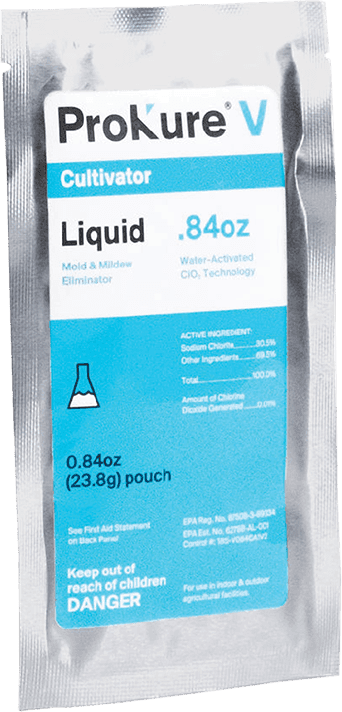
ProKure V is the liquid, EPA Reg. No. 87508-3-89334, a hospital-type disinfectant for hard, non-porous surfaces. It kills mold and mildew on those surfaces at 100 ppm with a 10-minute exposure time, leaves no residue, and is suitable for use with plants in the room, though in a turnover the room is empty anyway. In the turnover sequence, V is the surface wipe-down: benches, trim tables, tool handles, and trays get disinfected with V. V is where the kill claim lives, because G is a deodorizer with no kill claim. If your turnover goal includes disinfecting surfaces, that is a V job, and the ProKure V liquid surface disinfectant page carries the detail.
The order matters. Clean and disinfect the reachable surfaces with V first, then run G on the sealed, empty room. Doing the surface work first means you have removed the visible soil and knocked down the surface load before the gas handles the volume and the crevices, so the two steps reinforce each other rather than overlap. The manufacturer's own guidance for the slow-release product even recommends disinfecting the space with V prior to gas treatment for best results, and the same logic applies to a turnover: surfaces first with the disinfectant, then the air reset with the gas.
ProKure G for the empty-room air reset
G is the step this page is about: the fast air-and-odor reset of the empty, cleared room. It handles the volume and the crevices the surface wipe cannot reach, and it does it in a single shift. G is the air half of the turnover, V is the surface half.
ProKure D for ongoing air quality once the room is back in service
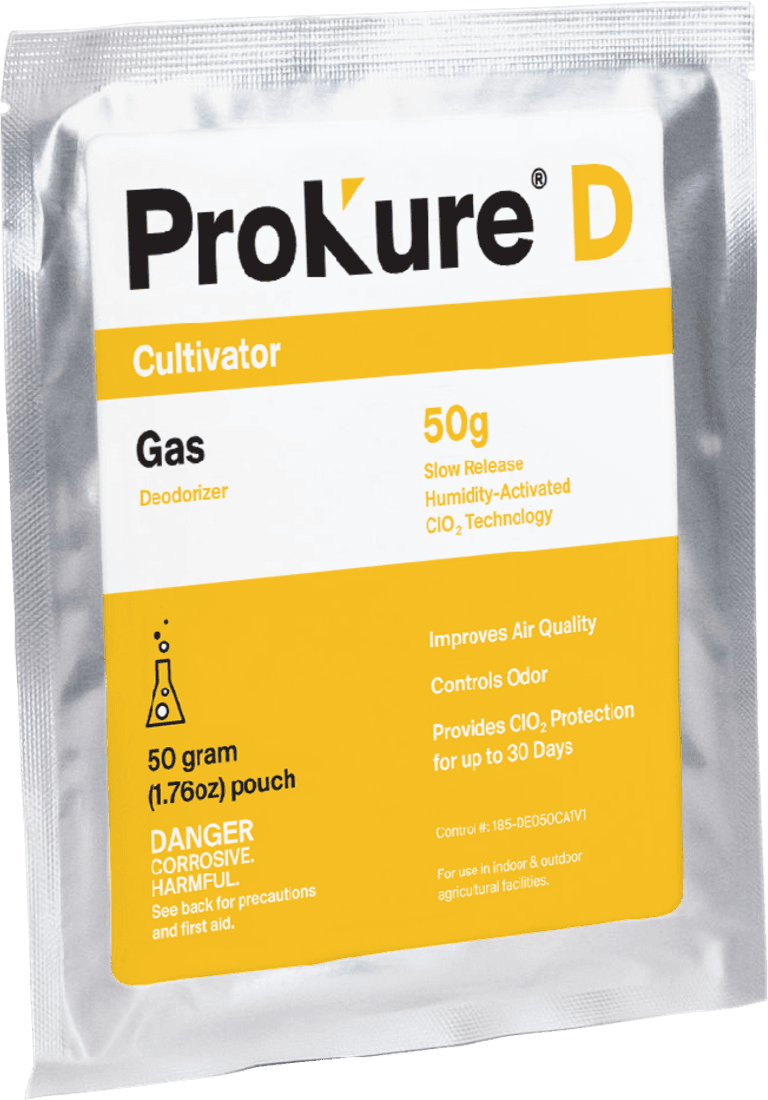
ProKure D is the slow-release ClO2 gas that improves air quality and controls odors for up to 30 days, and unlike G it can be used while plants or people are in the room. In a trim-room context, D is not the turnover tool. It is the maintenance layer you would run during an active trim cycle to hold the odor and air quality steady over days, because it works at trace levels with the room occupied. D is not an EPA-registered product and carries no kill claim; it is air-quality and odor control only. The ProKure D slow-release gas page covers that ongoing role.
The G-versus-D distinction is the one facility managers most often get backward, so it is worth stating plainly. G is fast and empty-room: high release, short window, no people or plants, used to reset a cleared room. D is slow and occupied-room: trace release, long window up to 30 days, used while the room is in use. A trim room in turnover is empty, so it is a G job. A trim room in the middle of an active multi-day trim run, with crew and biomass present, is a D job if you want to hold the odor down during the run. Reaching for G while people are trimming would be both a label violation and a safety problem, and reaching for D to reset an empty room fast would simply be too slow for the job. Match the product to the room state, and the choice is obvious.
The one-line decision
For a trim room: clean the surfaces with V, reset the empty room's air fast with G, and hold ongoing air quality during an active cycle with D. Three products, three jobs, one air-and-surface outcome. The error to avoid is reaching for G when the room is occupied, because G is unoccupied-only, or reaching for D when you need a fast empty-room reset, because D is slow and designed to run with the room in use.
The downtime and throughput math
The reason a facility manager cares about which product resets the trim room is throughput, so put the comparison in those terms. A turnover method that forces a multi-day air-out costs you those days of room production every cycle. A within-shift reset gives most of them back.
Same-shift versus multi-day
Run the numbers on your own cadence. If a bleach-based turnover sidelines a trim room for three days and a fast-release gas reset brings it back in a single overnight window, you have recovered roughly two to three days of room time per turnover. Across a facility that turns rooms frequently, that recovered time compounds into meaningful additional throughput without adding a single square foot of space. The product cost is small against the value of the room-hours you get back.
Work it through with your own figures rather than a generic claim. Count how many times a year each trim room turns over, multiply by the days you currently lose to air-out per turnover, and that is your annual downtime in room-days. Then estimate what a room-day of trim throughput is worth to your operation in finished product. For most commercial facilities, even a conservative estimate makes the recovered room-days worth many multiples of the cost of the pouches, because a trim room is a revenue-producing asset and every day it sits idle is a day that asset earns nothing. The pouch is cheap; the idle room is not.
The hidden labor cost
There is also a labor dimension. A method that evacuates the crew and then requires a long air-out is a method that strands labor and scrambles the schedule. A reset that runs overnight while nobody is in the room uses time you were not using anyway. The crew cleans surfaces and activates the pouch at end of shift, the room resets overnight, and the next crew walks into a ready room. That is labor you did not spend standing around waiting for fumes to clear.
Why this is an investment, not a cost line
Facility managers get asked to justify sanitation spend, and the honest framing is that a faster, residue-free turnover is an investment in throughput, not a cost to minimize. The question is not whether the pouch is cheaper than bleach per unit. It is whether the recovered room-time and the avoided labor friction are worth more than the difference, and in a bottleneck room they almost always are.
The comparison that loses facilities money is the per-unit one. Bleach is cheap by the jug, so a line item comparison makes it look like the frugal choice, and that comparison ignores the room-days and labor hours it costs on the back end. The right comparison is total cost per turnover, including the downtime and the labor, not the price of the chemical. Once you count the idle room and the stranded crew, the cheap jug of bleach is usually the expensive option, and the pouch that resets the room overnight is the one that actually protects the operation's throughput. Framing the spend that way is how a facility manager wins the budget conversation with an owner who is looking at the per-unit price and nothing else.
Documenting the turnover for compliance and consistency
A turnover that is not documented is a turnover you cannot prove, and in a licensed facility proof matters. Build the G step into a written turnover SOP and keep a record of each run.
What to log
Record the product and SKU, the EPA registration number, the room, the pouch activation date and time, the treatment window, the ventilation completion time, and who performed the turnover. That record does two things. It gives a state auditor or a buyer a defensible sanitation and odor-control trail, and it gives you a consistency check so every turnover runs the same way regardless of which crew did it. Consistency is what turns a good result into a repeatable one.
The log also pays off the first time something goes wrong. If a flower lot draws a quality question downstream, a turnover record lets you show exactly how the room was reset before that cycle, which room, which product, which date, and confirmed ventilation. Without it, you are reconstructing from memory, which reads to an auditor like you were not managing the process. A simple one-page log per room per turnover is cheap insurance, and because the G cycle is short and defined, filling it out takes a crew member a minute at activation and a minute at re-entry.
Keep the roles straight in the record
Because the turnover uses more than one product, keep the roles distinct in the log. Note the V surface disinfection separately from the G air reset, because they are different label uses doing different jobs, and because an auditor reading your SOP should see that you understand the distinction. The kill-claim work is V on surfaces; the air-and-odor reset is G in the empty room; the ongoing in-room maintenance, if you run it, is D. A clean record mirrors the clean protocol.
Standardizing across rooms and sites
If you run multiple trim rooms, or multiple facilities, the turnover SOP is the thing you standardize. The same activation, the same sizing by room volume, the same ventilation step, and the same log, run identically everywhere, so a turnover in one room is a turnover in every room.
Standardization is what keeps quality from depending on which crew worked that night. Without a written SOP, one shift runs a thorough reset and the next shift cuts the ventilation step short or skips the surface wipe, and your results wander. A one-page turnover SOP with the sizing table, the prep checklist, the activation and ventilation times, and the log fields turns the turnover into a procedure anyone can run the same way. That consistency is worth as much as the speed, because a reset that only works when your best operator does it is not a reset you can schedule around. For a single-room or small operation, that is a reorder on shop.groclarity.com and a one-page SOP. For a larger operation standardizing across sites, it is a conversation about a protocol that travels, which is where GroClarity's cultivation-IPM expertise turns a product into a repeatable program.
If your trim room turnover is eating days and evacuating crews, the fast-release gas is built for exactly that job, provided the room is empty for the treatment window. Clean the surfaces with ProKure V, reset the empty room's air with ProKure G in a single overnight window, and document the run. Order ProKure G and ProKure V on shop.groclarity.com for a single room, pull the deep label and SDS from prokuresolutions.com, and request a quote through GroClarity if you are standardizing turnover across multiple rooms or sites. The goal is a room that resets on one shift, not one that sits for three days airing out. Get the empty-room window, the sizing, and the ventilation step right, and the trim room stops being the bottleneck in your harvest schedule.
Frequently asked questions
These are the questions a facility manager genuinely asks when deciding whether ProKure G fits a trim room turnover.
Related resources