
Can Chlorine Dioxide Be Used in Greenhouses? Yes, for Three Specific Jobs (and One Thing to Avoid)
Yes, chlorine dioxide belongs in a greenhouse, and the useful answer is which job and which format. ClO2 does three things in a greenhouse: it disinfects irrigation water and controls biofilm in the lines, it sanitizes hard surfaces between crops, and it treats the air of an empty structure. The one thing to avoid is high-concentration contact with living plant tissue outside a labeled low-ppm use. Match the format to the job, and keep each product on its own EPA label. In the ProKure line that means ProKure V (liquid) for water and surfaces, and ProKure G and ProKure D (gases) for the air.
The three greenhouse jobs chlorine dioxide is labeled for
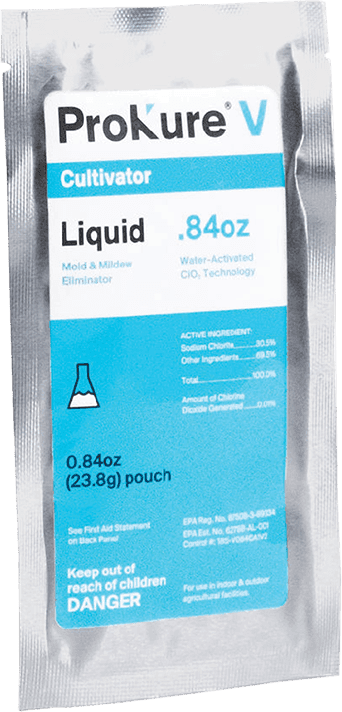
Job one, irrigation water. Chlorine dioxide is a proven greenhouse water treatment: industry sources describe it as very effective for removing biofilm, and it holds efficacy across a wide pH range where chlorine does not. ProKure V, the liquid, carries horticultural water-system uses on its label, including non-potable water systems in horticultural settings and dip or drench applications for cuttings at a 5 ppm dilution. Published horticulture guidance cites an irrigation residual in the range of 0.25 to 0.50 ppm from a 2,000-to-3,000 ppm stock. Dose to a residual your crop and label support and monitor it; this is a liquid job, so it is ProKure V, not a gas.
Job two, surface sanitation between crops. This is the ProKure V job too. ProKure V is the EPA-registered liquid hospital-type disinfectant (EPA Reg. No. 87508-3-89334), applied to hard, non-porous surfaces at 100 ppm for a 10-minute contact time, and its label kills odor-causing bacteria, mold, and mildew, with a fungi list that includes Aspergillus niger (ATCC 9642), Botrytis sp., and Fusarium solani (ATCC 36031). It leaves no residue, so it is suitable for use on surfaces with plants in the room, because you treat the bench or tray, not the canopy.
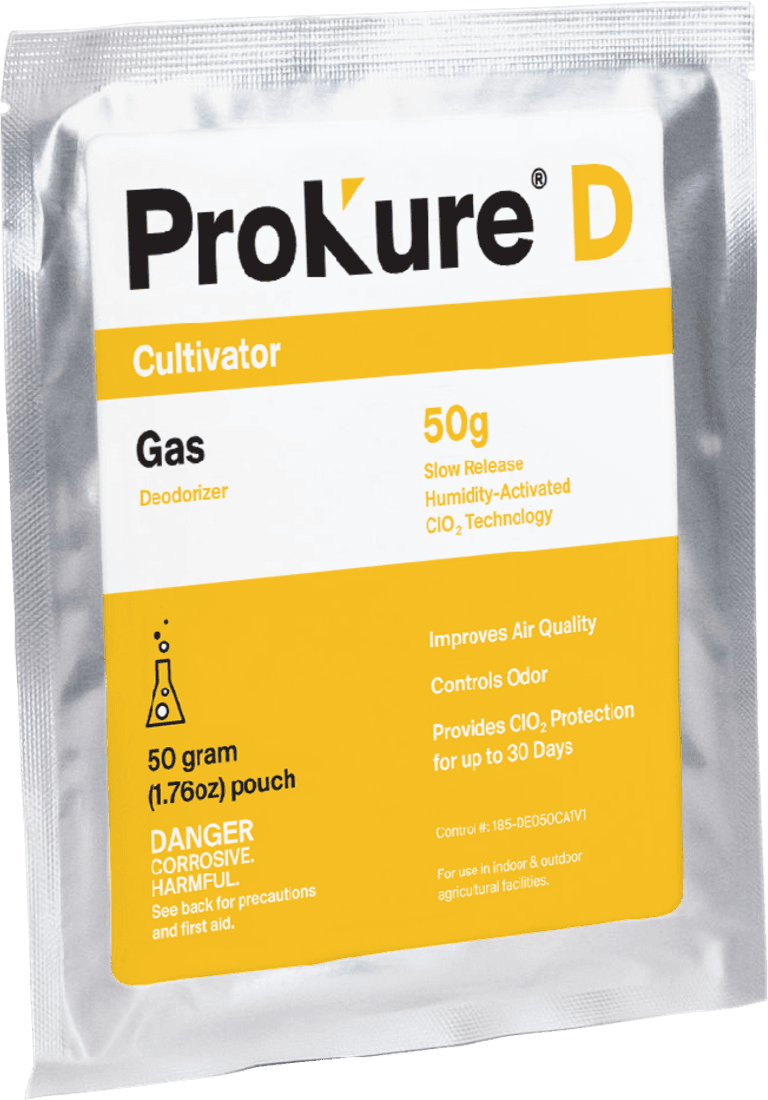
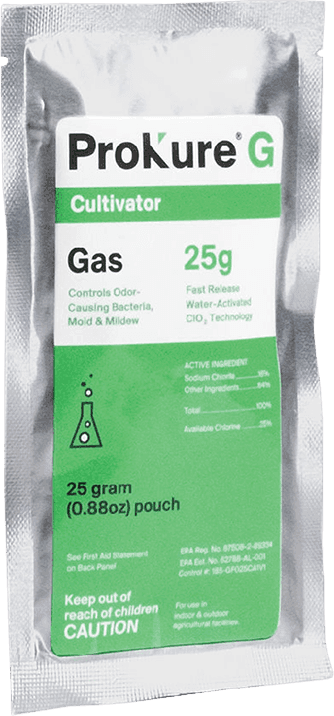
Job three, the air of an empty structure. Here the gases do the work. ProKure G is the EPA-registered fast-release ClO2 gas deodorizer (EPA Reg. No. 87508-2-89334) for a sealed, empty structure, run four to six hours with a one-hour vent before re-entry; its label is "Not for use with/on plants/crops/feed." ProKure D is the slow-release ClO2 gas deodorizer that holds air quality for up to 30 days; ProKure D is not an EPA-registered product and is not labeled for sale as a pesticide under 40 CFR. Both gases treat air, never water, and neither carries a kill claim.
What chlorine dioxide should not be used for in a greenhouse
The honest "no" is high-concentration contact with living plant tissue. ClO2 is a strong oxidant, and horticulture sources are candid that it can damage treated plants if used as a foliar treatment at the wrong concentration. A 1996 study on diluted ClO2 applied to radish and lettuce through drinking water concluded the treated water was safe for growing the plants at that low level, which is the point: safety is a function of concentration and use. The labeled low-ppm water and the hard-surface uses are the safe lanes; a high-concentration spray on a live canopy is not.
The second thing to avoid is conflating the formats. A gas is not a water treatment, and a water treatment is not an air product. ProKure G and D treat air in an empty or occupied structure respectively; neither is dosed into a reservoir or irrigation line. ProKure V is the liquid for water and surfaces. Mixing those up is how a grower ends up off-label.
EPA registration and label discipline
This is the Q40 worry, so state it plainly: every ClO2 product carries its own label, and you cannot borrow one product's claim for another. ProKure V is EPA-registered (87508-3-89334) for hard surfaces and horticultural water uses. ProKure G is EPA-registered (87508-2-89334) and labeled not for use with plants, crops, or feed, so it runs in an empty structure. ProKure D is not an EPA-registered product and is not labeled for sale as a pesticide under 40 CFR; it is an air-quality and odor product. The "Not for use with/on plants/crops/feed" disclaimer is G's, and it tells you where G can run, not whether it is legitimate. Keep each product's EPA number and current SDS on file, retrievable from prokuresolutions.com, so you can hand an auditor the right document for the right use.
How chlorine dioxide compares to other greenhouse sanitation options
Greenhouse water and surface sanitation has a crowded shelf: bleach, hydrogen peroxide products, UV, ozone, copper ionization, and heat pasteurization all appear in the standard options list. ClO2's edge is that it is effective across a wide pH range, it strips biofilm that other oxidizers leave behind, and in the ProKure V liquid form it leaves no surface residue and needs no rinse. Bleach, by contrast, is pH-sensitive and leaves chlorinated residue that is a poor neighbor to a crop, and quaternary products leave a surfactant film. The residue-free, no-rinse surface pass is the practical reason a grower reaches for V between crops instead of bleach.
Concentration ranges by job
Dose by the job, not by habit. Irrigation residual runs roughly 0.25 to 0.50 ppm from a 2,000-to-3,000 ppm stock, per published horticulture guidance; ProKure V's label also specifies a 5 ppm dilution for dip and drench of cuttings and horticultural water, and 100 ppm for a 10-minute contact on hard surfaces. For the gases, follow the pouch dosing on the ProKure G and ProKure D labels (coverage by cubic feet), run G for a four-to-six-hour dwell, and hold D for up to 30 days. The numbers are on the labels; the discipline is matching the ppm to the use site.
Cannabis greenhouse use and proving it worked
For a cannabis greenhouse the stakes rise, because state pre-sale yeast-and-mold and Aspergillus thresholds can pull a harvest at final test. The three-job frame maps cleanly: V disinfects water and surfaces, G resets the empty structure between crops, and D holds air quality through the cycle. For the cannabis-specific thresholds and room-turnover detail, hand off to the cannabis cultivation guide; this page qualifies the technology.
Whatever the crop, log it. A dated record of which product treated which zone, at what concentration, for how long, is the data trail a compliance auditor and your ownership want to see, and for a multi-facility operator it is the SOP that reads the same in every greenhouse. Built on Science. Backed by Results.
FAQ
The questions below are the ones greenhouse growers actually ask.
Related resources
Related resources