
ProKure V vs G vs D for Greenhouses: Which One, When, and Why
In a greenhouse, the choice between ProKure V, G, and D comes down to surface versus air and whether plants can stay. ProKure V is a liquid that disinfects hard, non-porous surfaces and is suitable for use with plants in the room. ProKure D is a slow-release gas that improves air quality and controls odors, runs with plants in the room, and provides ClO2 protection for up to 30 days. ProKure G is a fast-release gas for an empty greenhouse during turnover, not for use with plants. One fact up front, because it is the biggest compliance question here: ProKure D is not an EPA-registered product and not labeled for sale as a pesticide under 40 CFR.
All three run on the same chemistry, chlorine dioxide (ClO2), delivered from a water-activated or humidity-activated pouch. What changes between them is the form (liquid vs gas), the speed (fast vs slow), whether plants can stay in the room, and what the product is legally allowed to claim. A greenhouse makes those differences matter more than a sealed indoor room does, because the air volumes are larger and the venting never really stops.
Growing in a sealed indoor room instead of a greenhouse? The math changes. See our indoor-grow ProKure comparison before you buy.
The 30-second answer
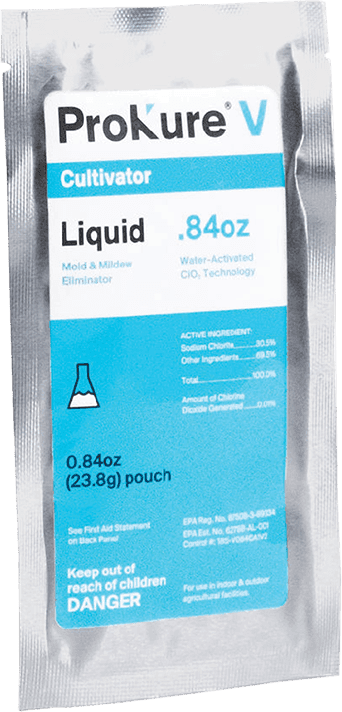
Three products, three jobs. ProKure V handles surfaces: benches, walkways, irrigation manifolds, polycarbonate glazing, and the aluminum extrusion your crew touches on the way back in. It is a liquid, applied by sprayer, mop, or sponge, and it is suitable for use with plants in the room.
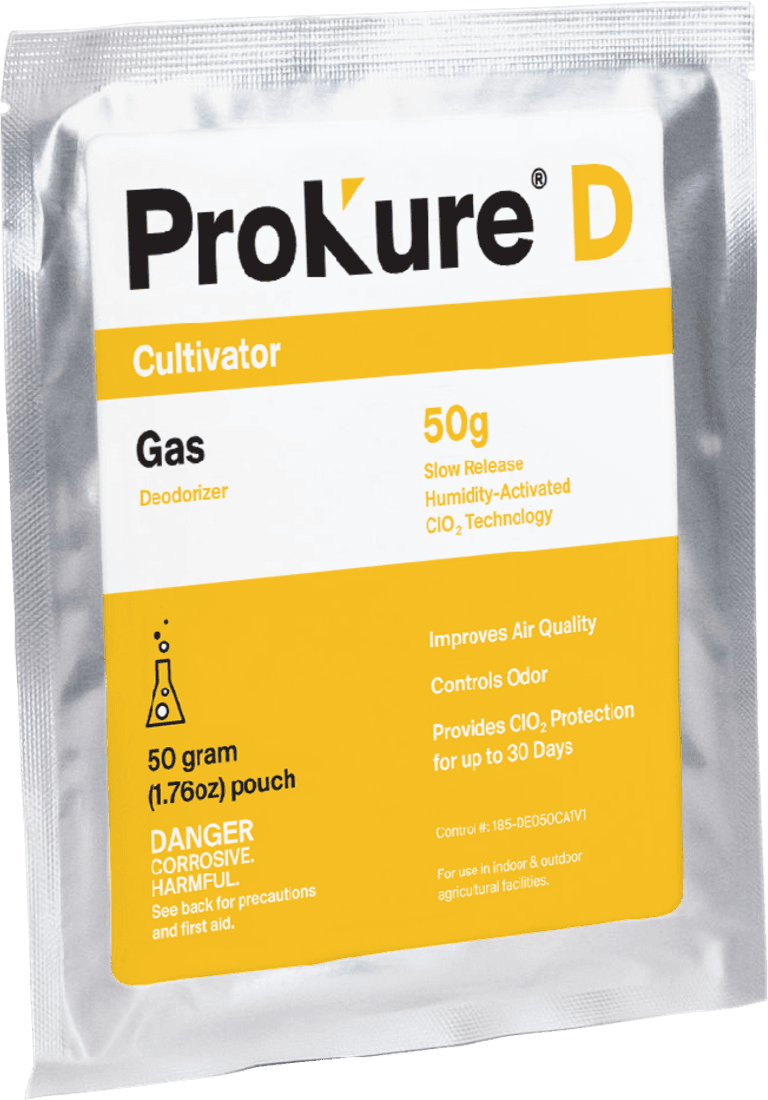
ProKure D handles ongoing air quality while the crop is growing. It is a slow-release gas that improves air quality and controls odors, provides ClO2 protection for up to 30 days, and can be used while plants are in the room. It is also the one product here that is not an EPA-registered product and not labeled for sale as a pesticide under 40 CFR, so it carries no kill claims.
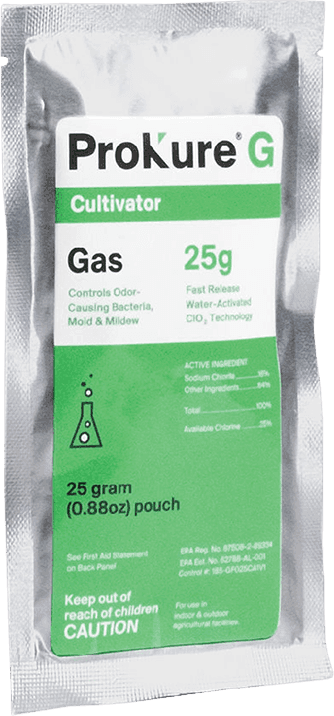
ProKure G handles turnover. It is a fast-release gas, it works in 4-6 hours, and it is for unoccupied spaces, no people or plants in the greenhouse during treatment. Match the product to the job and the greenhouse decision gets simple.
Side-by-side comparison table
Here is the whole decision on one screen. Read it as a greenhouse operator, not a lab tech: the rows that matter most in a greenhouse are plants-in-room permission, coverage per unit against your cubic footage, and EPA status.
Form factor. ProKure V is a liquid formula packet you add water to activate. ProKure G is a fast-release gas (a deodorizing delivery system). ProKure D is a slow-release gas. All three are ClO2 technology.
What it is for. V is a hospital-type disinfectant for hard, non-porous surfaces. G is the solution for mold and mildew, odor-causing bacteria, and chemical odors, used between harvests. D improves air quality and controls odors.
EPA registration status. ProKure V is EPA Reg. No. 87508-3-89334. ProKure G is EPA Reg. No. 87508-2-89334. ProKure D is not an EPA-registered product and not labeled for sale as a pesticide under 40 CFR. That disclosure is not a footnote, it is the product's status, and it belongs anywhere you compare D to the other two.
Plants in room OK? V, yes, suitable for use with plants in the room. D, yes, can be used while plants are in the room. G, no, the ProKure G fast gas is for unoccupied spaces, no people or plants in the space during treatment time.
People in room OK? V at 100 ppm does not require respiratory PPE. G, no, people and pets must not be in the area undergoing treatment, and you ventilate for one hour prior to re-entry. D is an air-quality product with no occupancy kill-claim profile; follow the label.
Coverage per unit. ProKure D: a 10-gram pouch treats approximately 1,000 cubic feet, a 50-gram pouch approximately 4,000 cubic feet, and a 95-gram pouch approximately 8,000 cubic feet. ProKure G: a 10-gram pouch covers approximately 1,000 cubic feet for standard odors, a 25-gram pouch approximately 2,250 cubic feet for standard odors. ProKure V coverage is a dilution question, not a cubic-foot question: one 3.36 oz pouch yields 20 gallons of 100 ppm solution.
Dwell time. V needs an exposure time of 10 minutes at 100 ppm to disinfect hard surfaces (30 seconds at 100 ppm for SARS-CoV-2). G works in 4-6 hours, then ventilate one hour before re-entry. D is continuous, up to 30 days per placement.
Best greenhouse use case. V, surface turnover and disinfecting hard surfaces around live plants. G, deodorizing an empty greenhouse between cycles. D, ongoing mid-cycle air quality with the crop in the house.
To see the raw specs for all three without the greenhouse filter, use the ProKure V vs G vs D hub.
ProKure V for greenhouses: liquid, surface, plants-safe-in-room
ProKure V is a liquid formula packet. You add water to activate, and you get a hospital-type disinfectant for hard, non-porous surfaces. It leaves no residue. Per the ProKure FAQ, V is suitable for use with plants in the room, and that single fact is why a greenhouse grower reaches for it instead of bleach or a quat when the crop cannot leave.
What V does. Used at an exposure time of 10 minutes at 100 ppm, ProKure V disinfects hard, non-porous surfaces. The fungicide claims on the label include Fusarium solani (ATCC 36031), Botrytis sp. and Penicillium digitatum (ATCC 201167), and Aspergillus niger (ATCC 9642). The disinfectant list includes methicillin-resistant S. aureus (MRSA) (ATCC 33591), Staphylococcus aureus (ATCC 6538), Pseudomonas aeruginosa (ATCC 15442), and Listeria monocytogenes (ATCC 19111), among others. It kills odor-causing bacteria, mold, and mildew. Per the ProKure whyprokure page, used with an exposure time of 10 minutes at 100 ppm, ProKure V is an effective fungicide against Aspergillus niger.
Greenhouse surfaces V is right for. Twin-wall polycarbonate glazing is a hard, non-porous surface, so it is in scope. Aluminum extrusion frames, stainless benches, vinyl, glass, PVC, and your irrigation manifolds are all on the label's list of hard non-permeable surfaces. The one surface to be careful about is greenhouse poly film: polyethylene film is technically non-porous, but the FAQ language speaks to hard non-porous surfaces, so treat film as a check-the-label case rather than an assumption.
Application method. Apply V by sprayer, mop, or sponge. Do not fog it. Per the ProKure FAQ, ProKure V should be applied by sprayer, mop, or sponge to disinfect all hard, non-porous surfaces. Pre-clean visibly soiled surfaces first, then apply to visible wetness and hold the surface wet for the 10-minute exposure.
PPE and re-entry. At 100 ppm, ProKure V does not require respiratory PPE. Wear protective gloves if hands will come into contact with activated solution during dilution or application. That is a meaningful operational difference in a greenhouse where the crew is in and out all day.
15-day active life after activation. Once activated, V does not last forever. Per the ProKure FAQ, if any formula remains unused, store it in a dark, closed container in a cool, dark location, and use the stored formula within 15 days of activation. Record the activation date. For a greenhouse that mixes a large batch for a surface pass, that window is your planning constraint.
When V is the wrong choice for a greenhouse. V does nothing for airborne odor or air quality across 20,000 cubic feet of greenhouse volume, because it is a surface liquid, not a gas. If your problem is the air rather than the benches, V is not the tool. That is where D and G come in.
ProKure G for greenhouses: fast-release gas, turnover, unoccupied
ProKure G is a fast-release gas, a deodorizing delivery system. It is the solution for mold and mildew, odor-causing bacteria, and chemical odors between harvests, it reduces downtime, and it works in 4-6 hours. In a greenhouse, G is a turnover tool, full stop.
Why G is turnover-only in a greenhouse. Per the ProKure FAQ, the ProKure G fast gas is for unoccupied spaces, no people or plants in the space during treatment time. The product's own required disclaimer with instructions is not for use with/on plants/crops/feed. So G runs in the window after you pull a crop and before you bring the next one in, never mid-cycle.
How to prep a greenhouse for G treatment. A greenhouse vents constantly, and venting breaks gas dwell time. Before you activate G, seal the envelope: drop and seal blackout and light-dep curtains, close peak vents, close roll-up sidewalls, shut side vents, and kill the HAF fans or set a dedicated ventilation system to recirculation. Per the FAQ, if the ventilation system is solely for the space being treated, turn on the air conditioning or ventilation system to circulate air; if not, turn off and close the ducts. Cover smoke detectors. Turn off lights.
Placement math. ClO2 gas is heavier than air. Per the ProKure FAQ, activate ProKure G in a high, central location no closer than 18 to 24 inches away from fabrics, leather, electronics, mirrors, metals, or plated surfaces, and use a fan or air mover to distribute gas within the confined treatment space. For coverage, a 10-gram pouch covers approximately 1,000 cubic feet for standard odors and a 25-gram pouch approximately 2,250 cubic feet; place one pouch per area for everyday smells and place multiple pouches strategically for even coverage.
Ventilate before re-entry. Allow at least 4-6 hours (or overnight) for the system to work, then ventilate and turn on lights for one hour before re-entry. Use the caution placards to record treatment and safe re-entry times.
When G is the wrong choice. Any time the crop is in the greenhouse. If plants are present, G is off the table, and you are choosing between V for surfaces and D for air.
ProKure D for greenhouses: extended-release, plants-in-room OK
ProKure D is the one that stays in the greenhouse with the crop. It is a slow-release gas that improves air quality and controls odors, and it provides ClO2 protection for up to 30 days. Per the ProKure FAQ, ProKure D can be used while plants are in the room. For the greenhouse grower whose air-quality problem runs across the whole grow cycle, D is the answer.
The EPA disclosure you need to know. This is the Q40 compliance line, and it is not optional. ProKure D is not an EPA-registered product and not labeled for sale as a pesticide under 40 CFR. Per the ProKure FAQ, ProKure D Extended-Release is not a disinfectant or pesticide, it is not registered with the EPA, and it has no kill claims regarding disinfection or sanitization. Do not let anyone on your team describe D as killing mold. It improves air quality and controls odors. That is the claim, verbatim.
The coverage math for greenhouses. This is where a greenhouse diverges hard from a sealed indoor room. A 95-gram D pouch treats approximately 8,000 cubic feet, a 50-gram pouch approximately 4,000 cubic feet, and a 10-gram pouch approximately 1,000 cubic feet. A retailer listing on hydrobuilder.com lists a 50-gram D SKU at 4,000 cubic feet, which matches the label. Now run your house. A 30-foot by 96-foot greenhouse with a gutter-to-ground profile can clear 30,000 cubic feet of air volume, so at 8,000 cubic feet per 95-gram unit you are placing roughly four units, spaced equally apart per the label direction to use pouches placed equally apart for larger areas. A 30-by-144 house pushes that higher; a 42-by-200 house turns this into real procurement math. D coverage in a greenhouse is almost never one unit.
Why D is D's strongest greenhouse story. D runs with plants in the room, continuously, for up to 30 days. No other product here does that. For a head grower sitting on a six-figure crop who wants ongoing air-quality management without evacuating the house, that combination is the whole pitch. Do the coverage math with the ProKure D coverage calculator before you order, because a greenhouse almost always needs multiple units.
Decision matrix by greenhouse scenario
Five scenarios cover almost every greenhouse decision. Match your situation to the row.
Scenario 1: positive mold test on a mature crop. This is the Steven situation, a head grower responsible for crop health and pre-sale mold-test compliance, staring at a positive test on a harvest already worth six figures. The crop cannot leave. Use ProKure V on the hard surfaces around the live plants, benches, walkways, irrigation lines, because V is suitable for use with plants in the room and disinfects hard non-porous surfaces at 10 minutes at 100 ppm. Run ProKure D for ongoing air quality mid-cycle. Hold ProKure G for turnover after harvest, never now, because G is not for use with plants.
Scenario 2: between-cycle turnover of an empty greenhouse. This is the facility manager's window: the crop is out, downtime is the enemy, and the next crop is waiting. Run ProKure G to deep clean between harvests and reduce downtime, it works in 4-6 hours. Seal the house first. Then, as the crew comes back in, use ProKure V on the surfaces they touch. G for the empty air, V for the surfaces on the way back in.
Scenario 3: ongoing air quality management mid-cycle. Plants are in the house and will be for weeks. ProKure D is the only product here that runs with plants in the room, up to 30 days per placement. Size it with the coverage math above and replace each unit before its up-to-30-day window closes.
Scenario 4: multi-greenhouse MSO standardization. This is the Cultivation Director coordinating IPM across 4 to 15-plus facilities, under ownership pressure to standardize and defend protocols to auditors state by state. The answer is a single ClO2 platform: V for surfaces, D for mid-cycle air, G for turnover, with a per-facility coverage plan built on each house's cubic footage. If that is you, standardize across the portfolio with the ProKure V vs G vs D MSO multi-site guide and request a multi-site quote.
Scenario 5: an auditor asks for an air-quality data trail. Procurement and QA leads live here. The ProKure line gives you the SDS and label documentation an auditor asks for, with D carrying its non-EPA disclosure in writing. Pair that with ongoing air testing and reporting so the data trail exists before the auditor does.
Greenhouse-specific FAQs
Can I use ProKure V on greenhouse poly film? V is approved for hard, non-porous surfaces, and the FAQ language speaks to hard non-porous surfaces. Twin-wall polycarbonate glazing, glass, and aluminum frames are clearly in scope. Polyethylene greenhouse film is technically non-porous, but it is not the same as a hard surface, so check the product label for your specific glazing before you treat it rather than assuming.
Can I run ProKure D with plants in the greenhouse? Yes. Per the ProKure FAQ, ProKure D can be used while plants are in the room, which is exactly its mid-cycle greenhouse role. It improves air quality and controls odors and provides ClO2 protection for up to 30 days. Remember it is not an EPA-registered product and carries no kill claims.
How many ProKure D units do I need for a 30x96 greenhouse? A 95-gram D pouch treats approximately 8,000 cubic feet. A 30-foot by 96-foot greenhouse can reach roughly 30,000 cubic feet of air volume depending on gutter height, which works out to about four 95-gram units placed equally apart. Run your own volume through the ProKure D coverage calculator, because peak height changes the number.
Do I need to vent the greenhouse before workers re-enter after ProKure G? Yes. Per the label and FAQ, people and pets must not be in the area during treatment, and you ventilate and turn on lights for one hour before re-entry. Use the caution placards to record treatment and safe re-entry times.
Is ProKure D EPA-registered? No. ProKure D is not an EPA-registered product and not labeled for sale as a pesticide under 40 CFR. It is not a disinfectant or pesticide and has no kill claims. It improves air quality and controls odors.
How much does ProKure cost? Pricing varies by product, pouch size, and how much greenhouse volume you are covering, so there is no single number. Reorders for an established operation run around 13.6 times a year at roughly $2,466 per order per ProKure Brand Standards purchase data. For a current quote tied to your greenhouse cubic footage, shop the ClO2 line on shop.groclarity.com or request a quote.
What is the shelf life of ProKure packets? Per the ProKure FAQ, non-activated ProKure foil packets carry a 2-year warranty and will work past that as long as the foil packet is not breached and is kept in temperature-controlled settings.
How to buy
GroClarity is the education hub. You compare and decide here, you buy on shop.groclarity.com, and you pull the deep product detail, labels, SDS, and EPA registration numbers from prokuresolutions.com. For a greenhouse, that means a clear order of operations. First, size your D coverage against your real air volume and build your V surface plan here, on this page, using the coverage math above. Second, shop the ClO2 line or reorder on shop.groclarity.com, where the transactional buy lives. Third, send your procurement lead to prokuresolutions.com for every SDS, label, and EPA registration number an auditor will ask for, and remember ProKure D carries its non-EPA disclosure in writing there.
If you run a single greenhouse, the shop path is the fast route: pick your V surface SKU, size your D units, and reorder on the cadence your crop cycle sets. If you are standardizing across more than one greenhouse or more than one state, request a quote so the per-facility coverage math is built into the order rather than bolted on after. Either way, the decision you made on this page, V for surfaces around live plants, D for mid-cycle air, G for empty-house turnover, carries straight through to the cart. Built on Science. Backed by Results.
Related resources