
IPM Protocol for a Single-Room Cannabis Grow: The Prevention-First SOP
A single-room cannabis IPM protocol runs the same six steps every program does, prevention, identification, monitoring, action thresholds, management, and evaluation, but it scales them to one shared airspace with no quarantine room, no mother room, and no backup room to move plants into while you clean. Prevention and between-cycle sanitation carry most of the weight, because a one-room grower cannot wall off an outbreak the way a multi-room facility can. Surface disinfection happens when the room is plant-free. Every action lands in a single log an inspector can read. That is the whole protocol in one breath, and the rest of this page is the week-by-week and hour-by-hour of it.
This page is written for the operator running one flowering room, often one veg tent plus one flower room, or a single perpetual room with staggered plants. If you run several flowering rooms with a turnover crew, the multi-room cannabis IPM protocol is written for your reality, not this one. If you are standardizing IPM across a multi-state footprint, the MSO standardized protocol is the right page. Still here? Then you have one room, you cannot afford a failed harvest, and you want the protocol you actually run. Keep reading.
Why single-room IPM is a different problem
Most IPM guidance quietly assumes you have more than one room. It talks about material flow between spaces, about quarantining incoming clones in a separate area, about depopulating one room while you work in another. A single-room grower has none of that, and pretending otherwise is how a protocol fails in practice.
The constraints are concrete. You have no separate quarantine room, so incoming clones share air with your standing crop the moment they arrive unless you build a workaround. You have no backup room, so there is no way to move living plants out while you do a hard sanitation pass, which means your deep clean is locked to the narrow window between harvest and the next transplant. You have one HVAC system serving one space, so you cannot run a different environment for veg and flower. And you almost certainly have no compliance officer on payroll, so the recordkeeping an auditor expects falls on the same person running the lights.
The top-ranking IPM guides do not scope to this. One widely cited grower guide tells you to "Maintain positive pressure in growing rooms relative to hallways to keep spores and pests from drifting in." That is sound advice for a facility with hallways between rooms. In a single-room grow, positive pressure relative to what? Your kitchen? The question itself exposes the gap: the standard advice assumes a building layout a single-room operator does not have. You still want the room at slight positive pressure relative to the dirtiest adjacent space, usually the outdoors or a utility area, with filtered intake, but the hallway framing does not map, and nobody tells you that.
Here is the reframe that matters. In a multi-room facility, isolation is a tool: you contain a problem to one room and protect the rest. In a single room, you have no isolation to fall back on, so prevention is not one tool among several, it is the entire defense. Every dollar and every hour you would spend containing an outbreak in a bigger facility, you spend up front preventing one. That is not a downgrade. For a one-room operator it is the only version of the protocol that works, and it is why this page leads with prevention and between-cycle sanitation instead of with pest identification photos.
If, reading this, you realize you actually run two or three flowering rooms with staff moving between them, send yourself to the multi-room cannabis IPM protocol. The constraints there are different enough that the week-by-week changes. This page assumes one room and one operator, or close to it.
The six-step IPM framework, scaled to one room
The six-step framework is the spine of cannabis IPM, and the search results reward it because it answers the question people ask: what are the six steps of an IPM program. The steps are prevention, identification, monitoring, action thresholds, management options, and evaluation. We are not going to fight that framework. We are going to run each step through the single-room filter, because the step that reads as a formality in a big facility is often the step that saves a one-room harvest.
Prevention
Prevention in one room is sanitation, quarantine, and environmental control, with quarantine reinterpreted for a grower who has no quarantine room. You cannot build a separate clean room, so you build a clean window instead. Incoming clones get inspected and, where your protocol calls for it, treated before they ever touch the canopy, ideally during a period when your standing crop is at its least vulnerable stage. A dip or a quarantine shelf with its own small filtered enclosure is the single-room substitute for a quarantine room. It is not as good. It is what you have, and used consistently it catches most of what a quarantine room would.
Environmental control is where a single HVAC system either protects you or betrays you. You run one climate for the whole room, so you tune it to the most vulnerable stage present. In a perpetual room with plants at several stages, that usually means holding humidity tighter than a pure-veg grower would, because the flowering plants in the same air are the ones a humidity spike will cost you. Keep intake air filtered, keep the room slightly pressurized against the dirtiest adjacent space, and treat air movement as a sanitation measure, not just a temperature measure. Dead, saturated air in a corner of a single room is where mold starts.
Identification
You cannot manage what you have not correctly named. Four pests cause most indoor trouble: spider mites, thrips, whiteflies, and fungus gnats, and the pathogens that end harvests are powdery mildew and botrytis. The reason identification matters more in one room is that a wrong diagnosis sends you to the wrong intervention, and in a single room a wrong intervention is harder to undo because you cannot isolate the plants you treated. We do not reproduce a full pest photo library here, because grower-education sites and university IPM programs already own that content and rank well on it. Learn to tell your four pests apart, keep a reference handy, and when you are unsure, hold the intervention and scout harder rather than spraying on a guess.
Monitoring
Monitoring is scouting on a fixed cadence, and the single-room version is tighter than you might expect precisely because you have nowhere to hide a problem. Walk the room on a fixed schedule, at minimum weekly during vegetative growth and twice weekly once flowering begins. Sticky cards go in and above the canopy, not just on the floor, because thrips and whiteflies travel at canopy height. Log the counts every time, not just when something looks wrong, because the trend line is what warns you, and a single-room operator who only logs problems has no trend line. Pair the visual scout with an environmental sensor read, because the humidity number three weeks out often predicts the mold you have not seen yet.
Action thresholds
An action threshold is a documented trigger: when the sticky-card count or the visual damage hits a defined number, you intervene. Thresholds matter more in a single room, not less, because you cannot depopulate a backup room to buy time. There is no "move the clean plants out and treat the rest" option. So your threshold has to trigger early enough that a soft intervention, a biological release, still has room to work before the problem forces a hard one. Set thresholds by pest and by stage, write them down, and hold to them. A threshold you renegotiate in the moment is not a threshold, it is a feeling.
Management options, in order
The order is biological, mechanical, then chemical, and the order is not aesthetic, it is practical. Biological controls, predatory mites and beneficial insects, work best deployed before a population explodes, which is why your early threshold matters. Mechanical controls, sticky traps, removal of infested material, defoliation, come next. Chemical intervention is last, and in flower it is the most constrained, because sprays can leave residue that fails a lab test or taints the flower. In a single room, the chemical option is doubly constrained because you cannot confine the application, so lean on biology and prevention hard enough that you rarely reach the chemical step during flower. For the biocontrol species selection, a dedicated predatory-mites resource carries the catalog this page deliberately does not.
Evaluation and the log entry that closes the loop
Evaluation asks: did it work, and what do you change next cycle. This is the step single-room operators skip, and skipping it is why the same problem returns every run. The evaluation is a log entry. It records what you saw, what you did, and what happened, and it ties back to the environmental data from the same window. Over a few cycles, that log becomes the thing that tells you your botrytis always shows up when late-flower humidity drifts past a certain point, which turns a recurring crisis into a setpoint change. The log is also, not incidentally, exactly what an auditor wants to see.
The between-cycle turnover SOP, hour by hour
This is the section the top-ranking pages are thinnest on, and it is the single-room operator's whole game. A multi-room facility turns a room over while plants grow next door. You cannot. Your turnover is a clock that starts when the last plant comes down and ends when the next transplant goes in, and every hour the room sits dirty is an hour of lost production in your only room. Here is the turnover sequenced against a real harvest-to-transplant window. Treat the hour markers as a sequence, not a stopwatch; your room may run faster or slower.
Hour 0 to 4: harvest strip and gross debris removal. Everything organic comes out. Spent plants, root balls, fallen leaf litter, used media. Pests and spores live in debris, so debris removal is the first and biggest reduction in your microbial and pest load. Bag it and get it out of the room, not into a corner.
Hour 4 to 12: surface prep and biofilm removal. Before you disinfect anything, you clean it. Visibly soiled surfaces must be pre-cleaned with a non-disinfectant cleaning agent, because a disinfectant applied over a film of organic matter is a disinfectant wasted. Scrub benches, trays, walls within splash range, and any equipment that touched the crop. This is the step people skip when they are tired at the end of a harvest, and it is the step that decides whether the next step works.
Hour 12 to 24: hard-surface sanitation, done plant-free. Now the room is empty of plants and clean of gross soil, so you disinfect hard, non-porous surfaces. This is the window where chlorine dioxide surface disinfection fits, and it is critical to understand why it fits here specifically: the room has no living plants in it, and the products you reach for in an empty room are different from what you can use with a canopy present. We cover the chemistry and the exact EPA distinction in the next section, because getting the product-to-use-condition match right is the compliance crux of the whole SOP.
Hour 24 to 36: HVAC, ducts, and filters. The air system is a reservoir you cannot see. Change or clean filters, wipe accessible duct surfaces and coils, and verify the system runs clean before you reintroduce plants. In a single-room grow the HVAC is the one system that touched every plant in the last cycle and will touch every plant in the next, so it carries contamination forward if you ignore it.
Hour 36 to 48: air treatment and dwell. With surfaces and the air system handled, you address the room air and give disinfection its dwell time. This is the stage where air-quality products belong, again in an empty room, and where you let the room settle rather than rushing a plant back in.
Hour 48 to 72: transplant-ready verification and log sign-off. Before plants go back, verify: surfaces clean and dry, air system running, environment back to setpoint, and the turnover logged and signed. The log sign-off is not bureaucracy. It is the record that proves, to you next cycle and to an auditor this cycle, that the room was reset correctly. A single-room operator who turns a room over in under 72 hours with this sequence has beaten the 3-to-5-day downtime that an unstructured turnover usually costs, and done it without a crew.
Sanitation chemistry you can actually use in a single room
The between-cycle SOP lives or dies on picking the right chemistry for the right moment, and the moment that matters most is whether living plants are in the room. This is also where the single biggest compliance mistake happens, so we are going to be exact.
Bleach: why operators reach for it, and why the fumes are a real problem in one shared airspace
Bleach is cheap, available, and familiar, which is why a well-known forum thread describes a between-run routine of bleach spray, Lysol, and a wait period. It does disinfect surfaces. The problem in a single-room grow is that you have one airspace, and bleach fumes fill it. A multi-room facility can evacuate one room and keep working. You cannot. Bleach also leaves a chloride residue, and the fume-and-evacuate cycle is exactly the downtime a single-room operator cannot afford. It is not that bleach does nothing. It is that its downsides land hardest on an operator with one room.
Quats: residue reality
Quaternary ammonium products leave a film residue and are generally not labeled for use in contact with living plants at disinfectant strength. In a single room where you cannot fully separate a treated surface from a nearby plant, residue that lingers is a liability. Quats have their place in some facilities, but the plant-adjacency problem is sharper when there is only one room and one canopy.
Chlorine dioxide (ClO2): what it is and why it matters here
Chlorine dioxide is a selective oxidizing biocide delivered, in the product line GroClarity works with, three different ways, and knowing what ClO2 is addresses a real knowledge gap: many operators simply do not know what it is or how it differs from bleach and quats. In brief, ClO2 works by oxidation and, in the right delivery form, can be used without the chloride residue or the long evacuation that bleach imposes. The detailed chemistry comparison lives on the ClO2-versus-bleach page, and the full product specifications, labels, and SDS live on prokuresolutions.com, which is where product-detail intent belongs.
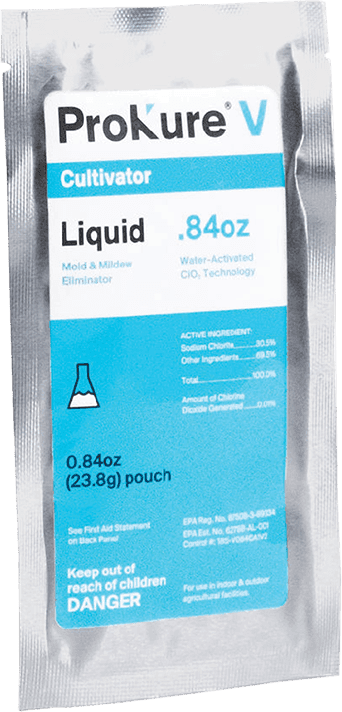
For surface disinfection, ProKure V is an EPA-registered hospital-type liquid disinfectant (EPA Reg. No. 87508-3-89334) that, on hard, non-porous surfaces, is suitable for use with plants in the room and leaves no residue. That combination, a surface disinfectant you can use with plants in the room, is the one bleach and quats cannot match, and it is why a single-room operator reaches for it during turnover. The disinfectant claim applies to surfaces, not to the plants themselves.
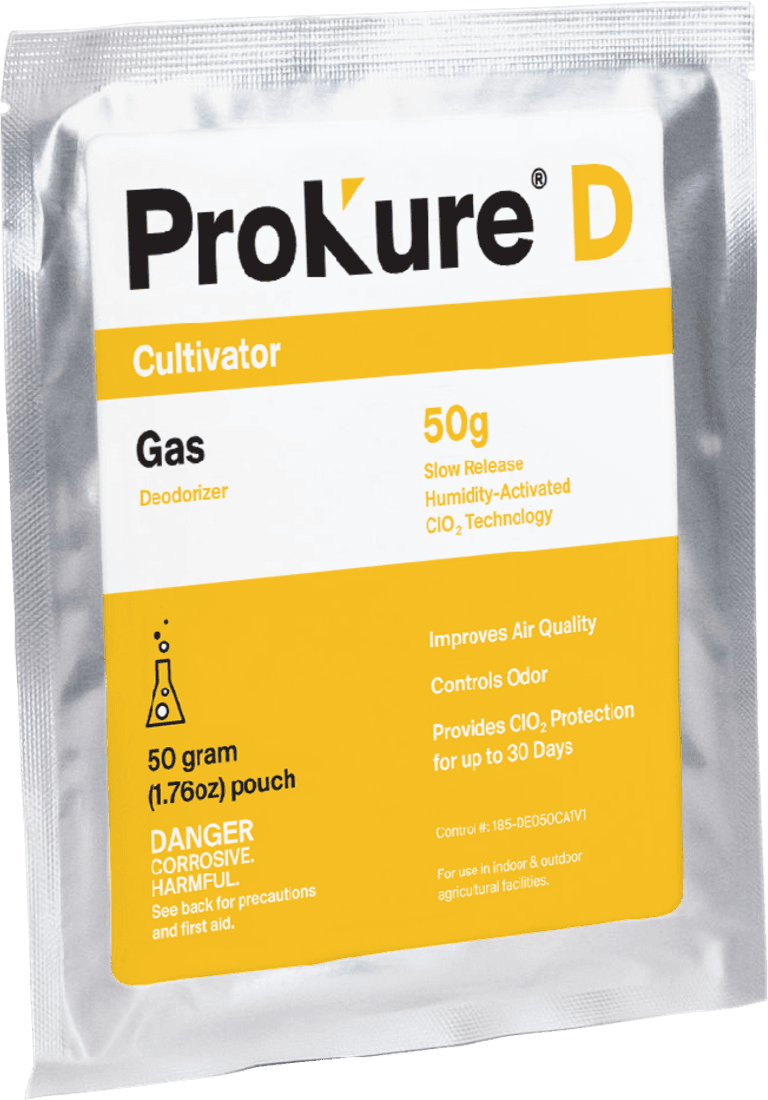
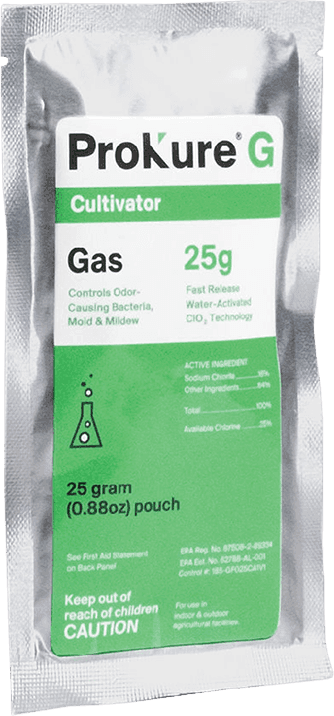
For air quality, the line splits into two gas products with different jobs, and keeping them straight is a compliance requirement, not a preference. ProKure G is an EPA-registered fast-release gas (EPA Reg. No. 87508-2-89334) that works in 4 to 6 hours and carries the required disclaimer, not for use with/on plants/crops/feed, which makes it an empty-room product. ProKure D is a slow-release gas that provides ClO2 protection for up to 30 days and improves air quality and controls odors; ProKure D is not an EPA-registered product and not labeled for sale as a pesticide under 40 CFR. Do not cross those claims. The with-plants surface claim belongs to V. The not-for-plants fast-gas claim belongs to G. The up-to-30-day air-quality claim belongs to D.
The EPA disclosure that determines when each product can be used relative to living plants
Here is the operational rule a single-room grower can hand a helper: any product whose label says not for use with/on plants/crops/feed is an empty-room product, and it does not run while a canopy is in the room. That disclaimer, which the fast-release gas carries, is a use-site restriction with legal force, not a suggestion. During the plant-free turnover window, the empty-room products are available. Once plants are back in, your surface options narrow to what is labeled suitable for use with plants in the room. Reading the label and matching it to whether plants are present is the compliance step, every single time.
Monitoring and action thresholds in a single-room grow
Monitoring and thresholds deserve their own pass because, in one room, they are your early-warning system and you have no second room to fall back on when the warning comes late.
Scouting cadence is weekly in veg and twice weekly in flower, and in a single room you hold that cadence religiously because there is no redundancy. Sticky cards go at and above canopy height, repositioned as the canopy grows, and you count them every scout, logging the number even when it is zero. The zero entries are not wasted ink; they are the baseline that makes a rising count legible. A single-room canopy is small enough that a thorough scout takes minutes, which removes the usual excuse for skipping it.
The environmental sensor stack, relative humidity, temperature, vapor pressure deficit, and CO2, is the other half of monitoring, and it is the half that predicts mold before you see it. A leading grower guide puts the failure mode plainly: growers "fail because a humidity spike three weeks before harvest went unlogged, or because a pesticide application happened without anyone writing down the date and product name." In a single room that is doubly true, because the one humidity spike hits every plant you own at once. Log the environmental reads alongside the scout counts, in the same log, so the humidity drift and the botrytis show up on the same page and you can see the causal line.
Thresholds in a single room have to trigger early. Without a backup room, you cannot isolate and wait, so your action trigger must leave room for a biological control to work before the population forces a hard chemical intervention you cannot confine. Set a starting threshold per pest and per stage, write it into the log template, and treat crossing it as a non-negotiable prompt to act. When the threshold trips, the decision tree is: can a biological release still handle this at this stage, or has it gone far enough that a hard intervention is the only option. In flower, that second branch is heavily constrained by residue risk, which is exactly why the early threshold exists.
EPA compliance for a single-room cannabis grow
Compliance is the worry operators name first, and the single-room operator carries it without a compliance officer. The good news is that the rules reduce to a few clear distinctions you can internalize.
Start with why most EPA-registered pesticides carry no cannabis label. Because cannabis remains federally unapproved for most pesticide registrations, most EPA-registered pesticides carry no cannabis use on their label, and that gap is why states publish their own approved lists. The practical meaning: a product being EPA-registered is not the same as being legal to apply to your cannabis crop. You read your state's approved list first, every time, before you buy a plant-contact product.
Then the distinction that the top-ranking pages blur and that a procurement or QA lead needs sharp: a plant-contact product and a hard-surface disinfectant used in an empty room are not the same regulatory category. A product you spray on or near living plants must clear your state's cannabis approved list. A hard-surface disinfectant used in an empty room during turnover falls under its own EPA registration for that use. This is where the not for use with/on plants/crops/feed disclaimer becomes operational: the product that carries it is an empty-room product, and using it with plants present is a label violation. Knowing which product carries which status, and when each may be used, is the core of single-room compliance.
Pre-harvest interval math is the trap unique to perpetual single-room grows. A pre-harvest interval tells you how long before harvest a product may last be applied. In a perpetual room with plants at several stages sharing one airspace, a spray aimed at a veg plant can drift onto a plant two weeks from harvest, blowing that plant's interval. The single-room answer is to treat the whole room's nearest harvest as the binding interval for any airborne application, or to avoid airborne plant-contact applications in a mixed-stage room entirely and lean on biology. This is a real constraint the general guides never address because they assume separate rooms by stage.
Finally, the audit-ready log. A state inspector will ask what you applied, when, at what rate, and to what, plus your monitoring records and your sanitation records. The single-room advantage is that one operator can keep one unified log, and one page that covers scouting, sanitation, and application records is enough if it is complete and current. Every product in this protocol should have an SDS and a current EPA label in your binder, so that when procurement or an auditor asks, the documentation is one request away, not a scramble.
When a single-room grow should call in outside help
There is a point where a single-room IPM program hits a ceiling, and recognizing it early is cheaper than recognizing it after a failed test. The signs: the same pest or pathogen returns every cycle despite a clean turnover, your lab results trend the wrong way across runs, or you are reaching for chemical intervention in flower more than rarely. Those are not personal failures. They are signals that the room's environment or the protocol has a gap your current tools are not closing.
This is where biosecurity consulting earns its cost for a single-room operator. A consulting engagement with Dr B maps your one room end to end, finds the environmental driver behind the recurring problem, builds the SOP and the log to your actual room rather than a generic template, and, when it fits, adds on-site air sampling with detailed reports so you have data to show ownership and an auditor. For an owner, the math is blunt: a failed harvest test on a mature crop is a five-to-six-figure event, and prevention consulting is a fraction of one failed run. The consulting is not a substitute for the protocol on this page. It is what you add when the protocol alone has stopped closing the gap.
Frequently Asked Questions
What are the three rules of IPM?
The three rules most IPM educators teach are: prevent first, monitor constantly, and intervene only on a documented threshold using the least-disruptive effective method. In a single-room grow those rules compress hard, because you have no backup room to fall back on. Prevention and monitoring do the heavy lifting, and the threshold rule keeps you from spraying on a hunch in an airspace you cannot isolate.
What are the 6 steps of an IPM program?
The six steps are prevention, identification, monitoring, action thresholds, management options (biological, mechanical, then chemical, in that order), and evaluation. State regulators and grower educators point to the same six-step spine. For a single-room operator, the steps are the same but prevention and evaluation carry more weight, because you cannot isolate a problem and you cannot afford to repeat it next cycle.
Why don't more farmers use IPM?
IPM asks for up-front work, monitoring cadence, recordkeeping, threshold discipline, before any problem is visible, and that discipline is harder to sustain than reaching for a spray when you see a pest. For a single-room operator the payoff is larger, though, because you have no second room to contain an outbreak, so the prevention work that feels optional in a big facility is the only defense you have.
Is IPM better than pesticides?
IPM is not the opposite of pesticides; it is a system that uses them last and least. Pesticides are one management option inside IPM, after biological and mechanical controls. For cannabis specifically, a spray in flower risks residue that fails a lab test and destroys a lot, so a prevention-first system that rarely reaches the chemical step protects the crop and the compliance record better than spraying on a schedule.
What is chlorine dioxide (ClO2) and why is it used in cannabis grow rooms?
Chlorine dioxide is a selective oxidizing biocide used for surface disinfection and air quality. In the ProKure line, ProKure V is an EPA-registered liquid surface disinfectant (EPA Reg. No. 87508-3-89334) suitable for use with plants in the room on hard, non-porous surfaces, leaving no residue. ProKure G is a fast-release gas (EPA Reg. No. 87508-2-89334) for empty rooms. ProKure D is a slow-release gas for air quality for up to 30 days and is not an EPA-registered product.
Can I use bleach between cycles in a single-room grow?
You can use bleach on surfaces, but in a single-room grow its fumes fill your only airspace and it leaves a chloride residue, so the evacuate-and-wait cycle costs downtime you cannot spread across other rooms. Many single-room operators prefer a residue-free surface disinfectant labeled suitable for use with plants in the room. Whatever you use, pre-clean soiled surfaces first and keep the label and SDS in your binder.
How long should room turnover take in a single-room grow?
A structured single-room turnover runs in roughly 48 to 72 hours: debris removal, surface pre-clean, plant-free hard-surface disinfection, HVAC and filter service, air treatment and dwell, then transplant-ready verification and log sign-off. An unstructured turnover commonly eats 3 to 5 days. The sequence, not the raw speed, is what protects the next crop, so do not skip the pre-clean to save an hour.
What EPA compliance records do I need to keep for a single-room grow?
Keep a unified log covering scouting counts, environmental reads, sanitation and turnover records, and every product application with date, product name, rate, and target. Keep an SDS and a current EPA label for each product on hand. A state inspector will ask what you applied, when, and to what, plus your monitoring and sanitation history. One complete, current page is enough for a single-room operator, which is the recordkeeping advantage of running one room.
Related resources
Related resources