
ProKure V vs G vs D for Vertical Farms: How to Match Product to Rack Geometry and Room State
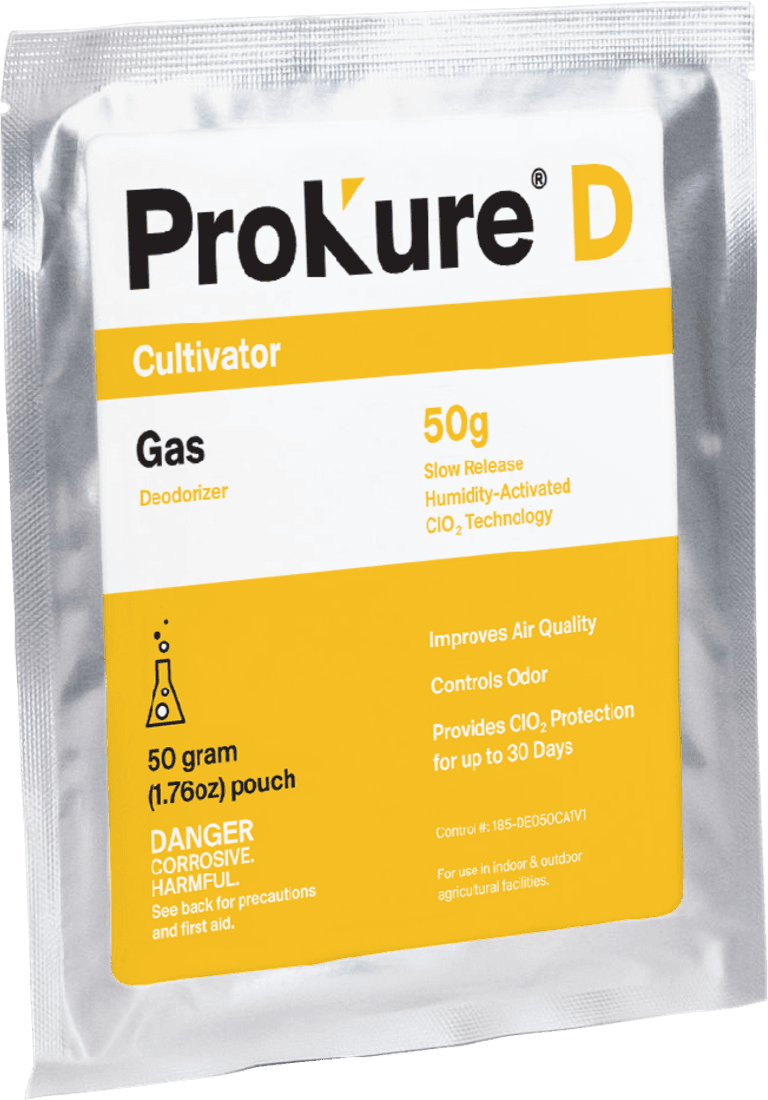
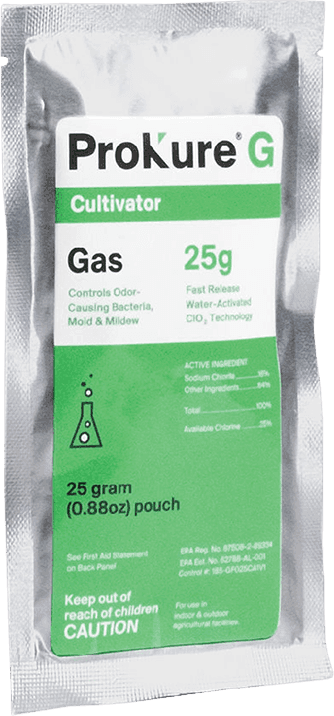
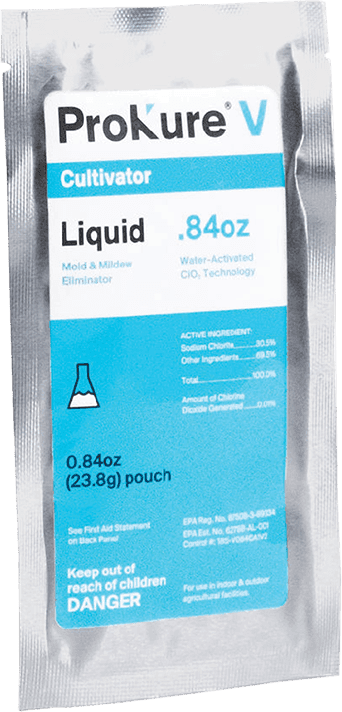
For a vertical farm the answer is not a single product, it is a sequence set by whether the room is occupied and how much clearance sits between canopy tiers. ProKure V is the liquid surface disinfectant for racks, trays, and tools, suitable for use with plants in the room because it treats surfaces, not the crop. ProKure G is the fast-release gas for an empty-room reset, labeled "Not for use with/on plants/crops/feed." ProKure D is the slow-release gas for occupied-room air quality, and its placement, hanging 18 to 24 inches above the canopy, is the spec that collides with stacked-rack math.
Short answer for vertical farm operators
ProKure V, EPA Reg. No. 87508-3-89334, is your surface disinfectant: hard, non-porous surfaces at 100 ppm for a 10-minute exposure, with plants in the room. ProKure G, EPA Reg. No. 87508-2-89334, is your between-cycle air reset in an empty room, 4 to 6 hours plus a one-hour ventilation. ProKure D, not an EPA-registered product and not labeled for sale as a pesticide under 40 CFR, provides ClO2 protection for up to 30 days of occupied-room air quality and carries no kill claim. The vertical-farm caveat is this: D is documented to hang 18 to 24 inches above the canopy, and if your tier clearance runs the common 24 to 48 inches, that placement competes with the plants for the same vertical space.
What each product actually is
Three forms, one ClO2 chemistry, three jobs. Do not swap them.
ProKure V, the surface disinfectant
ProKure V is a water-activated ClO2 liquid, a hospital-type disinfectant for hard, non-porous surfaces, used at 100 ppm for a 10-minute exposure. On a vertical farm that means rack uprights and shelving, trays, reservoir lids, tools, and grow-room surfaces. It leaves no residue, which matters more in a stacked system where overspray from one tier can drift toward the plants on another. For the product in full, see the ProKure V liquid disinfectant pillar.
ProKure G, the empty-room reset
ProKure G is a fast-release ClO2 gas deodorizing delivery system, EPA Reg. No. 87508-2-89334, that works in 4 to 6 hours. Its label is explicit: "Not for use with/on plants/crops/feed." In a vertical farm it runs only when the entire room is cleared, people and plants out, because the gas fills the whole volume across every tier at once. One-hour ventilation before re-entry.
ProKure D, the occupied-room air layer
ProKure D is a slow-release ClO2 gas that provides ClO2 protection for up to 30 days and runs with plants in the room for air quality and odor control. It carries no kill claim and is not EPA-registered. Product documentation places the trifold 18 to 24 inches above the canopy, and sizing runs by cubic footage: a 10-gram pouch to roughly 1,000 cubic feet, 50 grams to 4,000, and 95 grams to 8,000.
Why vertical farm geometry changes the answer
A single-level room treats product placement as a floor-plan problem. A vertical farm makes it a three-dimensional one, and that is where the top search results go silent.
Rack-height math
If ProKure D is documented to hang 18 to 24 inches above the canopy and your tier clearance is 24 to 48 inches, the D placement eats a large share of the inter-tier space on every level. You have two honest options: dedicate per-tier D placement sized to each tier's sub-volume, or treat the room as one volume and accept that a single hang height cannot sit 18 to 24 inches above every stacked canopy at once. Measure your actual clearance before you buy, because the rack spec, not the product, is the binding constraint.
Per-tier versus per-room placement
D is an air-quality product dosed by volume, so on a tall multi-tier rack you are choosing between distributing pouches per tier for even coverage or centralizing them and relying on air movement to carry ClO2 across levels. G, by contrast, is a whole-room reset where tier geometry matters less because the empty room is treated as one volume. V is surface-by-surface regardless of height.
Overspray and adjacent-tier exposure
V is a direct-application surface product, not a canopy fog. In a stacked system, spraying a tier's surfaces means keeping the application off the plants on the tier above and below. Apply to visible wetness on the target surface, not as an aerosol that drifts between levels.
Sequencing across the grow cycle
The products are not competitors, they are stages. Run them in order.
Turnover, room empty
Disinfect every rack surface, tray, and tool with ProKure V at 100 ppm for the 10-minute hold, then run a ProKure G reset across the empty room for 4 to 6 hours and ventilate one hour before re-entry. This is the deep reset a vertical farm gets only when the whole room is down.
Occupied cycle, plants in
Maintain in-room air quality with ProKure D sized to the room volume and placed per your tier clearance, and spot-disinfect surfaces with ProKure V as needed, keeping application off the canopy. For the broader program, see the air quality management overview and the cultivation IPM reference.
To order the ProKure V, G, and D line, visit shop.groclarity.com. For a vertical-farm placement plan across your rack geometry, request a GroClarity consultation at 866.206.1301, and see prokuresolutions.com for EPA labels and SDS. Built on Science. Backed by Results.
Related resources