
ProKure G for Dry Room Reset: EPA-Compliant Between-Batch Protocol
You just pulled the last batch out of the dry room, and the next harvest hangs in a few days. ProKure G resets that empty room, but only empty: it is a fast-release chlorine dioxide gas for unoccupied spaces, and the label reads not for use with/on plants/crops/feed. The protocol is a two-step reset: a ProKure V surface pass on the racks, screens, and drain pans, then a ProKure G gas treatment to reach the whole volume. Size the gas to the room's cubic feet, seal it, hold the 4 to 6 hour dwell, and ventilate for one hour before re-entry. Done right, the room is reset to zero residue before tested flower goes back in.
Why the dry room needs its own reset protocol
A dry room is not a flower room with the lights off. The variables are different, and they are exactly the ones that put a yeast and mold test at risk.
The room carries a history. Residual terpene, chlorophyll, and plant-material odor from the prior batch cling to surfaces. Trim dust and micro-debris settle into screens, hang lines, and the recessed corners of racks, and that debris shelters mold spores between batches. The RH history is its own problem: a dry room typically runs 55 to 62 percent relative humidity, a band that has already supported some microbial growth by the time you pull a batch.
Then comes the part that makes this a compliance problem, not just a housekeeping one. The next occupants are drying flower, and that flower gets tested for total yeast and mold before it can be sold. A dirty dry room is a way to fail a batch on contamination you introduced during the reset, and a residue-leaving disinfectant is a way to fail it twice. The reset has to leave zero residue that could contact finished product. That is why the dry room earns a protocol built around a residue-free chemistry rather than a bleach-and-air-out pass.
What ProKure G is, and what the label actually says
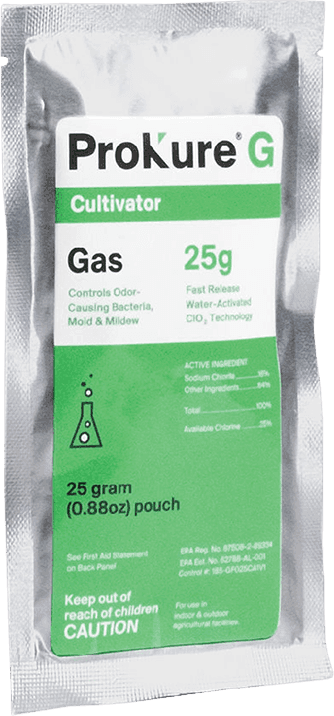
ProKure G is a water-activated, fast-release chlorine dioxide gas. Its approved job is the solution to mold and mildew, odor-causing bacteria, and chemical odors, delivered as a deep-penetrating ClO2 vapor that works in 4 to 6 hours. Because it is a true gas, it fills the whole room and reaches the screens, drain pans, and cracks a sprayer cannot, which is the reason it belongs in a dry-room reset at all.
The label restriction is the operating rule, not fine print. ProKure G is for unoccupied spaces, and it carries the verbatim line not for use with/on plants/crops/feed. For a dry room that means the room is empty of all hanging flower and plant material, with no people or pets present, for the entire treatment. If flower is already hanging, G is off the table, full stop. ProKure G is EPA-registered, and it is a violation of Federal Law to use an EPA-registered product in a manner inconsistent with its labeling, so the empty-room requirement, the dwell, and the ventilation step are conditions of use.
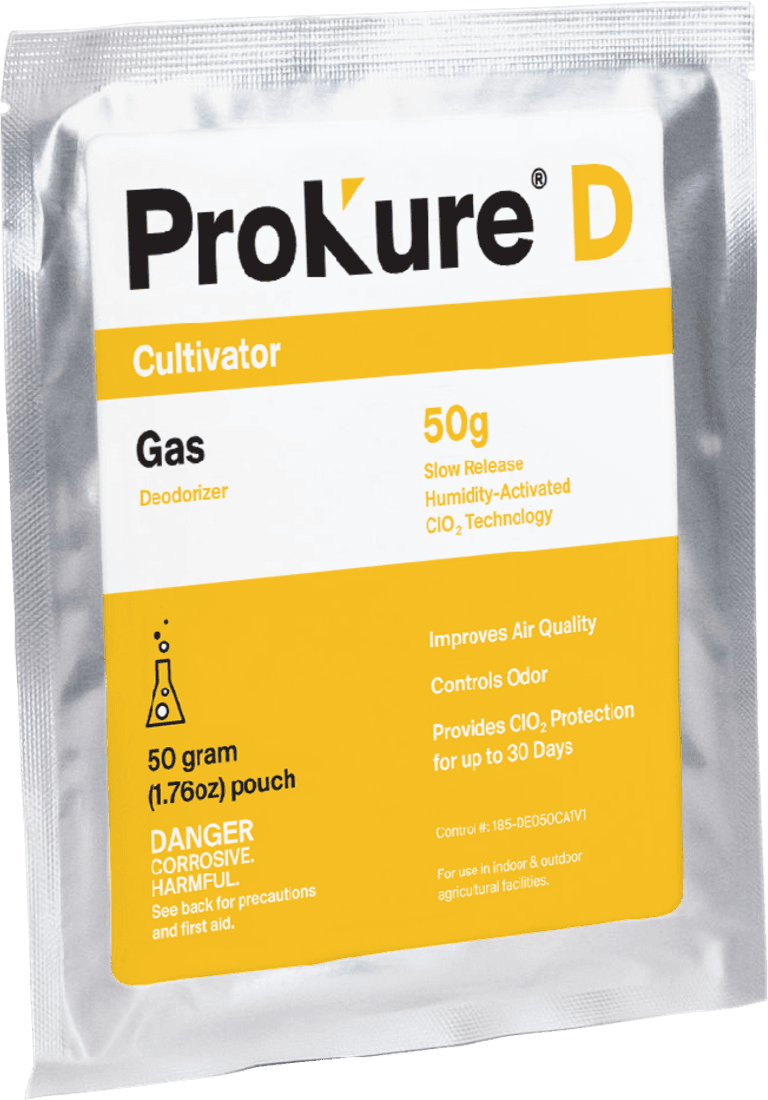
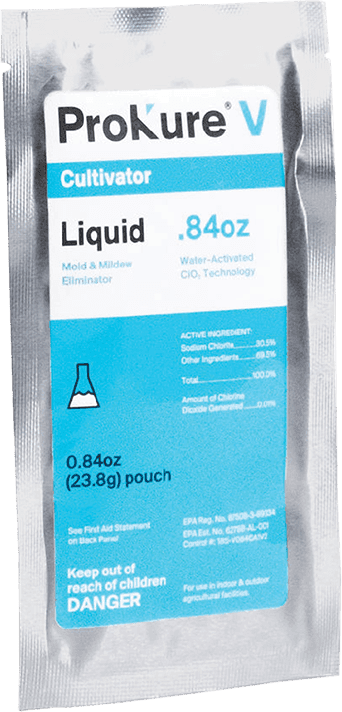
Keep the three products straight, because the reset uses two of them. ProKure V is the liquid hospital-type disinfectant for the surface pass, suitable for use with plants in the room and residue-free. ProKure D is the slow-release gas that provides ClO2 protection for up to 30 days and runs with plants present for background suppression during the dry, a different job from G's fast empty-room reset. G resets the empty room, V disinfects the surfaces, D maintains the air once flower is hanging.
The GroClarity dry room reset SOP
The one ranking page that touches this at all is a 2018 restoration case study about a flooded service tunnel, where the team wrote, "We used both ProKure V (Liquid Disinfectant/Fungicide/Deodorizer) and ProKure G (ClO 2 Deodorizer) to treat the tunnel." The two-step surface-then-gas logic is right, but a sewage tunnel is not a cannabis dry room. Here is the reset written for the room you actually have.
First, empty the room and remove every piece of plant material, including fallen trim and larf. The empty-room rule is absolute and it is the first compliance checkpoint. Second, dry-vacuum the debris off the screens, racks, hang lines, and floor, because organic soil is oxidizer demand that spends the gas before it reaches your target. Third, do the surface pass with ProKure V at label dilution: apply to visible wetness on the hard, non-porous surfaces, hold the 10-minute dwell at 100 ppm, and let it dry residue-free. Fourth, calculate the room's cubic feet (length times width times height) and size the ProKure G packet count to it, rounding up. Fifth, deploy the gas: place the activated cup on a stable, level surface in a central location, turn the lights off, and seal the room with no one inside. Sixth, hold the contact time, at least 4 to 6 hours per the label or overnight. Seventh, ventilate and turn the lights on for one full hour before re-entry. Eighth, reset the RH to your target and log the treatment before you hang the next harvest.
Coverage math for common dry room sizes
Size the gas to the air volume, not the floor. ProKure G covers approximately 1,000 cubic feet per 10 gram packet and approximately 2,250 cubic feet per 25 gram packet, the verbatim coverage specs. Measure length times width times height to the ceiling and match packets to that number.
A small 10 by 10 by 8 dry room is 800 cubic feet, so one 10 gram packet covers it with margin. A mid-size 400 square foot room at a 9 foot ceiling is 3,600 cubic feet, which takes two 25 gram packets (4,500 cubic feet of coverage) placed equally apart. A commercial 1,500 square foot dry room at a 12 foot ceiling is 18,000 cubic feet, which takes eight 25 gram packets distributed across the floor for even fill. When a room lands between counts, round up: under-dosing the air volume is where a reset quietly fails.
When to layer ProKure G with ProKure V and ProKure D
The products are not interchangeable, and the reset leans on the sequence. ProKure V is the surface step, step three of the SOP, because the gas treats the air and voids but a liquid disinfectant is what knocks the visible surface load off the racks and drain pans first. ProKure G is the empty-room gas that follows and reaches everything the liquid pass could not.
ProKure D enters once the next batch is hanging. It is the extended-release gas for background air-quality suppression during the dry, running with plants present where G legally cannot. The decision between G and D is simply empty versus occupied: G for the between-batch reset with the room empty, D for the ongoing air layer with flower in the room. A full drying program uses the surface pass, the empty-room reset, and the in-cycle maintenance in that order.
EPA compliance, residue, and the audit-ready treatment log
The reset is only as defensible as the record you keep, and this is where every ranking page comes up empty: none offers a dry-room treatment log or states the EPA label parameters a QA lead needs. GroClarity publishes both.
The residue point ties straight to the test. ProKure G controls odor-causing bacteria, mold, and mildew without leaving a residue film, and the ProKure V surface step is also residue-free and rinse-free, so neither step leaves a chemical on the racks that could read as a false positive on a yeast and mold panel. That residue-free reset is the whole argument for the QA reader whose output goes to a testing lab.
Log every reset with the entries a Vermont-or-any-state inspector will ask for: date, room, product and packet lot, concentration, contact time held, ventilation time, re-entry time, and operator initials. Use the caution placard enclosed with the product to record treatment and safe re-entry times on the door, then transcribe them. For an operation standardizing across rooms or facilities, write the SOP and the log fields once so every dry room runs the identical protocol. For SDS, the EPA registration number, and dilution charts, those live on prokuresolutions.com; reorder the packets on shop.groclarity.com; and to standardize the dry-room reset across a footprint or size packet counts to your actual rooms, request a quote from GroClarity.
Related resources