
Grow Bed Disinfectant for Cannabis: A Plant-Safe, Residue-Free Between-Cycle Protocol
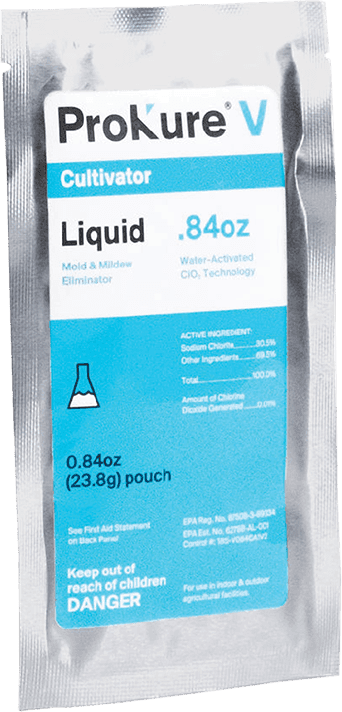
A cannabis grow bed disinfectant has one job the whole-room guides skip: clear the bed surface that will touch the next crop's root zone, without leaving residue that harms those roots. The bed is not the room. A fabric bed, a coco slab, a rockwool tray, an HDPE insert, and a raised soil bed each hold pathogens differently and tolerate residue differently. Bleach corrodes metal fittings and off-gasses, quaternary ammonium leaves a film at the root zone, and most options force a rinse-and-dry delay that eats turnover days. ProKure V, a chlorine dioxide liquid, EPA Reg. No. 87508-3-89334, disinfects hard, non-porous bed surfaces, is labeled as suitable for use with plants in the room, and leaves no residue.
What a grow bed disinfectant means for a cannabis operation
Treat the grow bed as its own use-site. The term covers the physical substrate container the root zone sits in: fabric beds, coco slabs, rockwool trays, rigid HDPE inserts, and raised soil beds. It matters because the bed, unlike a bench or a wall, is in direct contact with the next crop's roots, so any residue left on it is residue the plant absorbs. Porous beds (fabric, coco, rockwool) hold moisture and organic matter that shelter pathogens, while rigid HDPE accepts a wipe-down. Residue-free at the root zone is not a marketing phrase here; it is the difference between a clean reload and a crop that inherits last cycle's problem.
The pathogen problem specific to grow beds
Between cycles the bed is where last crop's Botrytis, Fusarium, and Pythium propagules wait in the porous media near the root line. That residual load is exactly what a pre-sale total yeast and mold count (TYMC) measures, reported by state labs in CFU per gram against a state-set threshold that varies by jurisdiction, so confirm your number with your state regulator. The economics are blunt: a failed TYMC on a mature crop can erase a six-figure harvest, which dwarfs the cost of a disinfection protocol. The bed is a quiet reservoir, and a disinfection step that only cleans the room leaves it loaded.
What growers use today, and where each falls short
The current advice is generic. Bleach (sodium hypochlorite) kills broadly but corrodes metal, carries a chlorine-gas risk in a sealed room, and leaves residue that forces a rinse. Hydrogen peroxide is popular; one top-ranking cultivation guide states that "Hydrogen peroxide is another great sanitizing solution and is completely safe to use around plants," but peroxide decomposes fast and growers often pair it precisely because it is not a complete answer alone. Quaternary ammonium leaves a surfactant film at the root zone that is disqualifying for a bed. Isopropyl alcohol is a wipe for small rigid parts, not a porous-bed treatment. None of these pages treats the bed as a distinct substrate with its own porosity and residue tolerance.
Why chlorine dioxide fits grow beds specifically
Here is the objection a grower raises: if a competitor already says chlorine dioxide is safe, why does the source matter? Because one ranking product page claims, verbatim, that "All chlorine dioxide cleaning products for cannabis cultivation are safe with no residue or post-treatment cleanup required," and never cites an EPA registration number or a site-of-use label to back it. ProKure V does. It is a water-activated chlorine dioxide liquid, EPA Reg. No. 87508-3-89334, labeled as a disinfectant, tuberculocide, and fungicide for hard, non-porous surfaces, effective at 100 ppm with a 10-minute contact time against a labeled organism list that includes Aspergillus niger and Fusarium solani. It works across a wide pH range, it is labeled as suitable for use with plants in the room, and it leaves no residue, which is the whole point at the root zone.
EPA registration and label discipline, the biggest worry
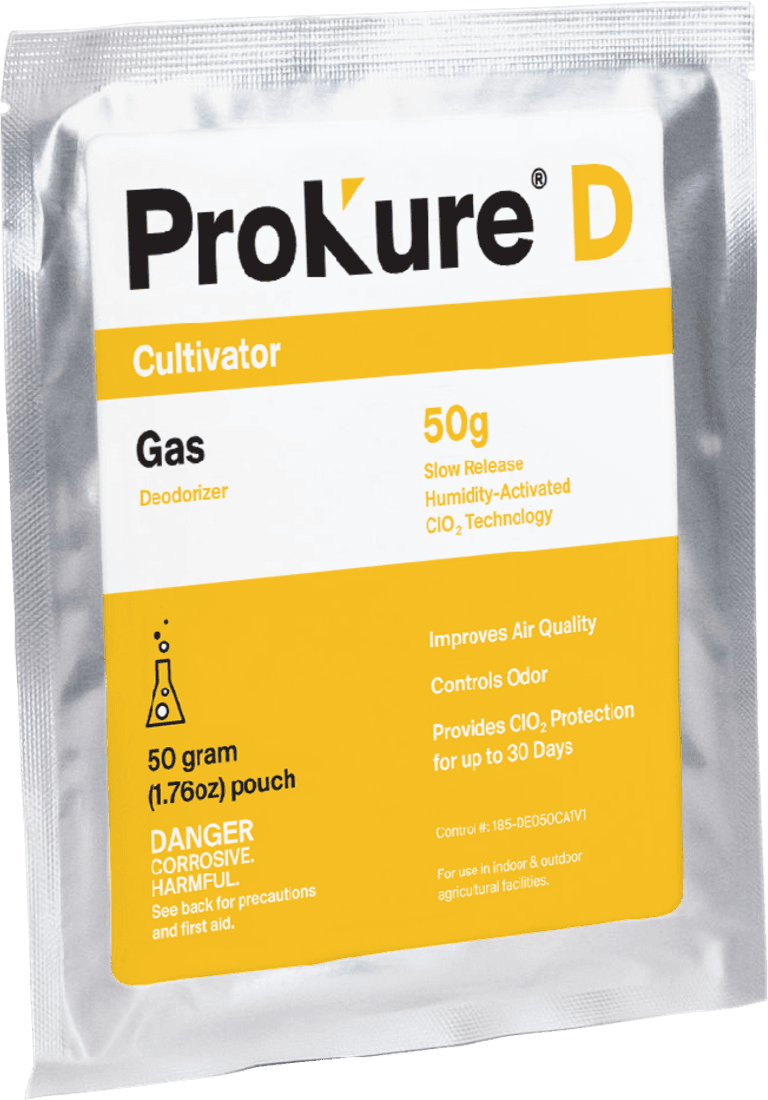
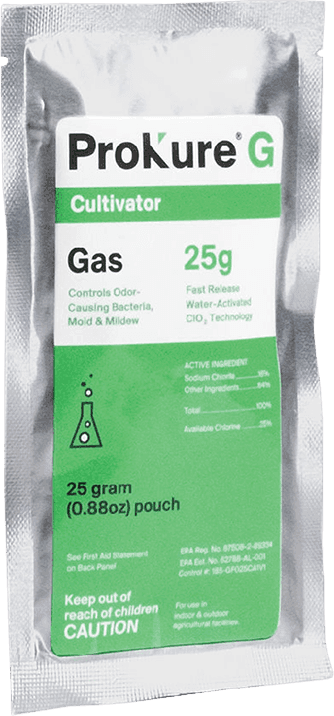
The governing fact for any cannabis cultivator: no pesticide is federally registered for use on the cannabis plant, so you treat the bed surface, not the crop, with a product whose label covers that site of use. ProKure V's hard, non-porous surface label covers rigid bed surfaces and fittings; read the Site of Use section before you apply it to any substrate. One clarification that keeps the product line straight: the verbatim disclaimer Not for use with/on plants/crops/feed belongs to ProKure G, the empty-room fast-release gas (EPA Reg. No. 87508-2-89334), not to ProKure V. ProKure D, the slow-release gas that provides ClO2 protection for up to 30 days and improves air quality and controls odors, is not an EPA-registered product and not labeled for sale as a pesticide under 40 CFR, and makes no kill claim. Read the entire label and use each product strictly in accordance with its directions. Keep the SDS and label on file for audits.
How to disinfect a cannabis grow bed between cycles
Run it in order. First, remove all plant matter and gross soil, because organic debris shields pathogens from any disinfectant. Second, for porous media decide replace-versus-disinfect: single-use coco and rockwool are usually replaced rather than treated, while reusable fabric and rigid beds proceed. Third, apply ProKure V at the labeled concentration to the hard, non-porous surfaces. Fourth, hold the labeled dwell time. Fifth, move air and confirm the surface is dry. Sixth, take a TYMC swab to verify the bed is clean before reload. Because ProKure V leaves no residue, the reload-to-transplant window is governed by drying, not by the long rinse-and-dry cycle bleach demands, which is where the between-cycle day savings come from.
Application method by bed type and cross-contamination control
Match the method to the substrate. Fabric beds cannot be wiped effectively, so they take fog or immersion where the bed is reusable; coco slabs and rockwool trays are usually replaced rather than disinfected; rigid HDPE and plastic inserts accept a spray-and-wipe; and raised living-soil beds are a special case where a surface disinfectant cannot be applied to the soil biology, so the control is bed-frame hygiene and media management, not chemical treatment of the soil. Then stop cross-contamination between adjacent beds: change gloves and use dedicated shears per bed, sanitize trellis clips and support hardware, and keep the irrigation manifold clean so a pathogen in one bed does not ride the shared plumbing to the next.
Prove it worked, and build it with GroClarity
What you now have that you did not have from a generic room guide is a bed-specific protocol: substrate-aware, residue-free, EPA-grounded, with a verification step. Document it. Keep TYMC plate counts before and after, log the product and EPA number with concentration and contact time, and retain the records an auditor will ask for. ProKure V is the liquid for bed surfaces; where a whole-room or air reset is needed, ProKure D and ProKure G handle the gas phase. Order the ProKure line on shop.groclarity.com, and for a bed and facility protocol request a quote. Labels and SDS live at prokuresolutions.com. See product label for specific instructions and claims. GroClarity consults from 5013 E. Washington St. Ste. 130, Phoenix, AZ 85034, 866.206.1301.
Related resources