
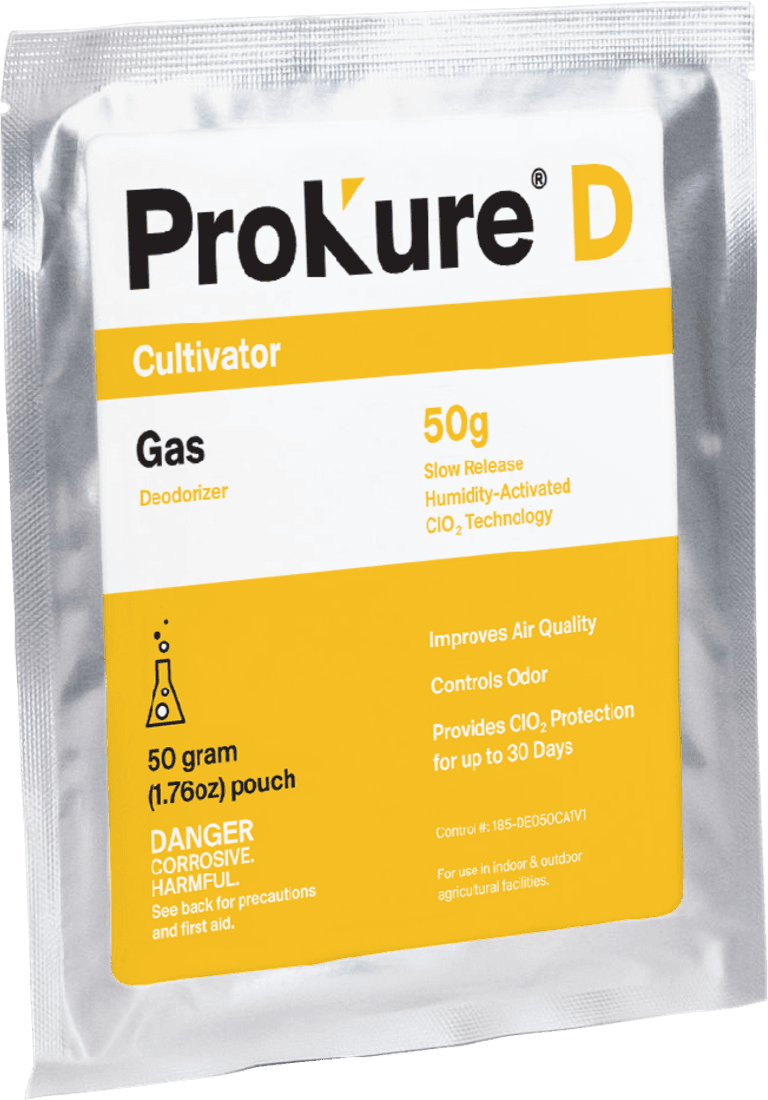
Disinfectant Safe for Plants: What "Safe to Use With Plants in the Room" Actually Means on an EPA Label
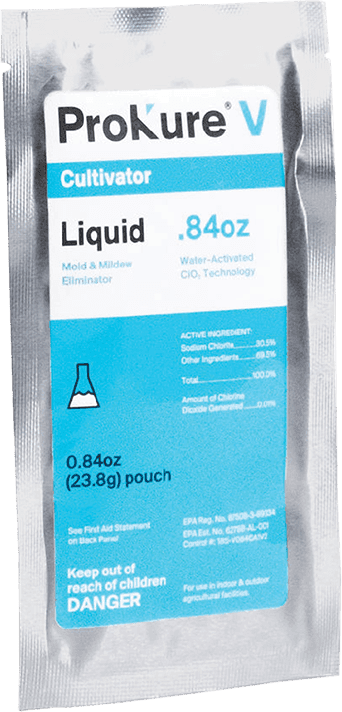
For a head grower with a six-figure crop in the room, "disinfectant safe for plants" is a compliance question with a short answer. Most disinfectants are not safe to apply with plants present, not because they fail to clean, but because their EPA label forbids it. Bleach, quats, and most alcohol and peroxide products carry a "Not for use on plants, crops, or feed" restriction, which legally requires you to pull the plants first. The product that does not carry that restriction is a liquid chlorine dioxide disinfectant like ProKure V, labeled suitable for use with plants in the room on hard, non-porous surfaces, residue-free, killing at 100 ppm over a 10-minute contact time.
Why this is a head grower's problem
The reader here is not browsing. You have living plants you cannot or will not move, mold pressure you have to control, and a pre-sale yeast-and-mold test coming that can turn a mature harvest into a write-off. Cost is not the blocker; crop value justifies the spend. The blocker is that the obvious products are off the table the moment plants are in the room, and the content that ranks for "safe for plants" is written for a hobbyist cleaning an empty pot, not for a cultivator protecting a canopy.
Look at what actually ranks. The most authoritative page on the subject is Iowa State University Extension, and its whole frame is reusing old pots. It opens by telling readers, "It is important to clean and disinfect old pots each time you use them." That is useful advice for a gardener and useless advice for you, because your problem is not an empty pot on a bench. It is a room full of flowering plants and a bench you cannot soak in a bucket. You need a residue-free surface disinfectant you can run with plants nearby and a data trail you can hand an auditor. That is a narrow requirement, and it rules out most of the shelf.
The EPA label test: read this one line before you buy
Turn the bottle around and find the use restrictions. The line that decides everything is "Not for use on plants, crops, or feed." When a label carries it, the product is legal only in a cleared space, full stop, no matter how well it kills. That single clause is why bleach and quats cannot do the job you actually have, and it is the first thing a compliance auditor looks for.
The counterpart is the ProKure V label language: suitable for use with plants in the room, applied to hard, non-porous surfaces at the labeled concentration. That is not marketing; it is the approved EPA label claim (EPA Reg. No. 87508-3-89334), and it is the entire moat. Suitable for use with plants in the room is also not the same as applied to plants. The first is allowed and is the point of this page. The second is off-label for every product discussed here. For cannabis operators, confirm your state's accepted products and any state-specific use conditions, because the federal label is the floor, not the ceiling, and state yeast-and-mold rules move. The regulatory deep-dive on label reading and state variance is a separate topic; this page stays on the suitability question.
The chemistries people try, and where each one fails around living plants
Four chemistries dominate the "safe for plants" conversation, and three of them fail the plants-present test for a reason worth naming.
Chlorine bleach (sodium hypochlorite) is the default the gardening SERP keeps recommending. Iowa State tells readers to "Soak the container in a solution containing one part household bleach to nine parts water for a minimum of 10 minutes and rinse." Read that carefully. It is a container soak, with a rinse, on an item you removed from the plant. Bleach is phytotoxic, leaves residue, corrodes equipment, and forces a rinse step and PPE on the crew. It is an empty-room or empty-bucket product, and the label restriction says so.
Quaternary ammonium compounds (quats) bind to organic matter and leave a residual film, which is the opposite of what you want on surfaces near foliage and root zones. Their labels carry the same plants-crops-feed restriction. Quats also invite resistance over time, which is a poor trait for a product you run on a schedule.
Hydrogen peroxide is gentler but oxidizes tender foliage on contact and needs dwell time to disinfect, so it is a tool-and-surface option rather than a spray-the-room-with-plants answer. Peracetic acid, the chemistry horticulture forums most often recommend as plant-safe, does work. It also brings a sharp odor, a real worker-exposure profile, and a plant-tolerance range you have to respect. It is a professional product, not a run-it-with-the-canopy product.
Here is the honest gap the ranking pages leave. The most authoritative page on the SERP, Iowa State, says of the household alternatives that "their effectiveness at killing plant pathogens on containers and garden equipment has not been well evaluated." So the consumer advice is either a restricted chemistry or an unproven one. Chlorine dioxide is the chemistry none of the top pages mention and the one whose label actually permits plants-present use. Activated from a liquid packet, ProKure V disinfects hard, non-porous surfaces at 100 ppm over a 10-minute contact time, leaves no residue, and needs no rinse.
The use-site grid: what you can actually do with plants in the room
Match the action to the room state, because "plants present" is not one scenario. The right tool depends on whether the room is occupied, empty, or mid-remediation.
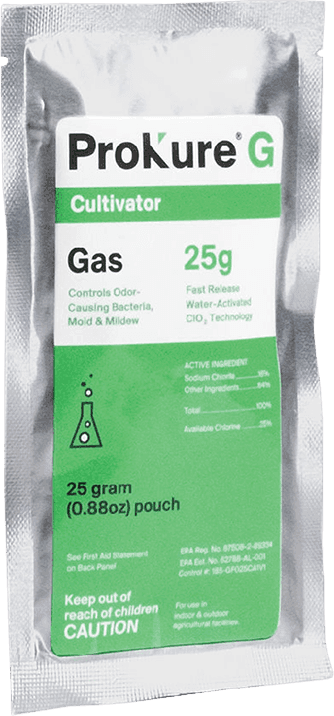
Between-cycle turnover with a few mother plants staying is the cleanest fit. You surface-disinfect benches, walls, and racks with the liquid, plants in place, no rinse. A full empty-room reset is a different job handled with a gas phase once the room is cleared, which is where ProKure G comes in.
An active flower room after a positive mold test is a remediation situation, not a routine clean. The liquid is still the plants-present surface option, but a positive test needs a full remediation protocol, not a single spray treated as the whole answer. Route that scenario to a mold-prevention and remediation protocol rather than improvising.
A veg room with clones present and a drying or cure room with hanging product are both plants-present or product-present surface-disinfection cases for the liquid on hard, non-porous surfaces. They are not spaces you fog with a restricted chemistry. Tool and shear sanitation between cuts is its own surface task that sits alongside the room disinfection step, not inside it, and it follows the same 100 ppm contact-time logic on hard, non-porous tools.
How ProKure V is applied with plants in the room
The application is a liquid, applied, not a fog. Activate the sealed inner pouch in cool water in an opaque, not clear, container, do not open the inner pouch, and allow one hour with agitation to reach full 100 ppm strength. Then apply to the hard, non-porous surface to visible wetness by sprayer, mop, or sponge. Hold the 10-minute contact time with the surface kept wet, and walk away. No wipe, no rinse, no residue.
Because it is a labeled plants-in-room product, you are not evacuating the canopy to do surface work, which is the single biggest reason it fits a head grower's calendar. At 100 ppm, respiratory PPE is not required; wear gloves if your hands will contact the activated solution during dilution or application. Verify the result the way an auditor expects, with air or surface sampling logged against date, room, and product, so the sanitation step produces a record and not just a clean bench. Activated solution should be used within 15 days of the activation date you record on the container.
What this does not replace
Be clear about the boundary so you buy the right thing. This is not the full empty-room turnover SOP. That sequence runs on a cleared room with a gas-phase reset and belongs to the grow-room turnover workflow, not to a plants-present surface spray. It is not an IPM foliar spray either. A product applied to plant foliage to manage pests is a different category than a surface disinfectant applied to the room around the plants, and the search results that mix in foliar washes are answering a different question. And it does not replace HVAC and dehumidification, which remain the upstream control on the humidity that drives mold in the first place.
Buying and routing by how you operate
If you run a single room or a small facility, order ProKure V through shop.groclarity.com and start with the surface-disinfection step on your next turnover. If you coordinate IPM across multiple facilities as a cultivation director, standardize the plants-present surface step across sites and open a procurement conversation through GroClarity at 866.206.1301 rather than buying ad hoc. Either way, pull the full technical label, SDS, and EPA registration number from prokuresolutions.com for your audit binder, and confirm ProKure V is the plants-present chemistry your state accepts before you standardize on it.
Frequently asked questions
These are the questions growers and QA leads ask before they trust a disinfectant around living plants.
Related resources