
Cannabis IPM best practices in 2026 come down to a stack that works in order: prevent first, monitor constantly, use biological and cultural controls before chemical ones, and keep EPA-compliant sanitation and a documented data trail underneath all of it. Integrated pest management (IPM) is not a spray or a single product; it is a program that keeps pest and pathogen pressure below the level that damages a crop or fails a state test. This guide lays out the ten practices that define a modern program, the state compliance thresholds they protect, and where to go next if you already know your problem is mold, sanitation, or chemistry.
If you want the definition and the five-step framework first rather than the best-practice list, start with the hub, cultivation IPM expertise. If you already know your issue is yeast and mold, jump to mold prevention protocols; if it is air handling specifically, see air quality management. Everyone building or auditing a full program, read on.
What integrated pest management means in cannabis
IPM is a method that prioritizes non-chemical solutions to preventing and controlling pests, and it matters more in cannabis than in most crops because the chemical options are so narrow. In contrast to conventional agriculture, most systemic pesticides are prohibited on cannabis, so a grower cannot spray their way out of a problem the way a row-crop farmer might. That constraint is the whole reason prevention, biosecurity, and biological controls carry so much weight here: they are not the gentle option, they are the only option that scales without failing a test.
The cost of getting it wrong is concrete. A dense indoor canopy is vulnerable through late flower, and many growers have faced catastrophic crop loss from a single outbreak or a failed pre-sale test on a harvest worth six figures. IPM is the discipline that keeps that event rare, and the practices below are the parts of that discipline.
It also helps to be clear that IPM is a sequence, not a checklist you run in any order. The whole logic is a hierarchy: prevent what you can, monitor what gets through, control living pests with biology and physics first, and reach for chemistry last and only within the rules. A grower who inverts that order, who sprays first and prevents never, spends more, fails more tests, and runs out of legal chemical options fast, because cannabis has so few. Reading the ten practices as a ranked stack rather than a grab bag is the difference between a program and a pile of tactics.
The 10 best practices that define a modern cannabis IPM program
Run these as a system, not a menu. Skipping one usually loads the others, and the load lands on the weakest link.
1. Prevention and biosecurity first
Most outbreaks walk in the door. Train everyone on biosecurity, and make it standard that staff do not report to work directly after visiting another farm or cultivation area. Put footbaths with a sanitizing solution at entrances, issue dedicated footwear and gowning, and control visitors. This is the foundation, and it has its own build in cultivation IPM expertise. The logic is simple: every pest that never enters the facility is a pest you never spend a biocontrol or a chemical control fighting. Biosecurity is cheap relative to an outbreak, and it is the one layer that protects every other layer at once. Facilities that treat it as optional tend to discover why it was not the hard way, usually after a staff member works a weekend side job at another grow and brings something back on their shoes.
2. Genetic selection and cultivar resistance
Start with cultivars that resist the pressures your facility actually sees, powdery mildew above all. Resistance is leverage you buy once and keep every cycle, and it compounds: a resistant cultivar lowers the pressure every other control has to absorb, so your biocontrols stretch further and your late-flower humidity margin gets wider. It will not carry a program on its own, and a susceptible but high-value cultivar may still be worth growing, but when two cultivars perform similarly on yield and market, the more resistant one quietly saves you labor and failed tests every cycle it is in the room. Trial new genetics in a quarantine space before they join the main rooms, and keep notes on which cultivars actually hold up under your facility's real conditions rather than the breeder's claims.
3. Clean start material
Importing live plants is the single highest-risk vector in the building. Start from seed or clean tissue-culture plantlets where you can, and quarantine anything that comes from outside before it touches the main rooms. A quarantine room is not a formality; it is a holding area with its own tools, its own airflow, and a scouting pass before anything graduates to production. The temptation to skip it is strongest exactly when you are in a hurry to fill a room, which is exactly when an untested clone carries in the pest that costs you the next three cycles.
4. Air handling and filtration
Air is both a pest vector and a control lever. A two-step system, a MERV-13 or better filter to remove particulates followed by a downstream UVC treatment to kill spores in the air column, is the standard commercial setup. The air-quality build is covered under air quality management. Filtration only works if the air actually moves through it, so pair it with enough circulation that there are no stagnant pockets where spores settle and humidity pools. A room can hit its target humidity on the sensor and still carry wet dead zones behind equipment and in corners, which is why airflow verification is a daily check, not a one-time install.
5. Surface sanitation between cycles
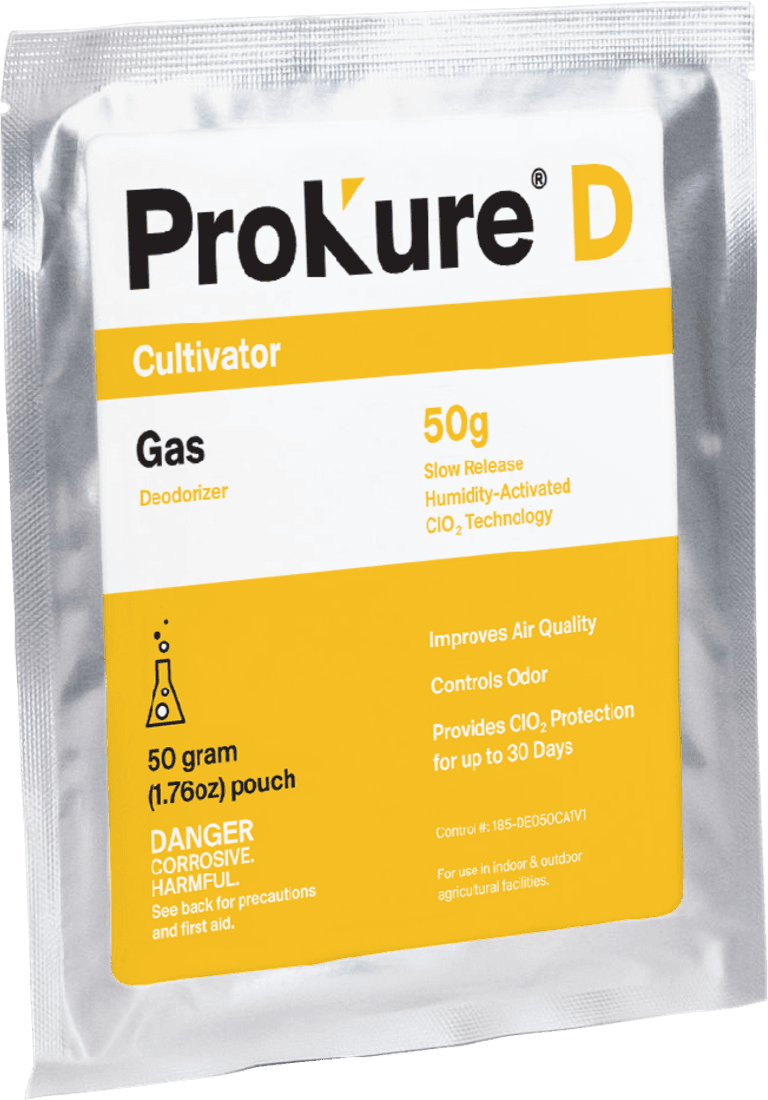
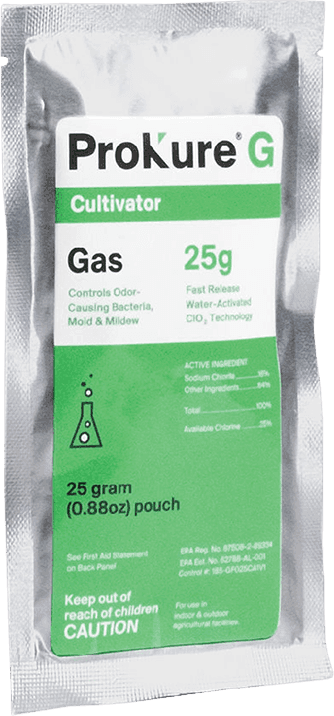
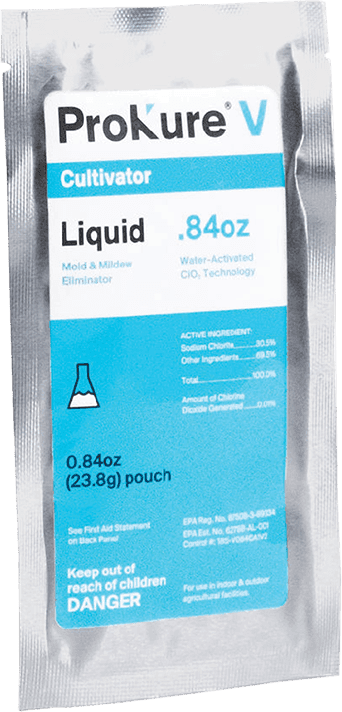
This is where mold prevention earns its ROI and where chemistry choice matters. The comparison that counts is residue and plant adjacency, not whether a product disinfects. Bleach off-gasses fumes that force the crew out, corrodes stainless, and leaves residue. Quaternary ammonium compounds (quats) leave residue too, a problem when the next crop touches the same surfaces. Chlorine dioxide (ClO2) splits across two products: ProKure V is a liquid surface disinfectant (EPA Reg. No. 87508-3-89334) that works at 100 ppm for a 10-minute exposure, leaves no residue, and is suitable for use with plants in the room; ProKure G is the fast-release gas deodorizer (EPA Reg. No. 87508-2-89334) that carries the verbatim restriction "Not for use with/on plants/crops/feed" and runs only in an empty room. For the full mechanism, see ProKure V liquid surface disinfectant and ProKure G fast-release gas. The reason this practice earns its own place in the stack is that between-cycle downtime is where prevention pays back fastest: a residue-free surface step and an empty-room gas step can turn a room in hours, where a bleach routine forces a multi-day evacuation and still leaves residue the next crop sits in. Clean before you disinfect, because no sanitizer works through a layer of dried sap and dust, and never combine ClO2 with acids or other cleaners. Finish one chemistry, ventilate, then move to the next.
6. Scouting, monitoring, and pest maps
Walk the rooms on a schedule, not when something looks wrong. Yellow sticky cards, a loupe, and a simple one-to-five severity score per zone turn a vague "looks okay" into data you can act on and log. Route work from low-pressure rooms to high-pressure ones so your crew does not carry pests upstream. The discipline that separates a real scouting program from a casual look is that it is scheduled, scored, and recorded. A severity score logged weekly builds a trend, and the trend is what tells you a room is sliding before the damage is visible. Scouting that lives only in a grower's memory cannot be handed to a new hire or shown to an auditor, which is why the monitoring step and the records step are two halves of the same practice. A simple pest map, a room diagram with the week's severity scores marked on it, makes a slide visible at a glance and tells you which zone to work first and which to keep your crew out of until last.
7. Biological controls by growth stage
Match the beneficial to the stage: predatory mites and soil predators early, sachets under a closing canopy in veg, specialist predators and parasitic wasps as late-flower pressure shifts. Biocontrols work when they are released ahead of the problem, which is why they live inside the scouting cadence, not outside it. The most common biocontrol failure is timing: a grower waits until they see the pest, orders the beneficial, and releases it a week later into an infestation that is already past the point predators can hold. Preventive, scheduled releases against your known pressures beat reactive ones almost every time, and they are cheaper per cycle than the crop loss a late release fails to stop. Log each release so you can see what actually worked.
8. Chemical controls within EPA and state rules
This is the practice most lists hedge, and it is the biggest compliance worry. Under FIFRA, a pesticide label is a legal document, and it is your responsibility to ensure only products registered for use on cannabis in your jurisdiction are applied. Systemic pesticides are broadly off-limits, and once plants enter flower, foliar sprays are sharply restricted to avoid flower contamination. States maintain their own approved-for-cannabis lists, so a product legal in one state may be disallowed in the next. Keep the allowed materials (horticultural oils, sulfur, potassium bicarbonate, and the like) matched to your state, and keep the SDS and label for every product on file. The practical trap for procurement is the sanitizer that reads "Not for use with/on plants/crops/feed": that label class is empty-room only, and using it with plants present is a violation even if nothing visibly goes wrong. Write every product into the program with its EPA registration status and the room condition it requires, so an operator never has to interpret a label in the moment. A product legal next door is not legal here unless your state's list says so. The record a state inspector scrutinizes hardest is the pesticide application log, and it needs the product, its EPA registration number, the applicator, the PPE, the date and time, the exact location, the target pest, and the re-entry interval the label requires. Miss any one field and a legal application becomes a documentation violation, regardless of whether the application itself was correct.
9. Climate management as an IPM tool
In the final weeks of flower, climate management is one of the few tools left, and the strategy shifts from optimizing photosynthesis to minimizing disease. Hold humidity down as the canopy densifies, because that is exactly when Botrytis and powdery mildew want to move. The yeast-and-mold side of this is covered under mold prevention protocols. The hard part is that the late-flower humidity target fights the instinct to keep conditions comfortable for the plant. Dense, resinous buds hold moisture, transpiration adds more, and a room that felt fine in veg becomes a Botrytis incubator in week seven if the humidity is not pulled down. Treat the humidity drop as a scheduled step on the SOP, not a judgment call, so it happens on time rather than after the first gray patch shows up.
10. Mechanical and cultural controls
Prune for airflow, space the canopy, use trap and banker plants where they fit, and apply UVC in late flower to suppress fungal pathogens and knock down microbial counts before flower enters post-harvest processing. These are the unglamorous levers that make every other practice work better. Pruning for airflow is a pest-control act, not just a yield one, because it dries the canopy microclimate the pathogens depend on. Trap and banker plants give beneficials somewhere to live between pest flushes, so your biocontrols are established before pressure arrives rather than scrambling to catch up. None of these cost much, and together they lower the baseline pressure every other practice in the stack has to manage.
State compliance: yeast, mold, and pesticide thresholds
The reason the whole stack exists is a number on a lab report. State-mandated pre-sale total yeast and mold limits, expressed in CFU per gram, vary by state, and several states screen for Aspergillus species separately. A routine that clears one state's threshold can fail across a border, which is why an IPM program is built to the strictest limit in its footprint, not the average. The Aspergillus screen is the one to weight carefully, because if Aspergillus was present its mycotoxins can persist even after the organism is killed, making prevention far cheaper than remediation. Tie your scouting and monitoring thresholds back to these limits so the program is aimed at the test that actually gates the sale.
The reason this framing matters is that it changes what prevention is for. A grower who thinks of IPM as keeping plants healthy will under-invest; a grower who thinks of it as keeping the pre-sale test under the state cap will build the program that protects revenue. Those are the same plants and often the same steps, but the second framing is the one an owner funds, because it connects a logged scouting pass to the difference between a sellable harvest and a destroyed one. Prevention that is priced against a failed six-figure test stops reading as a cost line.
Building an audit-ready IPM data trail
A program you cannot prove you ran is a program an auditor treats as not run, and this is the single thing the ranking competitors skip. Keep sanitation logs, air-test records, biocontrol release logs, and pesticide application logs, each with the required fields: for an application, that means product, EPA registration number, applicator, PPE, date, location, target pest, and re-entry interval. Store it where it is retrievable in minutes and keep it continuous, because a log that goes dark for weeks reads as a period the room was unmanaged. This data trail is also the Head Grower's best answer when ownership or a regulator asks for proof the environment was controlled, not just that it looked clean. The failure mode is not usually a missing policy; it is a log that runs for a month, lapses, and resumes the week before an inspection. An auditor reads a gap as a period the room went unmanaged, whatever actually happened in it. A boring, continuous log of in-range readings is more persuasive than a polished binder with holes, because it shows the routine ran on the ordinary days, not just the day someone remembered the audit was coming.
Running consistent IPM across a multi-state operation
Every competing page assumes a single facility. A multi-state operator faces a harder problem: different pesticide lists and different thresholds in every state. The architecture that solves it is one master IPM program plus a per-state addendum, so the structure, roles, scouting method, and records format stay identical everywhere while each state's allowed list and thresholds live in its own addendum. When a state changes a rule, you update one addendum, not the whole program, and a Cultivation Director can audit any facility against the same master. That consistency is what a Director defends to ownership and to an auditor who crossed a state line. It also compresses training: a cultivator who transfers between facilities relearns only the addendum, not the whole program, so onboarding is faster and errors drop. Build the addendum structure from the start even if you operate in one state today, because retrofitting it after five facilities have each drifted into their own version is far more work than designing for it up front.
The IPM mistakes that kill harvests
Five failure modes account for most catastrophic losses. First, importing live clones without quarantine, the fastest way to seed a facility with a pest. Second, skipping the between-cycle deep clean, which lets the next crop inherit the last one's load. Third, applying an off-label or out-of-state pesticide, a compliance violation regardless of whether it worked. Fourth, releasing biocontrols after the pest is established rather than ahead of it, which wastes the beneficial. Fifth, ignoring late-flower humidity, which hands dense buds exactly the condition Botrytis wants. Every one of these is prevented by a practice above, which is the point of running the stack as a system. Notice the pattern: none of these failures is exotic. They are ordinary shortcuts taken under time pressure, the quarantine skipped to fill a room, the deep clean cut short because the next crop is waiting, the humidity drop forgotten in a busy week. That is why the program is written down and logged rather than carried in memory. A documented routine survives the busy week; an undocumented intention does not, and the busy week is exactly when the shortcut becomes the outbreak.
Where to go next
Use the section you lingered on to pick your next step. If prevention and the full framework are what you need, the hub is cultivation IPM expertise. If the pressure is yeast and mold, go to mold prevention protocols. If it is air handling, see air quality management. You now have the full stack, which means you know enough to tell whether your gap is biosecurity, chemistry, climate, or documentation, and where to go deep on it.
If you take one thing from this guide, make it the order. The facilities that run clean are not the ones with the most products on the shelf; they are the ones that prevent hard, monitor honestly, and keep chemistry as the last and most tightly controlled step. Everything else in the stack is in service of making that last step rare. Start with the practice your operation is weakest on, log what you change, and let the data tell you whether the pressure is actually dropping.
Related resources