
ProKure D in the Greenhouse: How Slow-Release ClO2 Fits an Open-Structure Grow
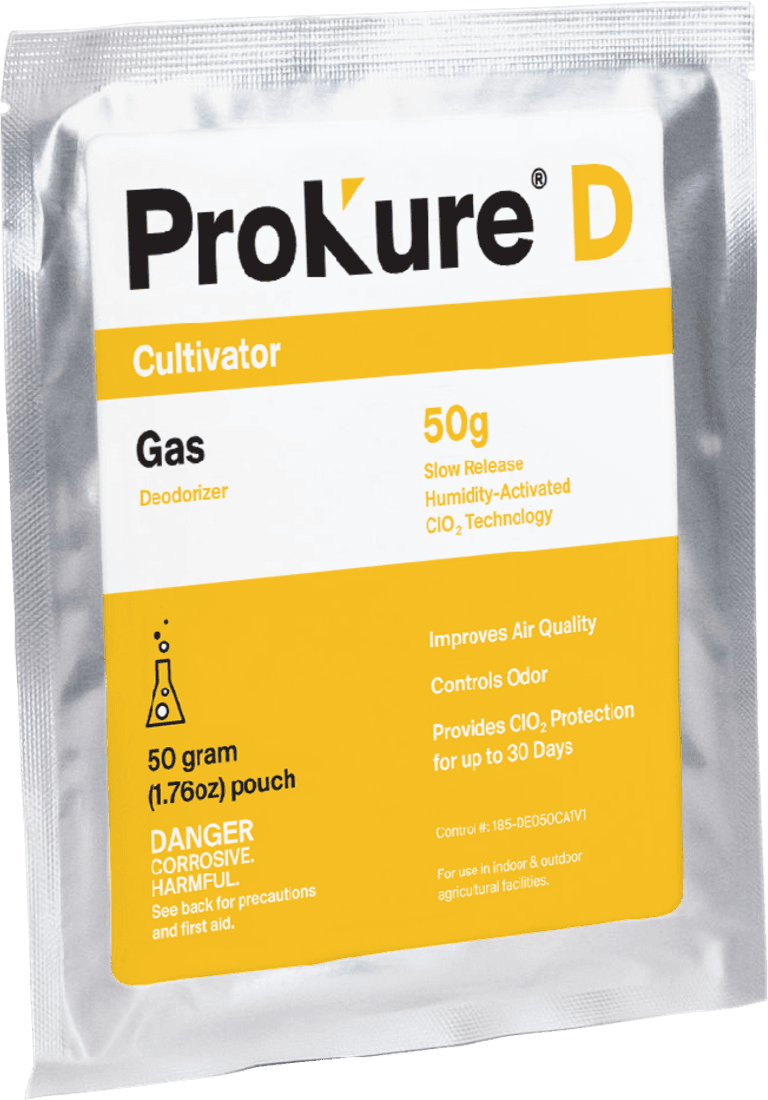
The ProKure D greenhouse application question is really a fit question: a greenhouse is a different air-quality problem than a sealed indoor room. D is a humidity-activated slow-release gas that improves air quality and controls odor, providing ClO2 protection for up to 30 days per pouch, and it runs with plants and crew in the structure. The catch is the environment: relative humidity swinging from 40 percent on a bright afternoon to 90 percent-plus overnight, ridge and sidewall vents cycling, and evaporative cooling moving air. Those conditions change when and where you deploy. One thing they do not change: ProKure D is not an EPA-registered product and not labeled for sale as a pesticide under 40 CFR.
Why a greenhouse is not a sealed room
If you have only run ProKure D in a closed indoor room, a greenhouse will not behave the same way, and that surprises people. Start with humidity, because D is humidity-activated: the pouch releases ClO2 in response to moisture in the air. A sealed room holds a tight RH band. A greenhouse does not. Daytime sun load and active ventilation can pull RH down toward 40 percent, while a closed night house with transpiring canopy can push it past 90 percent. That swing means the release is not perfectly even across a 24-hour cycle, so you plan placement and timing around the humid windows rather than assuming a flat curve.
The second difference is air exchange. A greenhouse under active ventilation can turn over its entire air volume many times an hour, and open ridge vents send a gas straight out the top. The competitor product copy only goes as far as saying that fans, air movers, and closed circulation systems can improve performance. True for a closed room, and incomplete for an open structure, because in a greenhouse the same fans under open vents can carry the ClO2 out before it does its air-quality work. The deployment section below is about getting the gas to stay long enough to matter.
The third difference is load. Sun-driven transpiration, dense summer canopy, and damp media raise the odor and volatile load a greenhouse carries, which is exactly the load D is positioned to manage on the air side.
What ProKure D is, and what it is not
Say the limit first, because it is the biggest worry for a compliance-minded operator. ProKure D is "Not an EPA-registered product and not labeled for sale as a pesticide under 40 CFR." That is not a loophole to explain away, it is the product's classification. D is positioned for odor control and air quality. It is not a pesticide, not a fungicide, not a sanitizer, not a disinfectant, and it makes no mold-kill or antimicrobial claim. If you need a kill claim, that is a different ProKure product on a different label. Do not log D as a pesticide application, and do not expect it to clear an active infection.
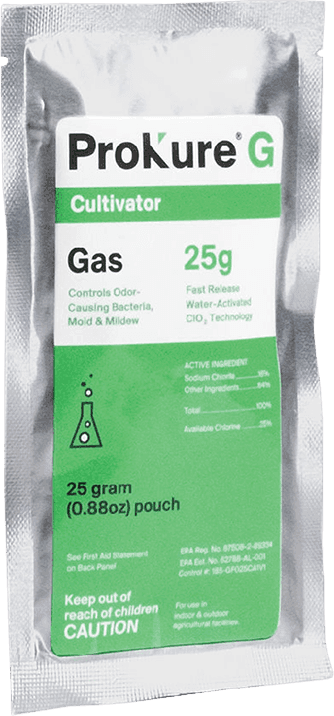
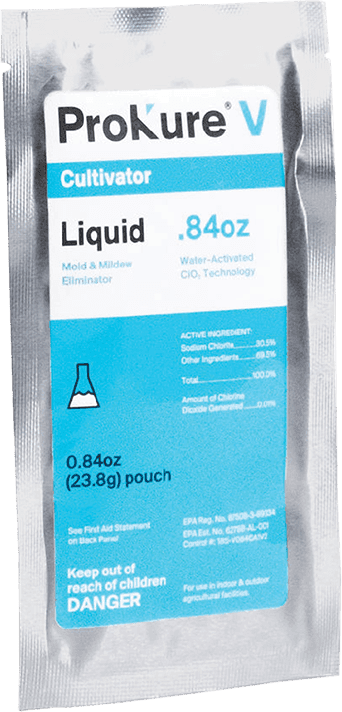
What D is, said in the manufacturer's own terms: a humidity-activated slow-release gas that provides ClO2 protection for up to 30 days per pouch. Keep the "up to" on it, because that window is a maximum and greenhouse humidity can move the real figure. Where D sits in the system matters for a greenhouse operator planning a full protocol. ProKure V is the EPA-registered liquid disinfectant for hard, non-porous surfaces like benches, tools, and reservoirs. ProKure G is the fast-release gas for an empty-room reset between cycles, and it carries its own restriction, Not for use with/on plants/crops/feed, for empty-structure use only. D is the in-crop air-quality layer that runs while the plants are in the house. Keep each product on its own claim and its own label.
Deploying ProKure D in a greenhouse
Placement follows the physics. ClO2 gas is heavier than air, and the retailer body confirms the practical rule: ClO2 gas is heavier than air, so place units at a high point so the gas distributes downward through the canopy zone you are protecting. In a gutter-connected house, that means pouches at height, spaced down the aisles so coverage is even rather than concentrated at one end. For a room larger than a single pouch's coverage, space multiple pouches equally apart.
Timing is where a greenhouse earns its own instructions. Because D is humidity-activated and open vents carry gas out, deploy into the humid, low-ventilation windows: the night cycle, or a closed-vent period, when RH is up and air exchange is down. That is when a slow-release gas has the dwell to do its air-quality work. If your house runs hard daytime ventilation with ridge vents wide open, do not expect the same behavior you would get in a closed room; lean on the night window and on gentle internal circulation that moves the gas through dead-air pockets without exhausting it. Log each deployment: the date installed, the pouch size, the house or zone, the replace-by date, and the operator. Replace each pouch before its up-to-30-day window closes so coverage does not lapse. That log is also your audit trail.
Sizing ProKure D for a greenhouse footprint
Match pouch count to cubic feet, and greenhouse cubic footage adds up fast because of the peak height. The coverage figures are: a 10g pouch treats up to about 1,000 cubic feet, a 50g up to 4,000, and a 95g up to 8,000. Measure length by width by average height (account for the gutter and peak, not just sidewall height). A 30 by 96 gutter-connected house at roughly a 12-foot average height is about 34,560 cubic feet, which pencils to nine 50g pouches spaced down the aisles, each on its own replace-by date. A small 20 by 50 hoop at 8 feet is about 8,000 cubic feet, or one 95g or two 50g pouches.
The cost math a greenhouse buyer actually wants is cents per cubic foot per day, not dollars per case. Using a captured retailer figure, a 50g case of 12 listed at $440.01 on Hydrobuilder works out to about $36.67 per pouch, and one 50g pouch covers 4,000 cubic feet for its up-to-30-day window. That is roughly three hundredths of a cent per cubic foot per day. Set that against a crop loss and the air-quality layer reads as cheap insurance, not an expense.
How D fits a full greenhouse protocol
D is one layer, not the whole sanitation program, and the layers do different jobs. Between cycles, when the house is emptied, the fast-release reset is a ProKure G job for the empty structure. Surfaces (benches, tools, reservoirs, tables) are a ProKure V job, because V is the EPA-registered liquid disinfectant for hard, non-porous surfaces and is suitable for use with plants in the room. D is the in-crop air-quality maintenance that runs on an up-to-30-day cadence while the canopy is in the house. The retailer copy makes the penetration case for the gas form plainly: ProKure D gas vapors can creep into cracks and crevices that other liquid applications cannot, which is the argument for a gas over a wipe when the target is air and hard-to-reach volume rather than a surface.
What to tell your compliance auditor
The honest framing protects you. ProKure D is documented as an air-quality and odor-control product, so your deployment log reads as air-quality maintenance, not pest control. Do not represent D as a kill-claim product to an auditor, because its label does not support that, and the mismatch is what creates exposure. The disclaimer belongs in your file verbatim: "Not an EPA-registered product and not labeled for sale as a pesticide under 40 CFR." Keep the product label and SDS on hand from prokuresolutions.com, and note that ClO2 use in cultivation can carry state-by-state nuances worth confirming with your own regulator. Where you need an EPA-registered chemistry for a specific claim, that routes to ProKure V for surface work, not to D.
When you are ready to size and order pouches for your houses, that lives on shop.groclarity.com, and a GroClarity contact can build a greenhouse-specific deployment plan across multiple structures or sites. Always read product labels before use.
Related resources