
Sizing air quality for a small grow room means matching four variables to the room's cubic feet: moisture removal (dehumidifier pints per 24 hours), air exchange (ventilation CFM), temperature (BTU or HVAC), and air disinfection (ClO2 gas coverage by volume). Most guides size the first three and skip the fourth. For a room at or under 1,000 cubic feet, the entry fit is the 10g ProKure D slow-release gas, which is rated to roughly 1,000 cubic feet. The whole method is simple: measure length by width by height to get your volume, then size each layer to that one number. This page walks all four, in order.
What air quality sizing actually means for a small grow room
The searcher here is diagnostic and pre-purchase. They want a cubic-foot-to-product map, not a philosophy of ventilation. There are four variables you are sizing: moisture, air exchange, temperature, and disinfection. The industry does a good job on the first three. The dehumidifiercorp.com guide, for instance, names the stakes directly, that "Molds such as powdery mildew could ruin your entire harvest," and then sizes a dehumidifier to fight the humidity that feeds that mold. What it never does, and what no ranking page does, is size the air disinfection layer that actually knocks the microbial load down. That is the gap this page fills.
The 1,000 cubic foot line is the cutoff for calling a room small. It is also the ProKure D 10g coverage line, which is why a single-room operator searching this query is, whether they know it yet or not, searching for the entry-point SKU.
Step 1: measure your room in cubic feet
Length times width times height. The height is the number people forget, and it is the one that changes a dehumidifier and a disinfection calculation the most. A 4x4 tent at 6.5 feet of usable height is about 104 cubic feet. An 8x8 closet grow at 8 feet is about 512 cubic feet. A 10x10 room at an 8-foot ceiling is 800 cubic feet, right at the edge of the small-room tier. Write that cubic-foot number down; every step below reads from it.
Step 2: size your dehumidifier in pints per 24 hours
Moisture is a plant-count problem. Plants transpire roughly 97 percent of the water you give them, so your daily watering volume is a close proxy for the moisture you have to pull back out. Convert gallons in to pints out (eight pints per gallon, and about one pound of moisture per pint), then add for conditions. The standard adders are straightforward: add pints for a humid climate, for human occupancy in the room, and for a space with multiple doors or windows. Size the dehumidifier to the total, not to the room footprint alone.
Step 3: size your ventilation in CFM and air changes per minute
Ventilation is sized to volume, and the baseline most growers use is one full air change per minute. As the dutch-passion.blog guide puts it, "Many growers aim to replace the air in their grow room once every minute," and it treats that as a floor, with two to three exchanges per minute for hot rooms or HPS lighting. In CFM terms, a 100 cubic foot space wants an extraction fan of at least 100 CFM, scaled up two to three times for heat. Run the intake slightly smaller than the exhaust to hold the room at slight negative pressure so odors and spores do not push out through gaps.
Step 4: size your air disinfection by cubic foot
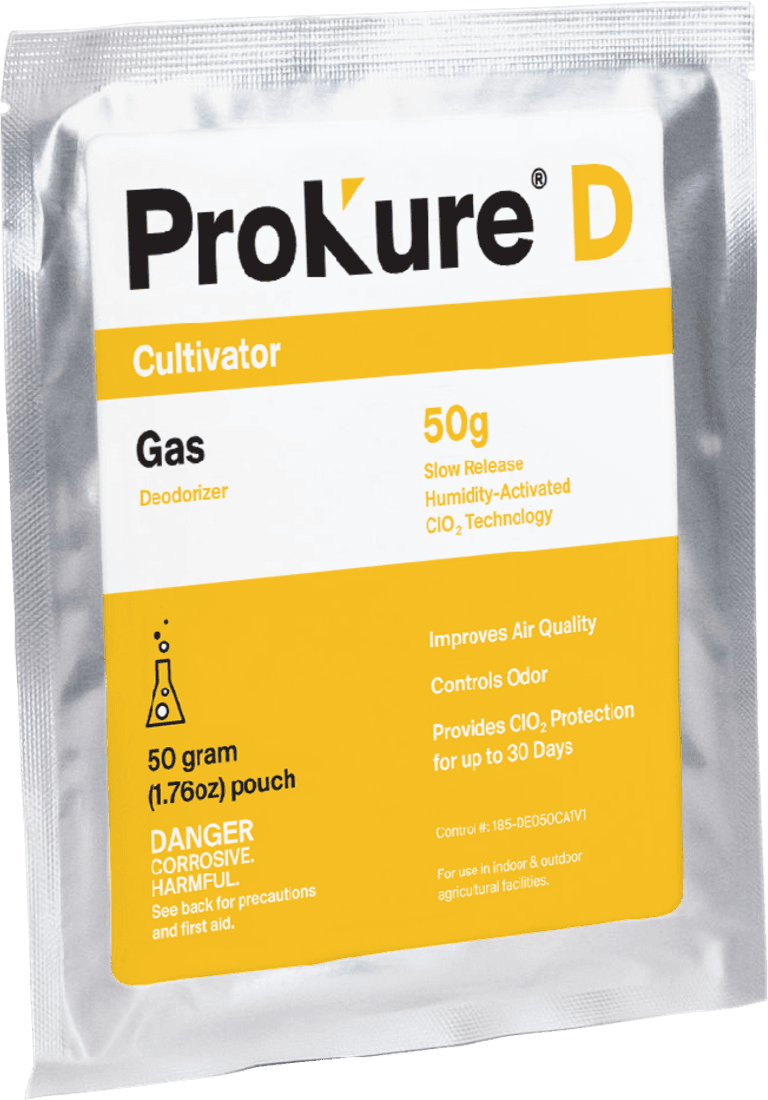
Here is the step the top-ranked pages never take. Dehumidifiers, fans, and AC units all get sized to the room; air disinfection almost never does, because the common tools (bleach, quats) are surface applications that cannot be sized to air volume at all. Chlorine dioxide gas can, because it fills a space by volume. The 10g ProKure D slow-release gas is rated to roughly 1,000 cubic feet, which covers every room you measured in Step 1. ProKure D provides ClO2 protection for up to 30 days and runs in the room while plants are present, so it is the in-cycle air-quality layer for a small grow.
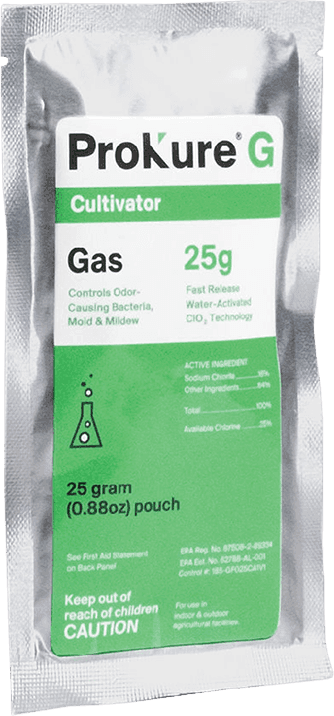
A compliance note belongs right here. ProKure D is not an EPA-registered product and not labeled for sale as a pesticide under 40 CFR, so it is an air-quality and odor layer, never a mold-kill claim on the plant. That is a different product from the empty-room, fast-reset gas. If you are resetting an unoccupied room between cycles, that job uses ProKure G, which is EPA-registered (EPA Reg. No. 87508-2-89334) and whose label states, verbatim, Not for use with/on plants/crops/feed. Keep the two straight: D runs with plants for ongoing air quality, G runs in an empty room for a fast reset. New to chlorine dioxide? Read grow-room air quality management before the sizing math.
Step 5: turnover sizing vs continuous production sizing
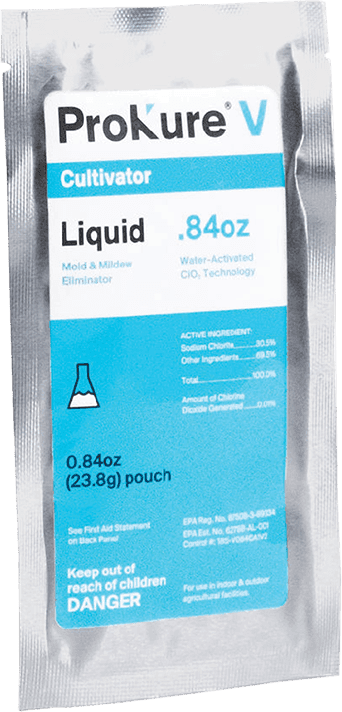
The sizing changes with the job. For continuous production with plants in the room, the ProKure D 10g is the in-cycle air-quality layer at the 1,000 cubic foot line. For a between-cycle turnover, the room is empty, and the job is surface disinfection plus a fast air reset. Surfaces are where ProKure V earns its place: it is a liquid surface disinfectant (EPA Reg. No. 87508-3-89334) for hard, non-porous surfaces at 100 ppm with a 10-minute exposure, it leaves no residue, and it is suitable for use with plants in the room because it touches surfaces only, never the crop. Bleach and quats leave residue that touches your next crop and cannot be sized to air volume at all. For the full downtime workflow, see the between-cycle mold prevention protocols.
Compliance and documentation
Air quality sizing has a downstream consequence most sizing guides ignore: a state pre-sale yeast and mold test on a mature crop. Undersize the air layer and a humid small room drives Total Yeast and Mold counts up by harvest. Size it correctly and keep the record. An auditor-ready log captures date, room, product, EPA registration number where it applies, concentration, dwell time, and the post-treatment reading. For a small operator, that log is the difference between a defensible prevention program and a story.
When your room is bigger than 1,000 ft3
If your measured volume runs past 1,000 cubic feet, the 10g ProKure D is no longer the fit. Step up to the larger ProKure D tiers (the 50g covers about 4,000 cubic feet and the 95g about 8,000), and for empty-room resets at scale look at ProKure G fast-release gas. Multi-room operators standardizing across a footprint should treat sizing as a per-room spec rolled up to a facility plan. The products and current labels live on prokuresolutions.com, and the 10g ProKure D SKU reorders through shop.groclarity.com. If you want a sized plan for your exact dimensions, request a quote and talk to a real person who understands cannabis cultivation.
Related resources