
ProKure V is the right ClO2 product for cannabis surface disinfection, and the wrong one for anything you spray on the plant. It is an EPA-registered liquid disinfectant (EPA Reg. 87508-3-89334) for hard, non-porous surfaces: walls, floors, benches, trays, and tools during between-cycle room turnover. Mixed to 100 ppm and held for 10 minutes, it is an effective fungicide against Aspergillus niger, and it leaves no residue. The label line that decides everything: ProKure V is for surfaces only, not for use directly on plants, crops, or feed. For air quality with plants in the room, that is ProKure D. For an empty-room gas reset, that is ProKure G.
ProKure V for Cannabis: When to Use the Liquid ClO2 Disinfectant in Your Grow
What ProKure V is, in a cannabis operator's terms
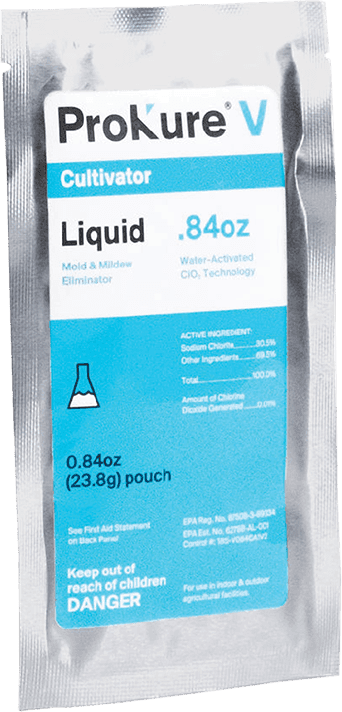
ProKure V is the liquid member of the ProKure ClO2 line. In the reseller's own words, "ProKure V liquid is an EPA-registered, hospital-type disinfectant. It is used to eliminate bacteria, viruses, mold and mildew on hard" non-porous surfaces. It ships as a dry pouch you activate in water. You do not buy it as a ready-to-spray bottle; you mix it to a target concentration, let it reach full strength, and apply it to surfaces.
For a grow, that means V is your between-cycle surface tool. It is not an air product and it is not a plant treatment. Keep that frame and the rest of the page falls into place.
The EPA restriction, up front
The single most important thing about ProKure V for a cannabis operator is what it is not cleared to do. The reseller pages sell it without saying this. The manufacturer FAQ says it plainly, and so will we.
Hard, non-porous surfaces only
ProKure V is approved for hard, non-porous surfaces: sealed walls and floors, metal and plastic benches, trays, drain covers, light fixtures, and tools. Porous surfaces (bare wood, fabric, unsealed concrete) are not the target. The 10-minute contact time at 100 ppm assumes a surface that holds the solution wet, not one that soaks it up.
Not for use directly on plants, crops, or feed
From the manufacturer FAQ, verbatim: "Can ProKure V be used directly on plants? No, ProKure V is approved to use on hard, non-porous surfaces." Do not spray it on a canopy, on cuttings, or into feed or media. This is the Q40 compliance line, and it is also a FIFRA line: using an EPA-registered product in a manner inconsistent with its label is a federal violation.
If you need something you can run with plants in the room
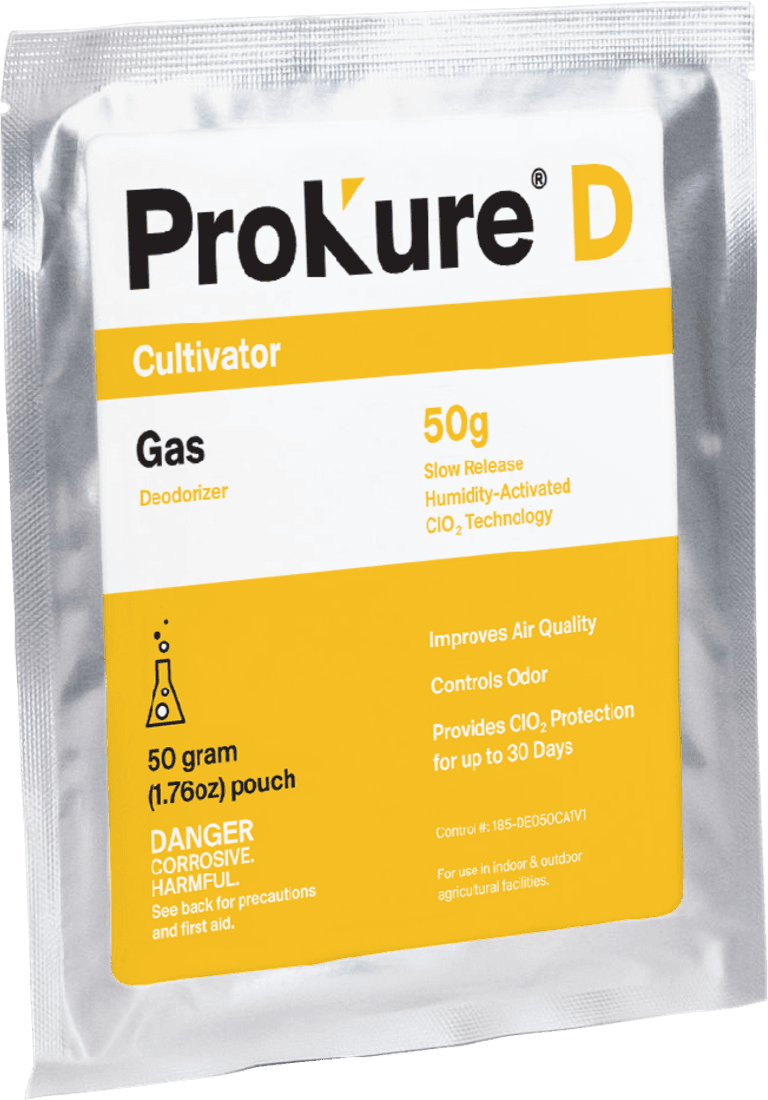
Then you do not need V, you need D. ProKure D is the slow-release ClO2 gas that improves air quality and runs with plants present for up to 30 days. See when to use ProKure D with plants in the room. V is the surface half of the system; D is the air half.
Where ProKure V fits in a cannabis cultivation workflow
V earns its place at specific points in the cycle, not everywhere.
Between-cycle room turnover
This is V's home. After harvest and strip-out, with the room empty, you wet-wipe or spray walls, floors, benches, trays, and tools with ProKure V at 100 ppm, hold the 10-minute contact time, and let the surfaces dry. That pass drives down the microbial load the last crop left behind before the next one goes in.
Post-harvest surface and tool sanitation
Shears, totes, trim tables, and dry-room racks all carry inoculum between harvests. V disinfects them as hard, non-porous surfaces at the same 100 ppm, 10-minute spec. Dedicate a mix for tool dips and refresh it when it looks soiled.
Where V does not fit
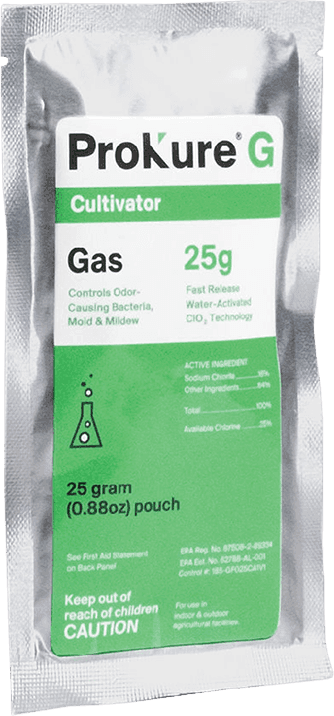
Two jobs are not V's. In-canopy air quality while plants grow is a ProKure D job, the slow-release gas built to run with the crop in the room. A whole-room empty-house gas reset is a ProKure G job, the fast-release gas, 2,250 cubic feet per 25-gram pouch, with no plants present. Reach for the right SKU and V stays in its lane.
Dosing and contact time for cannabis room surfaces
The number to anchor on is 100 ppm for 10 minutes. The manufacturer publishes the efficacy anchor directly: "When used with an exposure time of 10 minutes at 100 ppm, ProKure V is an effective fungicide against Aspergillus Niger."
Pouch sizes and what each one makes
ProKure V comes in pouches sized to a finished disinfectant volume, each at 100 ppm: the 0.042 oz pouch makes 32 ounces (one quart), the 0.17 oz pouch makes 1 gallon, the 0.84 oz pouch makes 5 gallons, and the 3.36 oz pouch makes 20 gallons. Match the pouch to the surface area of your turnover: a small multi-room turnover usually fits the 5-gallon (0.84 oz) size.
Activate, wait, then apply
Add the inner pouch to an opaque container with the correct water volume and let the solution reach full strength before use (the liquid needs its activation hour, agitated at intervals, to hit 100 ppm). Apply to visible wetness, hold the 10-minute contact time, and do not shortcut it.
Verify ppm with ClO2 test strips
You cannot eyeball 100 ppm. Use high-range ClO2 test strips to confirm the mix is at concentration before you start the clock. Logging the verified ppm and the contact time is what turns a cleaning pass into an audit record.
Why residue-free matters for cannabis operations
The ProKure homepage lists "Leaves no residue" as a bullet and never explains it. For cannabis, it is the whole point.
The bleach and quat problem
Bleach and quaternary ammonium disinfectants leave a residue that has to be rinsed and that carries phytotoxicity risk for the next crop. That means an extra rinse step, crew time, and the chance of a residue reaction on sensitive cuttings. It is an operational cost, not just a chemistry note.
What residue-free means at re-entry
ProKure V leaves no hazardous residue on treated hard surfaces when used per label, so once surfaces are dry you can move to the next step without a decontamination rinse. For a facility manager fighting a three-to-five-day turnover window, removing a rinse step is real time back.
ProKure V vs G vs D for cannabis: the short decision
One line each. For the full matrix, see the V vs G vs D decision guide.
V, G, and D, side by side
V is the liquid for hard, non-porous surfaces, no plants in the room, 100 ppm for 10 minutes. G is the fast-release gas for an empty-room fumigation reset, no plants in the room, 2,250 cubic feet per 25-gram pouch, four to six hours. D is the slow-release gas for air quality with plants in the room, 4,000 cubic feet per 50-gram pouch, up to 30 days. If the job is a surface, it is V. If the job is an empty room's air, it is G. If the job is an occupied room's air, it is D. For the gas-side pages, see use ProKure G for room fumigation and use ProKure D when plants are in the room.
State compliance context
The reason a cannabis operator buys V at all is the test at the end of the cycle.
Pre-sale yeast and mold thresholds vary by state
Most licensed markets run a pre-sale total yeast and mold test, and the pass/fail limit varies by state. A surface disinfection pass between cycles lowers the microbial load the next crop inherits, which is upstream of that test. V does not test your flower; it reduces the pressure that makes flower fail.
Documentation for audits
Keep the ProKure V EPA label and SDS on file for audit, available from prokuresolutions.com, and log each disinfection pass with the verified ppm, contact time, room ID, and operator. That record is your proof the surface-sanitation step happened the way your SOP says it does.
What ProKure V costs, and FAQ
Pricing moves, so the live number lives on the store, not here.
Reseller MSRP and where to buy
Captured reseller MSRP for the pouches: 0.042 oz (32 oz) at $27.55, 0.17 oz (1 gallon) at $28.55, 0.84 oz (5 gallons) at $39.95, and 3.36 oz (20 gallons) at $105.95. Because the pouch price maps to a finished-gallon volume, the real figure to budget is cost per gallon of 100 ppm disinfectant for your turnover. For live pricing and to order, go to shop.groclarity.com; for the label, SKU sheet, and SDS, see prokuresolutions.com, or call GroClarity at 866.206.1301. Built on Science. Backed by Results.
Related resources