
How to Deep Clean a Flower Room with ProKure G Between Cycles
The short version: ProKure G is a fast-release chlorine dioxide gas you run after the flower room is empty, never with a crop in it, because the label reads not for use with/on plants/crops/feed. For a between-cycle deep clean you clear the plants and debris, pre-clean the surfaces, size packets to room volume at one 25 gram packet per 2,250 cubic feet, activate in a central location, hold the 4 to 6 hour dwell with the lights off, then ventilate for one hour before re-entry and write the treatment down. This page is the room-turnover job map, done by end of shift and defensible to a QA auditor.
What ProKure G is, and why it fits the between-cycle deep clean
You are turning a flower room between harvests and you want to know if ProKure G is the right tool for the deep clean. It is, with one condition that decides everything else on this page: the room has to be empty of plants. Get that straight first and the rest is procedure.
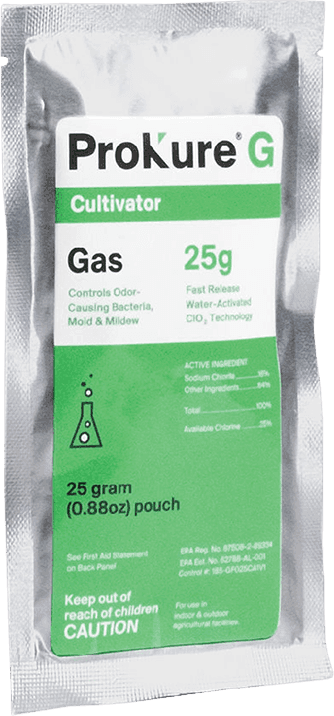
ProKure G is an EPA-registered fast-release ClO2 gas, approved language: the solution to mold and mildew, odor-causing bacteria, and chemical odors, delivered as a deep-penetrating ClO2 vapor. It works in 4 to 6 hours. Chlorine dioxide is a true gas, so it fills the whole room and reaches the cracks, drain lines, and corners a sprayer never touches. That whole-room fill is exactly what a between-cycle reset needs, and it is why G earns the deep-clean job over a wipe-down.
The "not for use with/on plants/crops/feed" line, in plain terms
The product label carries this restriction verbatim: Not for use with/on plants/crops/feed. In a flower room that is not legal fine print to skim. It is the operating rule. It means the room must be empty of living plants, with no plant material present: no drying flower, no trim piles, no seedlings, no clones, nothing green or harvested in the space while G is activated. People and pets out too. The ProKure FAQ states it the same way, the fast gas is for unoccupied spaces, no people or plants during treatment. If you have a crop in the room, G is the wrong product and you stop here.
Why this is a between-harvests treatment, not a live-canopy treatment
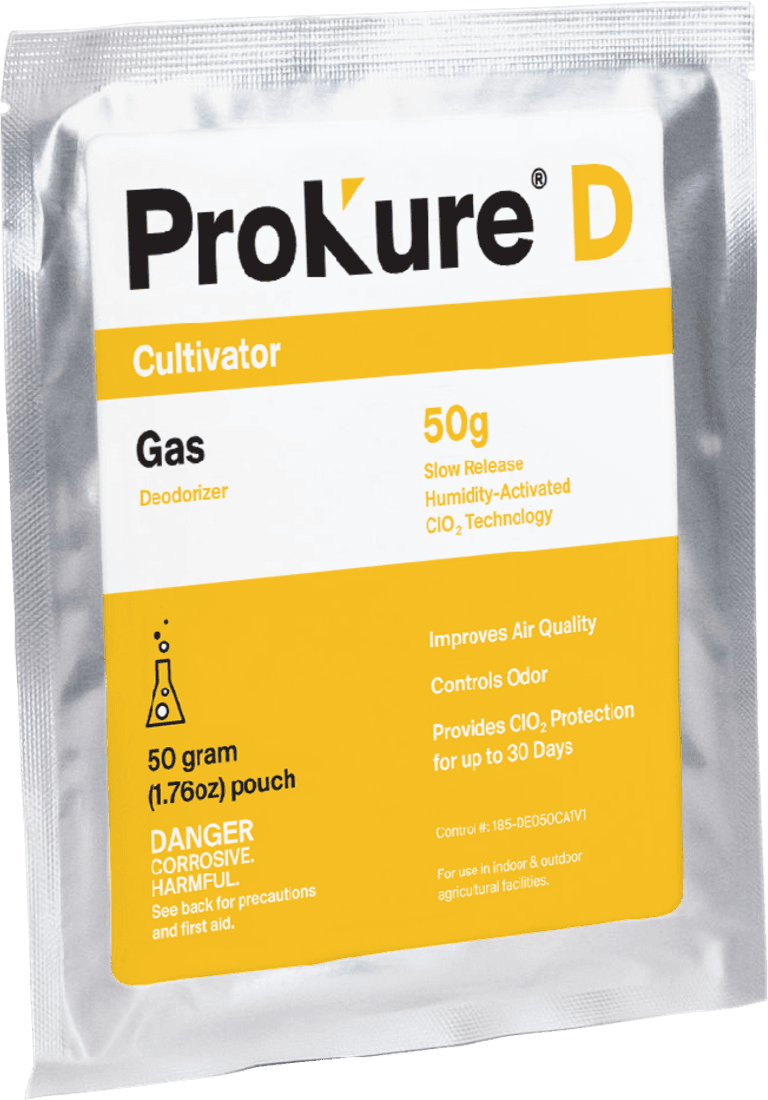
Think of the flower cycle as having two different air jobs. During the grow, with plants in the room, air quality is a maintenance problem you solve with ProKure D, the slow-release gas that provides up to 30 days of ClO2 protection while the canopy is present. Between grows, with the room empty, you have a reset problem: knock the accumulated mold, mildew, and odor load down fast before the next crop goes in. That reset is the ProKure G job. G is the fast knock-down in an empty room. D is the steady maintenance with plants present. Pointing G at a live canopy is not a judgment call, it is off-label, so the between-harvest window is the only window G belongs in.
Before you activate: the flower room pre-treatment checklist
A deep clean that fails usually failed before activation. The gas did its job, the room was not ready for it. Run this checklist in order, because each step changes what the ClO2 has to work against.
Plants and plant material removed
This is the compliance-critical step, so it is first. Every plant out. Every piece of plant material out: fallen leaf litter, popcorn trim, stray buds, the bag of larf someone left on the bench. Bag it and remove it from the room. The label restriction is absolute, and an auditor who sees plant material logged in the room during a G treatment has a finding. Empty means empty.
Physical debris cleared
ClO2 gas penetrates, but it is not a substitute for a shop vac. Pull the leaf litter, soil spills, and dust off the floor and surfaces. Organic debris is oxidizer demand: the more biomass sitting in the room, the more of the gas gets spent on the debris instead of the mold and odor you are targeting. A clean room lets the dose you calculated actually land on the problem.
Surface pre-clean with ProKure V
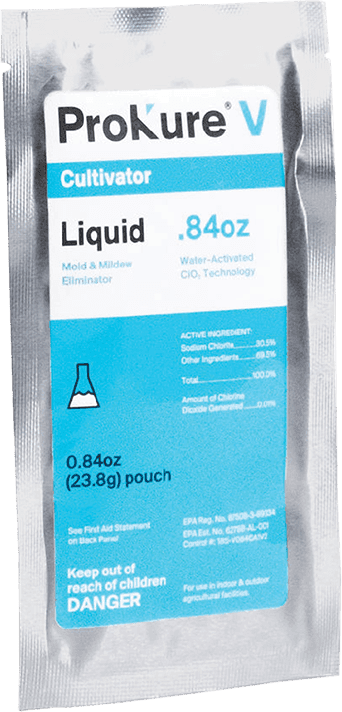
Gas treats the air and reaches surfaces, but visibly soiled benches, trays, and drain pans want a liquid surface pass first. ProKure V is the sibling for that: a liquid hospital-type disinfectant for hard, non-porous surfaces, applied by sprayer, mop, or sponge, that leaves no residue. Do the surface disinfection with V, let it work its 10 minute dwell at 100 ppm, and you have knocked the surface load down before G handles the air and the hard-to-reach spaces. The two products split the work, surfaces to V, whole-room air to G.
HVAC set to recirculate, exhausts closed
You want the gas to stay in the room and circulate, not get pulled out the exhaust. If the ventilation system serves only this room, set it to recirculate so it moves the gas around. If it is shared, turn it off and close the ducts. Cover the smoke detectors. The goal is a sealed box the ClO2 can fill evenly.
Air movers positioned for even distribution
ClO2 distributes well on its own, but a sealed flower room with racking and benches has dead corners. Position your existing air movers to keep the room turning over so the gas reaches every surface and void. Hydrobuilder's own helpful hints for the product say to use air movers to increase circulation, which is the same instruction. Even distribution is the difference between a treated room and a room with a treated center and untreated corners.
How many packets do you need? Flower room coverage math
Here is where every top-ranking page quits. The product listings give you the raw coverage number and a reusable cup and leave the arithmetic to you. ProKure's own product page stops at the line "Coverage: 2,250 ft3 / Pair with: Reusable Gas Dispersion Cup" with no translation into a real room. Cultivators do that conversion wrong constantly, so let us do it correctly.
The two SKUs and their coverage
ProKure G ships in two sizes. The 10 gram packet covers approximately 1,000 cubic feet. The 25 gram packet covers approximately 2,250 cubic feet. Those are the verbatim ProKure coverage specs. Pick the SKU that divides your room most cleanly, then round up on packet count so no corner is under-dosed.
How to measure the room
Length times width times height gives you the cubic footage. Measure to the actual ceiling, not the canopy line, because the gas fills the whole volume. Do not subtract for racking: size to the full air space.
Sample rooms table
Four common flower rooms, worked end to end at the 25 gram SKU (2,250 cubic feet each). A 10 by 10 by 10 room is 1,000 cubic feet, so one 10 gram packet covers it. A 20 by 20 by 10 room is 4,000 cubic feet, so two 25 gram packets (4,500 cubic feet of coverage) do the job. A 30 by 40 by 12 room is 14,400 cubic feet, which needs seven 25 gram packets (15,750 cubic feet of coverage). A 40 by 60 by 14 room is 33,600 cubic feet, which needs fifteen 25 gram packets (33,750 cubic feet). When the room lands between packet counts, round up. Under-dosing the air volume is the one place you do not want to save a packet.
Multi-room flower deployments and packet staging
For a facility turning several flower rooms on a schedule, the planning unit is packets per room per turnover. Size each room once, then stage packets per room so turnover night does not stall on a count. A row of four 14,400 cubic foot rooms needs twenty-eight 25 gram packets staged to deep-clean the whole flower wing in one pass. That staged count is also what feeds your reorder cadence so procurement is never short on turnover day.
The deep clean SOP, step by step
This is the short-version activation and run. The bare mechanical activation SOP lives on its own page; here it is placed in the context of the full flower-room turnover.
Activation mirrors the ProKure label exactly. Tear open the foil packet, remove the white inner pouch, and do not open the white inner pouch. Place the end of the white pouch that has the square indentations into a plastic cup filled with 1.5 inches of water. The cup is reusable for future treatments.
Placement matters for an even fill. Set the cup on a stable, level surface in a central location. For a large flower room, distribute multiple packets equally across the floor rather than clustering them. Keep activated units at least two feet from fabrics, leathers, electronics, mirrors, and uncoated metals, which is the published placement guidance. Then turn the lights off: ClO2 works best in the dark, and light degrades the gas.
Dwell is 4 to 6 hours per the label, or overnight. Leave the room sealed and the air movers running for the full window. Do not shortcut the dwell to reclaim the room faster, because the kill and knock-down happen over those hours, not in the first thirty minutes.
When the dwell is done, ventilate and turn the lights on for one full hour before re-entry. That one-hour ventilation before re-entry is a label instruction, not a suggestion. Chlorine dioxide gas irritates the respiratory tract, so nobody goes back in until the room has cleared. If odors reappear after re-entry, the label says repeat the treatment.
Re-entry, validation, and the data trail your auditor wants
Running the treatment is half the job. Proving it worked is the other half, and it is the half the incumbents skip entirely. For a facility manager defending a turnover to ownership, and for the head grower facing a pre-sale mold and yeast test, the data trail is the deliverable.
Air testing before and after
Pull a mold spore count before you treat and another after re-entry. The delta is your evidence the deep clean moved the number, not just your confidence that it did. Baseline plus post-treatment sampling turns "we ran ProKure G" into "we took the room from X to Y spore count," which is the language an auditor and an owner both understand.
Surface validation
For surface confidence, ATP swabs on the benches, trays, and tools give you a quick post-clean read. Pair that with the air count and you have both halves of the room documented, air and surface.
Treatment log template
The record is what survives the turnover. Log every treatment with: room ID, packet SKU and count, water-cup placement, activation timestamp, re-entry timestamp, operator initials, and the pre and post air-test results. Use the caution placard enclosed with the product to record treatment and safe re-entry time on the door, which is the published practice, and transcribe those times into the log. A room-by-room treatment log is the paper trail that holds up when a state inspector asks how you control mold between cycles.
EPA compliance: what you need to know before you use ProKure G
EPA compliance is the worry that keeps cultivation leads up at night, so it belongs on the page in plain language, not buried at the bottom as a disclaimer.
The federal-law language, verbatim
The governing line is verbatim: This material is not a replacement for the product label. It is a violation of Federal Law to use EPA registered products in a manner inconsistent with the product labeling. Read the entire product label and use strictly in accordance with precautionary statements and use. ProKure G is EPA-registered, which is what lets it carry its kill-and-control claims, and that registration is exactly why the label restrictions, empty room, no plants, 4 to 6 hour dwell, one-hour ventilation, are not optional.
SDS and EPA label at hand
Keep the ProKure G Safety Data Sheet and the current EPA product label where the crew and an auditor can reach them, not three clicks deep. Pull both from the ProKure Solutions product pages, which are the authoritative source for the label and SDS PDFs. Having them one click away is a small thing that reads as a well-run facility during an inspection.
State-by-state shipping restrictions
Supply chain has a compliance wrinkle too. ProKure G cannot ship to every state, retailers disclose that it cannot be shipped to California, so if you run a multi-state footprint, verify availability per state before you build the SKU into a standard turnover SOP. Confirm current shipping eligibility with the retailer and the state regulator rather than assuming a product that stocks in one state stocks in all of them.
ProKure G vs ProKure V vs ProKure D: the decision matrix
Every competitor page is selling one product. None of them tells you honestly when their product is the wrong one. That omission is the opening. Hydrobuilder opens its pitch with "As a cultivator, maintaining a consistent grow environment is critical" and then sells the gas, without ever mapping the room scenarios where a different ProKure product is the right call. The honest map is the whole ProKure system, and it routes by job.
ProKure G
Fast-release gas. Empty rooms only. The between-cycle deep clean and the acute odor event. Works in 4 to 6 hours. This is the reset.
ProKure V
Liquid hospital-type disinfectant for hard, non-porous surfaces. Suitable for use with plants in the room, applied by sprayer, mop, or sponge, and leaves no residue. This is the surface work, and it is the product with the EPA-registered kill claims, including an effective fungicide against Aspergillus Niger at 100 ppm for 10 minutes. If you have an active contamination event or a surface to disinfect near a crop, V is the answer, not G.
ProKure D
Slow-release gas that provides up to 30 days of ClO2 protection. Runs with plants in the room as the year-round, low-level air-quality and odor layer. This is maintenance during the grow, the opposite job from G's fast empty-room reset. D is not EPA-registered and carries no kill claims: it is an air-quality and deodorizer product, and its label reads not an EPA-registered product and not labeled for sale as a pesticide under 40 CFR.
When to combine
A full turnover uses two of them in sequence: V to disinfect the surfaces, then G to deep-clean the empty room's air and voids. Then, once the next crop is in, D maintains the air across the grow. Surface, reset, maintain, three products, three jobs, one system.
Cost per turnover: the prevention math for owners, and what growers report
For an owner, prevention reads as a cost line until you put it next to what it prevents. So put the two numbers side by side.
A 30 by 40 by 12 flower room (14,400 cubic feet) takes roughly seven 25 gram packets for a deep clean. At the case level, a 12-pack of ProKure G 25 gram runs about $336 per the retailer listing, which is about $28 per packet, so one flower-room turnover is in the neighborhood of $196 in product. Confirm current pricing with the retailer, since case pricing moves. Against that sits the downtime the facility manager loses to a slow bleach-and-air-out turnover (3 to 5 days per cycle) and, worse, the six-figure value of a mature crop that fails a pre-sale mold test. ProKure frames the same math through its chief science officer, that ProKure costs .05% of a total crop loss. Prevention at a couple hundred dollars a room against a six-figure crop is insurance, not overhead.
The contrast with the old workflow is the other half of the owner's math. Bleach fogging forces crew evacuation and leaves residue. Quat foggers leave residue on surfaces and impose re-entry delays. ProKure G is a ClO2 vapor that, per the retailer description, controls odor-causing bacteria, mold, and mildew without generating hazardous residues, and on non-porous surfaces it does not demand a rinse step the way a residue chemistry does. Faster, cleaner turnover is more harvests per year from the same room.
Growers running the product report the same thing in plainer words. One cultivation customer, Thomas at Good Day Farm, reported mold levels down 98% after the first cleaning. Another, Kyler G. at MedMen, described it as easy to use and leaving no harmful residue, the two properties that matter most when a crop is going back into the room in days. Those are the operators this protocol is written for.
If you are standardizing a between-cycle flower-room SOP across one room or a multi-state footprint, that is the point to bring in a GroClarity specialist who can size the dose to your actual room dimensions and set up the air-test and treatment-log workflow your auditors will accept.
Related resources