
ProKure G for Cure Room Reset: Between-Cycle Turnover Protocol
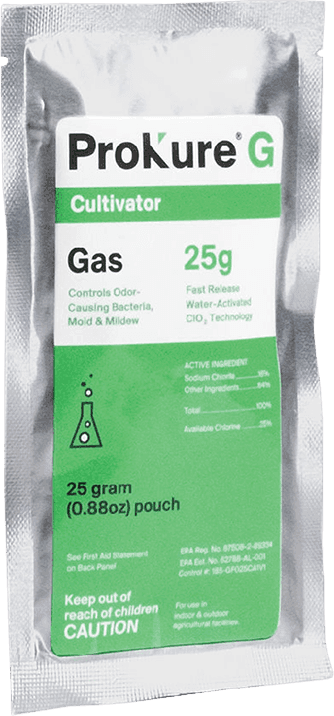
A ProKure G cure room reset is a between-cycle, empty-room turnover: you pull the product, pre-clean and surface-disinfect, then run ProKure G as a fast-release ClO2 gas to knock down odor-causing bacteria, mold, and mildew before the next batch goes in. Size the packet to the room (10g covers 1,000 cubic feet, 25g covers 2,250), activate it in a central spot, allow at least 4 to 6 hours, then ventilate and restore lights for one hour before re-entry. ProKure G runs in unoccupied spaces only, so the cure room must be empty of product and people.
The searcher who types this already knows the product. What they do not have is a protocol for the cure room specifically, and the pages ranking for it do not provide one: they are generic ProKure G product copy and activation steps that never say the words "cure room." A cure room is its own problem. It is small, often 500 to 2,000 cubic feet, it is packed with post-harvest product during operation, and it resets on a tight window, commonly 24 to 72 hours between batches. This page is the cure-room version of the reset, with the coverage math, the turnover scheduling, the HVAC call, and the EPA label rules in one place. If you are actually turning a flower room, that is the flower-room reset page; if your room still holds wet biomass on racks, that is drying, not curing, and the dry-room reset page covers it.
What a cure room reset means, and what it is not
Three post-harvest rooms get confused, so pin the scope first. A flower room is the largest class and the highest gas volume, reset between flowering cycles. A dry room holds wet biomass hanging on lines and racks, and its reset fights biofilm on those lines. A cure room holds jarred or bucked flower with moisture already stabilized, and it resets between cure cycles. Those are different jobs with different surfaces, and running the flower-room playbook in a cure room wastes gas on the wrong volume.
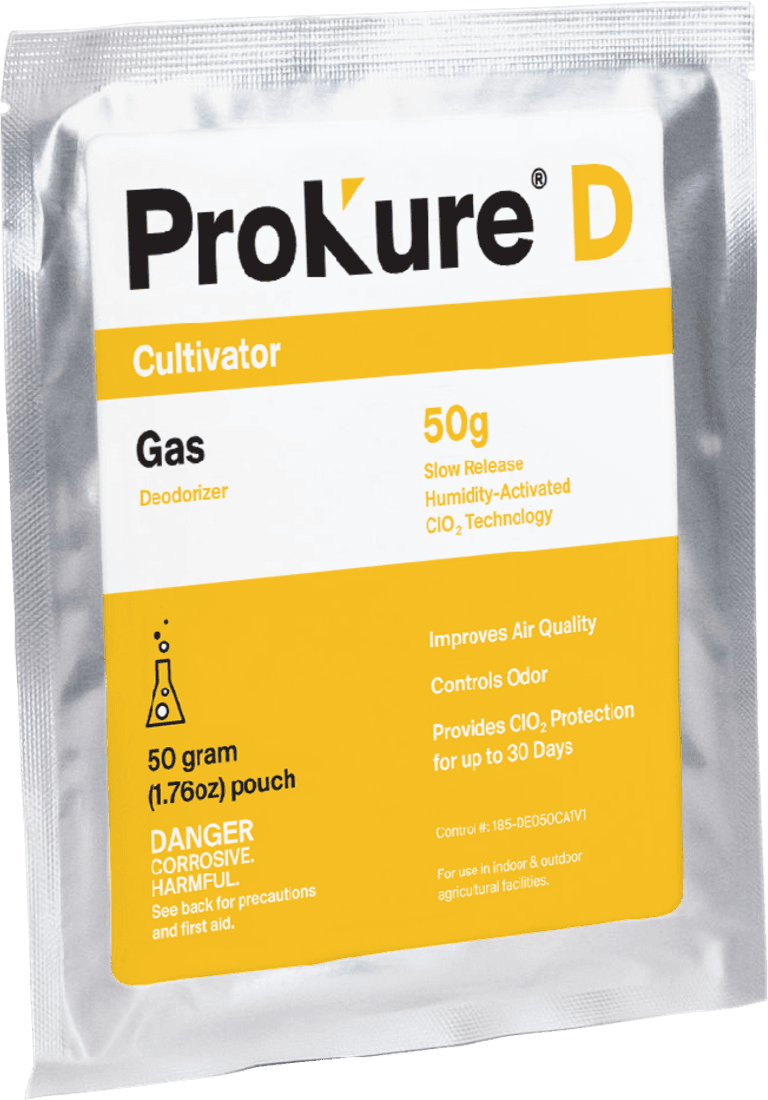
The second distinction is event versus ongoing. A reset is an event: a discrete, empty-room treatment you run in the turnover window. Ongoing air quality while product is in the room is a different product entirely. ProKure D is the extended-release SKU for that, and it runs with product in the room between reset events. Keep the two mentally separate: G is the reset, D is the maintenance. The rest of this page is the reset.
Here is the hard line that governs the whole protocol. ProKure G runs in unoccupied spaces only. The brand's own FAQ states it plainly, that the fast gas is for unoccupied spaces, no people or plants in the space during treatment, and because a cure room holds finished product that cannot be re-treated before packaging, the room has to be fully cleared of product too, not just people. If you are trying to treat a space with product still in it, that is the wrong tool and the wrong page, and the answer is a surface disinfectant like ProKure V used on hard surfaces, not a gas reset.
Why cure rooms carry more cross-batch risk than operators expect
A cure room looks clean. That is the trap. The room spent the last two to six weeks full of flower off-gassing terpenes and shedding resin dust onto every porous surface in it, and those surfaces hold a history a wipe-down does not reach. Wood shelving, burlap, cardboard, humidor gaskets, and the micro-texture of the room itself all bank residue, and residue plus the humidity a cure room is deliberately held at is a reservoir for the next batch's yeast and mold load.
Spores do not respect the gap between batches. A between-batch reservoir on a shelf or in a gasket seeds the incoming product the moment it arrives, and the incoming product is post-harvest, which means you cannot re-treat it before it goes to packaging. That is the structural reason cure-room cross-batch risk runs higher than flower-room risk: in flower you still have grow cycles to recover, but a cure room failure lands on finished goods one step from sale.
The cost makes it concrete. A failed post-cure yeast and mold test on a mature, six-figure harvest is a write-off, not a yield trim, and for a head grower that single number justifies a reset program many times over. The point of the cure room reset is to break the reservoir between every batch so the incoming product starts against a clean surface, and gas does that where a wipe cannot, because ClO2 vapor reaches the cracks, gaskets, and porous material a cloth skips. For the broader prevention context, the mold prevention protocols page carries the IPM frame this reset sits inside.
Does ProKure G fit the cure room reset, and the V-G-D decision
ProKure G is a fast-release gas Deodorizing Delivery System, EPA Reg. No. 87508-2-89334, and its approved frame is exact: the solution for mold and mildew, odor-causing bacteria, and chemical odors, delivered as deep-penetrating ClO2 vapor that works in 4 to 6 hours. That is a strong fit for an empty cure room between batches, because the job is knocking down odor and surface mold and mildew across porous material fast, inside a tight window. It carries the verbatim label restriction "Not for use with/on plants/crops/feed," and always read product labels before use.
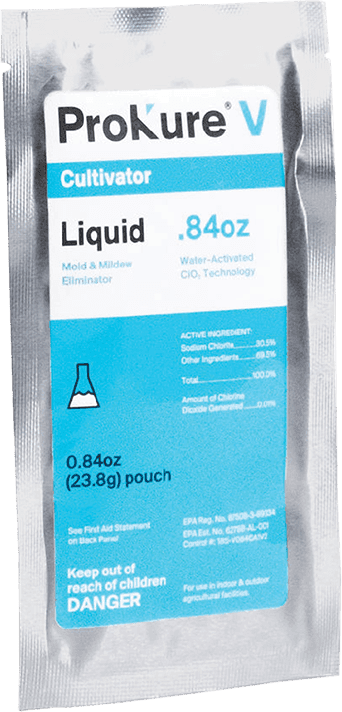
The V-G-D decision is where operators misorder, so run it clean. Use ProKure V, the liquid Hospital-Type Disinfectant (EPA Reg. No. 87508-3-89334), for the hard-surface disinfection step, because V is suitable for use with plants in the room, leaves no residue, and carries a labeled kill list for a 10-minute, 100 ppm surface pass. Use ProKure G, the fast gas, for the empty-room vapor reset that reaches porous surfaces a liquid cannot, in an unoccupied room only. Use ProKure D, the slow-release gas, for ongoing air quality between resets while product is in the room; D provides ClO2 protection for up to 30 days and can be used while plants are in the room. In a cure room, a thorough turnover often uses two of the three: a V surface pass front-loaded, then a G gas reset, with D handling the air between batches.
The residue question
Operators worry about residue on surfaces that touch finished flower, and it is a fair worry. The brand's own customers speak to it: one testimonial notes the product is "easy to use and does not leave any harmful residue, making it a great choice for facilities who prioritize both efficiency and safety." For a cure room, where the next thing on the shelf is product headed to packaging, a reset chemistry that clears without a harmful residue is exactly the property you want, which is why the V-plus-G sequence beats a bleach turnover that leaves a film and a smell.
Cure room coverage math: which SKU for which room
No ranking page publishes the cure-room coverage table, so here it is. ProKure G ships in two cultivator SKUs: the 10g packet covers approximately 1,000 cubic feet, and the 25g packet covers approximately 2,250 cubic feet. A cure room typically runs 500 to 2,000 cubic feet, which puts most cure rooms inside a single-packet treatment.
Work it by room volume at a 10-foot ceiling. A small cure room at 500 cubic feet (roughly 10 by 5 by 10) is covered by a single 10g packet with headroom. A 1,000-cubic-foot cure room (10 by 10 by 10) is the exact rating of the 10g packet. A larger cure room at 2,000 cubic feet (20 by 10 by 10) sits just inside the 25g packet's 2,250-cubic-foot rating, so one 25g does it. For a cure room above 2,250 cubic feet, you do not reach for a bigger single packet; you place multiple packets spaced equally apart so the gas distributes evenly, and an air mover helps it reach the corners. The read-across is simple: match the packet rating to the room volume, round up to the next packet, and for anything over 2,250 cubic feet, multiply packets rather than overcrowd one.
The cure room reset protocol, step by step
Run the reset in order. Each step has a reason, and skipping one is where a reset fails quietly.
First, clear and pre-clean. Remove all finished product, jars, bags, Boveda packs, hygrometers, and any loose material, because G runs unoccupied and because gas does not clean organic debris. Then surface-disinfect the hard, non-porous surfaces, shelving hardware, tables, and tools, with ProKure V at its labeled 10-minute, 100 ppm pass, so the gas step is not fighting a surface load it was never meant to carry. Front-loading the V surface pass is what lets the G gas do its actual job on the porous material.
Second, make the HVAC call, which is the single most important operational decision in a post-harvest reset and the one buried in the generic FAQ. The rule: if the ventilation system serves only the space being treated, turn on the air conditioning or ventilation to circulate the gas; if the duct is shared with other post-harvest spaces, turn the system off and close the ducts so you do not push ClO2 into an occupied adjacent room. Many cure rooms share ductwork with a dry room, so this is not a rare case; for a shared-duct facility, the HVAC duct treatment page covers the dedicated-duct deodorization path.
Third, place the activated product correctly. ClO2 gas is heavier than air, so activate ProKure G in a high, central location, no closer than 18 to 24 inches from fabrics, leather, electronics, mirrors, metals, or plated surfaces, which in a cure room means keep it clear of hygrometers, metal shelving brackets, and any mirror or plated fixture. A fan or air mover increases circulation and distributes the gas through the confined space. Then activate: tear open the foil package, remove the white inner pouch (do not open the white inner pouch), place the end with the square indentations into a reusable cup filled with 1.5 inches of water, set it on a stable, level surface in a central location, and turn off the lights.
Fourth, hold the window and re-enter safely. Allow at least 4 to 6 hours for the system to work, or leave it overnight. Then ventilate and turn on the lights for one hour before re-entry, using the caution placards included with the product to mark the treatment and safe re-entry times. Repeat treatment if odors reappear. That 4-to-6-hour treatment plus 1-hour ventilation is the whole clock you are scheduling around.
Fitting the reset inside a 24 to 72 hour turnover window
The practical question the searcher actually has is whether the reset fits the gap between batches, and it does, with room to spare, if you sequence it. The treatment itself is 4 to 6 hours plus a 1-hour ventilation, so the active ClO2 clock is well under a day.
A 24-hour reset looks like this. Hours 0 to 2: clear the room and run the ProKure V surface pass on hard surfaces, holding the 10-minute contact time per surface. Hours 2 to 3: dry, set the HVAC per the shared-or-dedicated rule, and place and activate the G packet. Hours 3 to 9: the 4-to-6-hour G treatment runs with the room sealed and dark. Hours 9 to 10: ventilate and restore lights. That leaves the rest of the day for a verification check and reload, comfortably inside 24 hours.
A 48-hour window lets you front-load the V surface sanitation more thoroughly on day one, including a second pass on the highest-risk porous surfaces, then run the G reset overnight and verify on day two before the next batch arrives. The sequencing discipline that matters most is adjacent rooms: because G demands an unoccupied space and a one-hour ventilation before re-entry, stagger resets so a crew working one cure room is never adjacent to a room mid-treatment on shared air. If the duct is shared, treat one room at a time with the duct closed, not both at once.
Verify the reset, and keep the audit trail
A reset you cannot prove worked is a reset ownership does not trust, and the facility manager's standing pain is exactly that: no visible data proving the sanitation actually worked. Close that gap before you load the next batch. A visual and olfactory check is the floor: the room should be free of visible residue and the chemical-odor and musty notes the reset targeted. The stronger proof is a surface check, an ATP swab on the shelving and contact surfaces or a contact plate, read against the clean baseline you should have taken, so the number says the surface load dropped rather than your nose saying it smells better.
Then build the audit trail. Log each reset event with the product name, EPA registration number, packet size and count, placement, treatment start and end times, ventilation time, operator, and the verification reading. That record is what a state inspector or a third-party auditor asks to see, and in a cure room it is the documentation that ties a clean post-cure test back to a sanitation event rather than to luck. Keep it where it maps to your seed-to-sale and compliance records. For the program-level documentation pattern, cultivation IPM expertise carries the SOP structure this log fits into.
EPA label rules, between-reset air quality, and the next step
The compliance rules for ProKure G are not a copyedit afterthought; they govern how you run it. It is a violation of Federal Law to use EPA registered products in a manner inconsistent with the product labeling, so read the entire product label and use strictly in accordance with the precautionary statements. ProKure G is for unoccupied spaces, people and pets must not be in the area during treatment, and PPE is not required precisely because the space is unoccupied, though chlorine dioxide gas can irritate the respiratory tract if the product is not used in strict accordance with the label. Use the caution placards to mark treatment and safe re-entry times and ventilate for one hour before re-entry.
Between reset events, the cure room is a strong fit for ProKure D. D improves air quality, provides 30 days of ClO2 protection, and controls ongoing nuisance odors, and it can be used while plants are in the room. It is not an EPA-registered product and not labeled for sale as a pesticide under 40 CFR, and it makes no kill claim; it is the passive air-quality layer that holds the room between the active G resets. A cure room, with its long occupied dwell and its odor load, is prime D territory.
Educate here on groclarity.com, order the ClO2 line on shop.groclarity.com, and pull the ProKure G product label, SKU sheet, and SDS for your audit binder from prokuresolutions.com. To standardize a cure room reset across multiple rooms or a multi-state footprint, reach GroClarity at 866.206.1301 or request a quote. Built on science, backed by results.
Related resources