
ProKure D for Small Grows: Which SKU Fits a Single-Room Facility
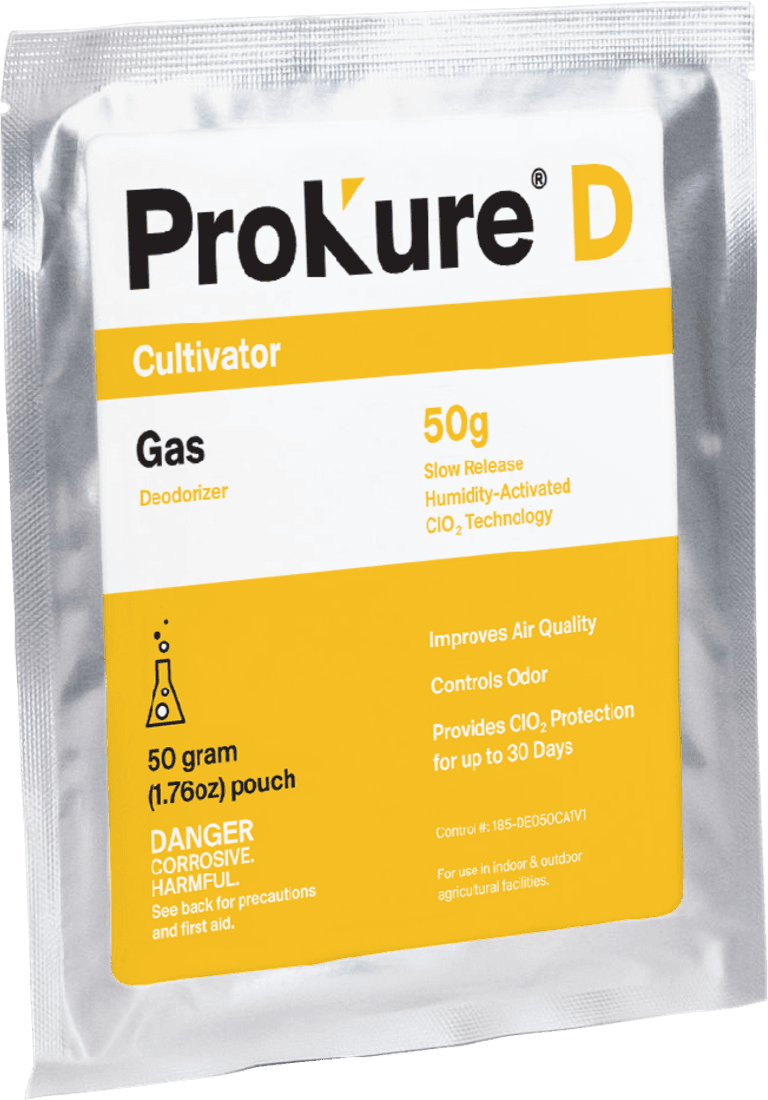
For a single-room or small multi-room grow, the right ProKure D is the one that matches your room volume in cubic feet. A 10 gram pouch covers approximately 1,000 cubic feet, which fits a 10 by 10 room with standard ceilings. A 50 gram pouch covers approximately 4,000 cubic feet, enough for a small multi-room setup or one large flower room. ProKure D is a slow-release chlorine dioxide gas that improves air quality and controls odors and provides ClO2 protection for up to 30 days, and it runs with plants in the room. You do not need the 95 gram or a case meant for a warehouse.
You run one or two rooms. You searched "ProKure D small grow" because every product page you opened sells the same three sizes in a case of 12 with no answer to the only question you have: does this fit my room, and am I buying too much. The ranking pages do not answer it. One of the top results leads with a 50 gram case priced for a commercial buyer, which is the wrong starting point for a 10 by 10 flower room. This page gives you the sizing math, the SKU decision, the 30-day replacement cadence, and the EPA scope note, written for an operator running 1,000 to 4,000 cubic feet.
What counts as a "small grow" for ProKure D sizing
ProKure D sells in three pouch sizes, and coverage is stated in cubic feet, not square feet. That distinction is where small operators lose the plot. The 10 gram pouch covers approximately 1,000 cubic feet. The 50 gram pouch covers approximately 4,000 cubic feet. The 95 gram pouch covers approximately 8,000 cubic feet. For sizing, "small grow" means roughly 1,000 to 4,000 cubic feet of treated space, which covers most single-room and small multi-room operators.
Translate your room into cubic feet first
Measure length times width times height. A 10 by 10 room with an 8 foot ceiling is 800 cubic feet, inside the 10 gram coverage. A 10 by 20 room at 8 feet is 1,600 cubic feet, past a single 10 gram pouch and into 50 gram territory. A 20 by 20 room at 8 feet is 3,200 cubic feet, still inside the 50 gram coverage of 4,000 cubic feet. A 15 by 25 room at 10 feet is 3,750 cubic feet, near the top of the 50 gram range. Height matters as much as floor area; a tall room eats coverage fast, so measure it, do not estimate from the footprint.
Where small ends and commercial begins
If your treated space runs past 4,000 cubic feet, you are into 95 gram or multi-pouch planning, and the economics shift toward case buying and standardized deployment. That is a different page. If you are scaling toward a multi-room or multi-facility footprint, see our guidance for multi-state and multi-facility cannabis operators, where the 95 gram and procurement standardization live. This page stays with the operator who runs one to three rooms and wants to buy exactly what those rooms need.
10g vs 50g: which ProKure D SKU fits your room
Two sizes cover almost every small grow. The decision is coverage headroom, not price.
The 10 gram pouch: one small room
The 10 gram pouch covers approximately 1,000 cubic feet. It is the right call for a single room at or under that volume, a 10 by 10 flower room, a small veg tent, a clone area, or a modest dry and cure space. One pouch, one room, up to 30 days of protection, then replace. For most single-room operators this is the starter SKU, and it is the one this page routes you to.
The 50 gram pouch: small multi-room or one large room
The 50 gram pouch covers approximately 4,000 cubic feet. Reach for it when you run a 10 by 20 or 20 by 20 room, or when you want one pouch to hold a small multi-room block rather than placing several 10 gram pouches. It is the efficient choice once a room passes roughly 1,000 cubic feet.
When a room sits between sizes
A 1,200 cubic foot room is 20 percent over the 10 gram coverage. You have two honest options: run a single 10 gram pouch and accept that the far corners sit at the edge of effective coverage, or step to the 50 gram for full coverage with headroom. For a room you care about, the 50 gram is the safer call, because undersizing is the quiet failure mode where the gas disperses but never reaches an effective level across the whole volume and you blame the product. When a room is larger than a single pouch covers, use multiple pouches placed equally apart for even distribution. To match your exact room against pouch coverage, start with the ProKure D slow-release gas product details and its coverage grid.
Skip the 95 gram for a small grow
The 95 gram pouch covers approximately 8,000 cubic feet. Unless you run a single very large room, it is more than a small grow needs, and buying it means paying for coverage you will not use. Leave it for the commercial footprint.
What ProKure D does (and does not) do in a small grow
ProKure D is a humidity-activated, slow-release chlorine dioxide gas. It emits very low, trace levels of ClO2 through a humidity-activated delivery system, and those trace levels provide odor control and ongoing ClO2 protection for up to 30 days. The gas can reach cracks and crevices that a liquid spray cannot, because as a true gas it fills the volume of the room evenly. That is the whole job: improve air quality and control odors, slowly, over a long window, with plants in the room.
The scope of the claim, stated plainly
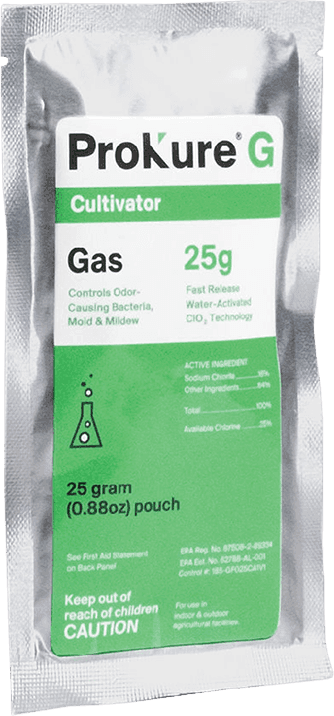
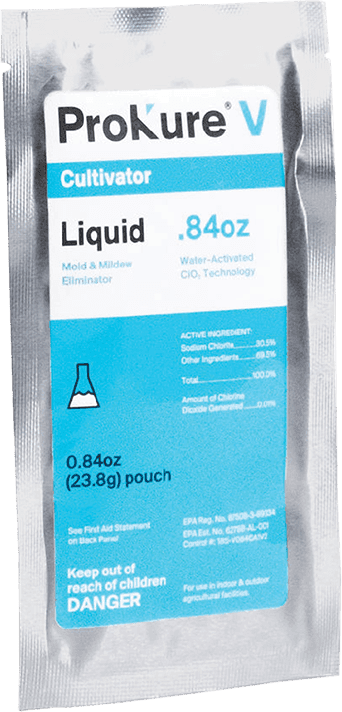
Here is the part the shopping pages bury in a footnote. ProKure D is not an EPA-registered product and is not labeled for sale as a pesticide under 40 CFR. That is not a flaw; it is the scope. ProKure D is an air-quality and odor-control product. It does not carry pesticidal or kill claims. If you need registered disinfectant or fungicidal action, that scope belongs to the other two products in the line: ProKure V, the EPA-registered liquid disinfectant for hard surfaces, and ProKure G, the EPA-registered fast-release gas for between-harvest resets in an empty room. GroClarity treats that EPA scope as part of how the page is written, not a disclaimer bolted on at the end, because an operator who mixes up what D is scoped to is the operator who gets a compliance surprise at audit time.
Occupancy and plants
ProKure D runs with plants in the room, which is exactly why a small grower reaches for it: slow trace release that holds air quality across a live cycle. That is the opposite of the fast-release gas, which runs only in an empty, unoccupied room. If you are weighing during-cycle protection against a between-cycle reset, the fast-release versus slow-release decision is its own topic and we cover it in the ProKure G fast-release gas overview. Always read the product label before use and follow it exactly; the label governs coverage, placement, and directions.
Replacement cadence and planning for a small grow
ProKure D protects for up to 30 days per pouch, so a small grow running continuous protection is really planning a monthly replacement, not a one-time buy. One room on continuous coverage is roughly 12 pouches a year. Two rooms on continuous coverage is roughly 24 pouches a year. A case of 12, then, is about a year of protection for one room, or about six months for two rooms. Keep the "up to 30 days" qualifier in your own planning: humidity drives the release, so a drier room may run closer to the top of the window and a very humid room may run shorter. Track the activation date on each pouch and replace before the window closes, the same way you would track any consumable in the room.
The round-number math above comes straight from the 30-day protection window on the label applied to continuous monthly replacement; it is arithmetic, not a marketing figure. We do not publish retailer sticker prices here because they vary by seller and change often; for current pricing, go to the store, where the single-room starter case is listed with live pricing.
Deploying ProKure D in a small room
The setup is simple, and a few placement details decide whether a small room gets even coverage.
Placement
Chlorine dioxide gas is heavier than air, so place units at a high point in the room per the manufacturer's own guidance. From a high point the gas settles and fills the volume evenly instead of pooling where you set it down. Keep the pouch clear of anything you do not want oxidizer vapor sitting against, and give it a central position so coverage reaches the corners.
Air movement
Fans, air movers, and closed circulation systems improve performance by distributing the gas, which matters more in an irregular or partitioned small room than in an open box. If you already run circulation for climate control, you are most of the way there.
Prep the surfaces first
ProKure D handles the air, not the grime on your benches. For best results, disinfect the space before treatment with the liquid line. ProKure V is a hospital-type disinfectant you can use with plants in the room, applied to hard, non-porous surfaces, residue-free, and it is the surface half of a clean room. Our guidance on the ProKure V liquid disinfectant for surface work covers that step. Surfaces first, then let D hold the air.
When a small grow should step up or switch products
ProKure D is prevention and maintenance, slow and steady. It is not the tool for every job.
Step up a size when your treated volume passes 4,000 cubic feet; that is 95 gram or multi-pouch planning, and if you are growing into a multi-room or multi-facility operation, the multi-state and multi-facility operator guidance is the better home for that decision. Switch products when the problem is active rather than preventive: a between-harvest reset of an empty room is the fast-release gas, and hard-surface disinfection is the liquid. ProKure D holds the air during the grow; the other two do the heavier, registered work around it. Knowing which of the three a job calls for is most of what keeps a small grow both clean and compliant.
Where to buy ProKure D for a small grow
For a single-room operator, the starter is the 10 gram case. It gives you about a year of continuous protection for one room, and it is the SKU this page points you to rather than the commercial 50 gram or 95 gram cases that dominate the search results. Buy it from the store, shop.groclarity.com, which is where ordering and reordering happen. For the deep product detail, label, SDS, and documentation your records need, those live on prokuresolutions.com, one click away when you need them at audit time. GroClarity educates the fit; the store ships the product. Measure the room in cubic feet, match it to the 10 gram or 50 gram pouch, plan a monthly replacement, and start with the single-room case.
Frequently asked questions
These are the questions small-grow operators ask most. If one of yours is not here, ask us.
Related resources