
Grow Room Air Quality for Multi-Room Facilities: Sizing, Turnover, and Cross-Contamination Protocol
Running 2 to 8 flower rooms changes the air-quality problem from a single-room question into a facility-design question. A multi-room program has to size treatment per room by cubic feet, sequence decontamination so a mold event in one room does not seed the next, and produce a data trail an auditor can follow. Map ProKure D to room volume (50g covers up to 4,000 cubic feet, 95g up to 8,000), run a residue-free ClO2 reset between cycles instead of a multi-day bleach stall, and isolate airflow room to room. Educate here, buy on shop.groclarity.com, pull labels and SDS from prokuresolutions.com.
If you run one flower room, a single-room protocol is a better fit and the sizing is simpler, so start with the single-room tier instead. If you operate across state lines, the harder problem is state-by-state EPA and cannabis regulatory variance, which the multi-state operator tier covers directly. This page is for the operator in between: you have outgrown one room, you are not yet standardizing an SOP across a multi-state footprint, and you need an air-quality program that scales across rooms in one building without rooms cross-contaminating each other.
What "multi-room" changes about your air quality program
The ranking pages for this query treat "grow room" as a single generic box. Every one of the top results is written as if you have one room, size one system, and you are done. That assumption breaks the moment you have three or more rooms sharing a building, a crew, and usually an HVAC trunk.
The incumbent content makes the gap obvious. The HVAC vendors ranking here pitch hardware: one page describes itself as "UVGI and PCO technology designed to fight mold, mildew, and airborne contaminants in grow operations." That is a box bolted into a duct. It does nothing about the room you just harvested, the surfaces the last crop touched, or the way a spore load travels from the room that failed its test to the room that was clean yesterday. A troubleshooting guide from another filtration vendor frames the entire subject as filtration and upkeep: "This guide covers everything growers need to know about optimizing air quality, from filtration system setup to humidity control and ongoing maintenance." Filtration and maintenance are real, but they are the steady-state picture. They are not a between-cycle decontamination program, and they are not a multi-room one.
Shared HVAC, shared risk
Most mid-market facilities were not purpose-built room by room. They grew into the space, and the air handling grew with them, which usually means rooms share ductwork, a return plenum, or at minimum a common corridor. Shared air is shared risk. A mold event that starts in Room 3 does not stay in Room 3 if Room 3's return feeds the same trunk as Rooms 1, 2, and 4.
This is the question no ranking page answers, and the one every multi-room operator actually asks: if one room molds, do they all mold? The honest answer is that shared HVAC makes it far more likely, and the fix is a combination of airflow isolation and a decontamination protocol that treats the air and the hard-to-reach voids, not just the surfaces a crew can wipe. Filtration slows airborne spread. It does not reset a room.
Staggered harvest schedules and decontamination windows
A single room has one turnover window. A multi-room facility has a rolling schedule, with rooms coming down on different days so the dry rooms, trim crew, and sales calendar stay fed. That rolling schedule is an advantage for decontamination if you plan it and a liability if you do not.
Planned, it means you always have an empty room to reset without halting production. You decontaminate the room that just came down while the others keep running. Unplanned, it means a crew walks straight from a room that failed its last mold test into a clean room with the same gloves, the same cart, and the same shoes, carrying the problem by hand. The decontamination window is not just "when is the room empty." It is "when is the room empty and how do we keep the reset we just did from being undone by crew flow."
Why single-room protocols break at 3-plus rooms
A single-room protocol assumes the room is the whole world. Clean it, treat it, re-plant it. At three or more rooms, three things break. Sizing stops being one number and becomes a per-room calculation, because your rooms are rarely the same volume. Sequencing starts to matter, because the order you decontaminate rooms in determines whether you are containing a problem or spreading it. And documentation stops being optional, because a facility at this scale is the size where a state inspector expects a written program, not a grower's memory.
There is also a labor dimension that single-room thinking misses. One room is one person's afternoon. Four to eight rooms on a rolling schedule is a crew moving through the building all week, and the air-quality program has to survive that movement without depending on any one person remembering the right step for the right room on the right day. That is why the multi-room answer leans on written sizing, a fixed sequence, and logged results rather than on individual diligence. The program is designed so a new hire can follow it and so a busy week does not quietly degrade the reset quality.
GroClarity's build-out of the program below is written at least 120% deeper than the deepest ranking page on purpose, because the depth is where the multi-room answer lives. The incumbents are thin here because they sell one box and one guide. A multi-room program is neither.
Sizing air quality treatment by room count and volume
Sizing is the first thing that stops being simple at scale, and it is the first gap in the ranking content. One filtration guide offers a sizing formula, but it sizes airflow only: room volume times air exchanges per hour, divided by 60, to get required CFM. That tells you how much air to move. It tells you nothing about how much decontamination product a room needs, because filtration and chemical room reset are different jobs.
Calculate room volume in cubic feet
Start with the number everything else depends on: cubic feet per room. Length times width times ceiling height. A room that is 20 feet by 40 feet with a 12-foot ceiling is 9,600 cubic feet. A smaller flower room at 15 by 20 by 10 is 3,000 cubic feet. Measure each room, because in a facility that grew room by room, no two are reliably the same, and a sizing number borrowed from the room next door is a guess dressed up as a spec.
Do the math once per room type and write it down. The payoff is that your crew is never recalculating on turnover day, and your SOP carries a real number an auditor can check against the product on the shelf.
Match volume to product coverage
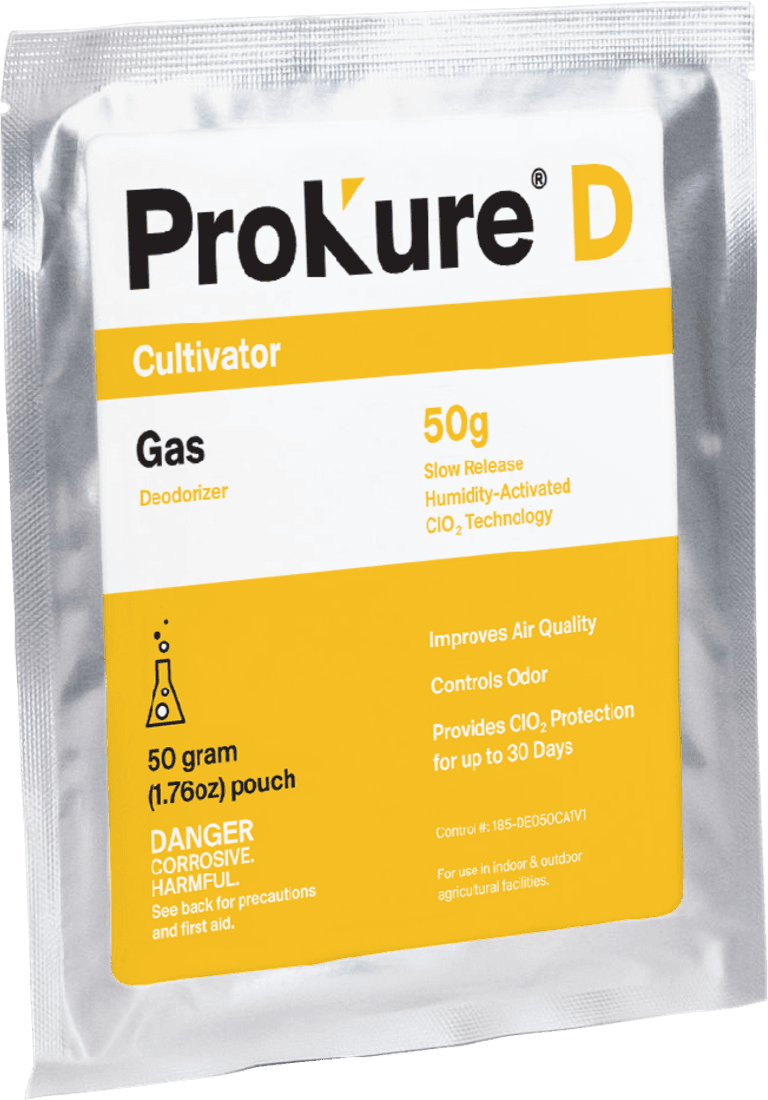
ProKure D is the slow-release ClO2 gas that improves air quality and controls odors, providing ClO2 protection for up to 30 days. Its coverage is published by SKU: the 50g pouch is rated for up to 4,000 cubic feet, and the 95g pouch for up to 8,000. A 10g pouch covers up to roughly 1,000 cubic feet for the smallest spaces. The sizing rule is simple once you have the room volume: pick the SKU whose coverage meets or exceeds the room, and for rooms that fall between sizes, size up rather than down and place units for even distribution.
That 3,000-cubic-foot flower room takes a 50g. The 9,600-cubic-foot room is past a single 95g's 8,000-cubic-foot rating, so it takes a 95g plus a smaller unit, or two units placed for coverage. ProKure D runs with plants in the room across the up-to-30-day window, which is what makes it the ongoing air-quality layer rather than an empty-room-only treatment. Pull the current label and SDS from prokuresolutions.com for each SKU before you build the sizing into an SOP, because the label is the controlling document for use.
Multi-room sizing: 2, 4, 6, and 8 room scenarios
Here is the sizing logic applied across facility tiers, using a representative 4,000-cubic-foot flower room as the unit. Your rooms will vary, so treat this as the method, not your exact bill of materials.
A 2-room facility at roughly 4,000 cubic feet per room runs one ProKure D 50g per room for the ongoing air-quality layer, so two 50g units cover the facility per 30-day window, replaced before each up-to-30-day window closes. A 4-room facility runs four 50g units, or fewer 95g units if rooms run larger toward 8,000 cubic feet. A 6-room facility is where operators start buying by the case and standardizing the per-room SKU so purchasing is predictable. An 8-room facility is at the top of the mid-market tier, and at that point the per-room method is the same, but the quantity and the documentation burden are what justify a written program and account-level pricing rather than one-off orders.
The sizing table belongs on the page as a scannable block so a facility manager can find their room count and read off the SKU plan. It is also the structure most likely to win a snippet, because no ranking page has one.
One more sizing input that trips operators up: coverage is a ceiling, not a target you want to run right up against. A 95g pouch rated for up to 8,000 cubic feet in a room that measures exactly 8,000 cubic feet leaves no margin for a high ceiling, an irregular layout, or dead-air corners behind benches. For rooms near the top of a SKU's rating, plan placement deliberately or step up to the next size, and for long or L-shaped rooms, two smaller units placed for even distribution beat one large unit parked in a corner. The published coverage assumes reasonable distribution of the gas, and in a real flower room full of canopy and equipment, distribution is something you design rather than assume.
Between-cycle turnover: cutting the 3 to 5 day gap
Facility managers lose 3 to 5 days per cycle to turnover, and that downtime is the pain this page exists to solve. Every day a room sits empty is a day it is not producing, and across a multi-room facility the lost days compound.
The bleach and quat problem
The default turnover tool in a lot of facilities is still bleach or a quaternary ammonium cleaner, and both carry costs that do not show up on the invoice. Bleach leaves a sodium-salt residue that has to be rinsed, corrodes stainless and HVAC components over time, and off-gasses fumes that force the crew out of the room during application and for a window after. Quats leave a persistent residue with their own food-contact and plant-contact considerations. Both are surface tools. Neither resets the air or reaches the voids, so even a thorough bleach wipe-down leaves the room's air and its hard-to-reach spaces untreated.
The hidden cost is time. A protocol built around fumes and rinsing is a protocol built around evacuating the room and waiting, which is exactly the multi-day stall that eats a turnover window.
There is a second hidden cost that shows up only at multi-room scale: inconsistency. When turnover depends on a crew wiping every surface by hand under time pressure, the quality of the reset varies room to room and day to day. The room turned over on a slow Tuesday gets a thorough wipe; the room turned over during a three-room harvest crush gets a rushed one. That variance is invisible until a rushed room fails a test, and then it is a six-figure lesson. A gas-phase reset does not depend on how thorough the wipe was, because the gas reaches the room volume and the voids regardless of crew pace, which is what makes the result repeatable across a busy schedule.
A residue-free ClO2 turnover protocol
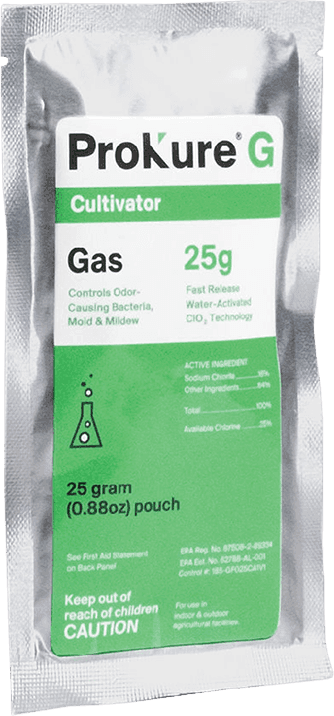
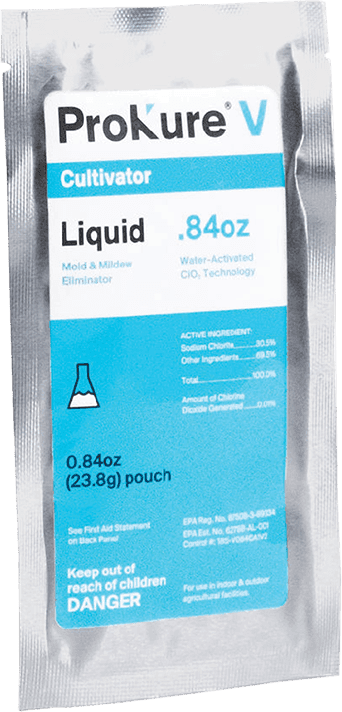
A ClO2-based turnover compresses the gap because it does not leave a residue to rinse and does not force a long re-entry wait beyond its defined ventilation window. The sequence is: strip the room, surface-clean with ProKure V (the EPA-registered liquid Hospital-Type Disinfectant, EPA Reg. No. 87508-3-89334, that leaves no residue and is suitable for use with plants in the room), then run the fast-release gas reset with ProKure G (EPA Reg. No. 87508-2-89334) in the empty room for the 4-to-6-hour dwell, ventilate one hour, re-enter, and deploy ProKure D for the ongoing air-quality layer as the next crop goes in.
Keep the products matched to their jobs. ProKure V handles surfaces and is plant-safe. ProKure G is the empty-room gas reset and carries the verbatim label restriction "Not for use with/on plants/crops/feed," so it runs only when the room is cleared. ProKure D is the slow-release air-quality layer that runs with plants present and carries the verbatim disclaimer that it is not an EPA-registered product and not labeled for sale as a pesticide under 40 CFR, with no kill claim. Three products, three jobs, three distinct label postures.
Turnover time comparison
The comparison a facility manager wants is bleach protocol against ClO2 protocol on the clock. A bleach-and-air-out turnover stretches across multiple days because of fume evacuation, rinsing, and dry time. A ClO2 turnover can fit the strip, surface-clean, gas reset, and ventilation inside roughly a 24-hour window, because the gas works in 4 to 6 hours and leaves no residue to rinse. That compression, multiplied across a rolling multi-room schedule, is the difference between a facility that loses a week a month to turnover and one that does not.
Preventing cross-contamination between rooms
This is the core multi-room question, and it is unanswered anywhere in the ranking content. If one room has a problem, how do you keep it from becoming every room's problem?
Airflow isolation basics
The first line of defense is air. If rooms share an HVAC trunk, a mold event in one room can circulate to the others through the return. Isolation means, at minimum, setting the affected room's handling to recirculation or sealing it from the shared return during decontamination, so you are not pushing a treated or a contaminated room's air into the common system. For facilities with shared HVAC and no room-level dampers, the decontamination sequence has to account for the shared air directly, because the duct is the highway.
Filtration helps here as a steady-state measure, catching airborne spores in circulation. It is not a substitute for isolating a room you are actively resetting. The HVAC vendors ranking for this query sell the filtration half and skip the reset half entirely.
A worked example makes the airflow risk concrete. Say Rooms 1 through 4 share a single return plenum, and Room 3 comes down with a visible Botrytis problem on its last week of flower. If the facility does nothing to isolate Room 3, every hour that its return keeps feeding the shared trunk is an hour of spore load circulating past the intakes of the other three rooms. The filtration box in the trunk reduces what gets through, but it does not stop the exposure, and the clean rooms are now defending against a problem that originated next door. Isolate Room 3 to recirculation or seal its return, treat it fully, verify with a post-treatment air sample, and only then return it to the shared system. The sequence is the control; the shared duct is the thing the sequence exists to manage.
Staggered decontamination sequencing
Sequence is a tool. In a rolling-harvest facility, decontaminate in an order that moves from cleanest to most-contaminated, or isolate and treat the problem room first and fully before touching the others, so you are never carrying a load from a dirty room into a clean one midway through. If a room failed its last yeast-and-mold test, it is the priority room, and it gets a full reset before the next crop goes anywhere near it. Treat the sequence as part of the written protocol, not a judgment call the crew makes on a busy harvest day.
PPE and crew flow between rooms
The most common cross-contamination vector in a multi-room facility is not the air. It is the crew. A worker who walks from the problem room into a clean room with the same gloves, cart, and shoes has hand-carried the spore load past every airflow control you installed. The fix is procedural: dedicated or changed PPE per room during a decontamination cycle, a defined crew-flow direction from clean to dirty, and gear that does not travel between rooms without being cleaned. This is cheap and it is the control facilities most often skip, which is why it belongs in the SOP in writing.
Building the compliance data trail
Steven, the head grower, needs proof for compliance auditors, and no ranking page mentions air testing, log sheets, or state thresholds at all. A multi-room program that cannot be documented is a program an inspector will not credit, and at this facility scale, the inspector expects documentation.
State pre-sale yeast and mold load thresholds
State cannabis programs set pre-sale total yeast and mold load thresholds, and those numbers vary by state and change over time. Do not build a protocol around a threshold you remember; confirm the current number with your state regulator and log your pre-sale results against it. The point of the whole air-quality program, from the ClO2 reset to the ongoing D layer, is to keep every room's harvest under that threshold so a six-figure crop clears testing.
Air testing cadence for multi-room ops
Verification is what turns a cadence into a defensible one. Pull air samples on a schedule that covers every room, not a representative one, because in a multi-room facility the whole point is that rooms differ. A workable cadence is pre- and post-treatment sampling at turnover plus periodic in-cycle checks, with results logged per room. GroClarity offers air-testing support to build exactly this data trail, which is the piece the filtration and HVAC pages leave entirely to the grower. If a specific room keeps trending toward its threshold despite a correct protocol, the data is telling you something upstream in that room, an HVAC return or a recurring source, needs attention.
Log sheet template
For the audit file, log per room, per treatment: the product and SKU, the room, the date, the operator, the dwell and ventilation times, and the test results that bracket the treatment. That record is what turns "we run an air-quality program" into a claim an inspector can follow line by line across every room in the building. The log is also how you catch a room drifting before it fails, which is the operational payoff on top of the compliance one.
Keep the supporting documents in the same binder as the logs: the current product label and SDS for each ProKure SKU you run, and the EPA registration references for V and G. An inspector who asks about the trifold hanging in a flower room or the gas reset you ran last turnover wants to see the label that governs it, the SDS, and the log entry that records the deployment. When those three line up, the question is answered in one motion. When they do not, a routine question becomes a finding. At multi-room scale this is a standing file you maintain, not a scramble you do the week before an inspection, because the volume of entries across several rooms is too much to reconstruct from memory after the fact.
EPA compliance across a multi-room protocol
EPA compliance is the biggest single worry for operators at this scale, and the confusion is specific: which product carries which restriction, and when can each run. Getting this wrong in a multi-room protocol means either a label violation or an under-protected room.
What the "Not for use with/on plants/crops/feed" restriction actually means
This restriction belongs to ProKure G, the fast-release gas, and it means exactly what it says: G runs in an empty room, with people, pets, and plants out, for the 4-to-6-hour dwell, followed by one hour of ventilation before re-entry. It does not mean G is unsafe or restricted from a cannabis facility. It means G is an empty-room treatment, which is why it lives in the turnover window and not during the grow. The restriction does not apply to ProKure V, which is suitable for use with plants in the room, and it does not apply to ProKure D, which runs with plants present as the ongoing air layer.
EPA reg numbers to look for
Put the registration numbers in your file so procurement and QA are never guessing. ProKure V, the liquid disinfectant, is EPA Reg. No. 87508-3-89334. ProKure G, the fast-release gas, is EPA Reg. No. 87508-2-89334. ProKure D is not an EPA-registered product and not labeled for sale as a pesticide under 40 CFR, because it is an air-quality and odor product with no kill claim, and that non-registration is the correct posture for what it is, not a gap. Keep the label and SDS for each on file from prokuresolutions.com.
Which ProKure SKU applies to which room state
The clean mental model for a multi-room protocol is room state. An empty room in turnover gets the surface-clean with V and the gas reset with G. An occupied room in the grow gets the ongoing air-quality layer with D, sized to room volume. V bridges both states because it is plant-safe. Map the product to the room state, not to a calendar, and the EPA posture takes care of itself because each product only ever runs where its label allows.
Compliance note: every claim about V, G, and D on this page uses ProKure's approved label language, and the controlling document for any deployment is the product label. Confirm pre-approved claim language and any state-specific requirements before standardizing the protocol across rooms.
What multi-room air quality actually costs
The "cost" modifier in related searches is unserved in the ranking content, and owners making the budget decision need a cost signal without a full pricing page. Pricing lives on shop.groclarity.com and through a GroClarity quote; the framing lives here.
Cost ranges for chemical decontamination per room per cycle
The honest way to think about cost is per room, per cycle, in three parts: the chemical cost (the ProKure SKUs sized to each room's volume), the labor (place units, run the dwell, ventilate), and the downtime (compressed to roughly a day with a ClO2 turnover rather than stretched to several with a bleach-and-air-out). The ongoing D layer is a per-30-day cost per room, replaced before each up-to-30-day window closes. Rather than publish a figure that would mislead across different room sizes and facility scales, price your real per-room cost against current pricing on shop.groclarity.com for the SKUs your sizing calls for, and request a quote for facility-scale and account pricing.
Cost of a failed mold test versus cost of prevention
For an owner weighing prevention as a cost line, the comparison that matters is a failed test against a year of prevention. A single failed yeast-and-mold test on a mature crop is a six-figure loss plus the licensing and reputation exposure that follows. A year of ongoing air-quality protection across the facility is a predictable operating cost measured in product and labor. The prevention math is not close when one failed harvest outweighs twelve months of protection.
There is a compounding cost owners tend to miss, too. A failed test rarely stays contained to the failed batch. It triggers a hold, a retest, and often a hard look at every room that shares air with the one that failed, which pulls finished product off the sales calendar and ties up labor chasing the source. The prevention spend buys predictability as much as it buys protection: a known monthly cost per room against the unknown, lumpy cost of a failure that cascades across a facility. For an owner who is not sure what ClO2 even is, the plain version is this: chlorine dioxide is an oxidizing gas and liquid chemistry that resets a room's air and surfaces and dissipates without leaving a residue, which is why it suits a facility where the next crop comes right back into the room.
Frequently asked questions
These are the questions multi-room operators ask before they commit to a program.
Can you have too much CO2 in your grow room?
Yes. CO2 is dosed to boost photosynthesis, but too much displaces oxygen and becomes a crew-safety hazard at high concentration, and it stops helping the plants past the point they can use it. In a multi-room facility, CO2 is managed per room by the environmental controls, not by the decontamination program. The air-quality program covered here is about pathogen and odor control between and during cycles, which is a separate system from CO2 enrichment. Keep CO2 sensing and ventilation tuned per room so a sealed room does not drift into either depletion or excess.
What is the best type of ventilation for a grow room?
The best ventilation depends on whether the room is sealed or runs air exchanges, and multi-room facilities usually run a mix. Sealed rooms with recirculation give you the most control over temperature, humidity, and CO2, and they also make it easier to isolate a room during decontamination. Air-exchange setups bring in outside air, which helps with heat and humidity but introduces outside spore load. For a multi-room operation, the practical answer is sealed rooms with room-level control so you can isolate any one room from the shared system when you reset it.
How do you size ClO2 treatment across multiple grow rooms?
Size per room, not per facility. Calculate each room's cubic feet (length times width times height), then match the volume to a ProKure D SKU: 50g for up to 4,000 cubic feet, 95g for up to 8,000, and size up for rooms that fall between coverage ratings. A 2-to-8-room facility sums those per-room numbers into a facility total, which is also the basis for case-quantity and account pricing. Write the per-room SKU into the SOP so the crew is not recalculating on turnover day.
What air exchange rate do multi-room facilities need?
Air exchange is tuned per room and per growth stage rather than set once for the whole facility. The decontamination program is separate from the exchange rate: a ClO2 reset runs during the empty-room turnover window with the room sealed, and the ongoing D air-quality layer runs with the room's normal environmental controls. Confirm exchange targets with your environmental-controls vendor per room, and keep the ability to seal any room from the shared return so decontamination of one room does not push air into the others.
How does a multi-room protocol differ from a single-room protocol?
A single-room protocol sizes one treatment and treats the room as the whole system. A multi-room protocol adds three things: per-room sizing because rooms differ in volume, decontamination sequencing because the order you treat rooms in determines whether you contain or spread a problem, and written documentation because a facility at this scale is where an inspector expects a program, not a memory. The products are the same; the planning around them is what scales.
Which ProKure product is EPA-approved for use with plants nearby?
ProKure V, the liquid Hospital-Type Disinfectant (EPA Reg. No. 87508-3-89334), is suitable for use with plants in the room and leaves no residue. ProKure D runs with plants present as the ongoing air-quality layer, though D is not an EPA-registered product because it carries no kill claim. ProKure G is the opposite case: its label reads "Not for use with/on plants/crops/feed," so it runs only in an empty room. Match the product to whether the room is occupied or empty.
How often should we decontaminate between cycles?
Run one full reset per room, per turnover: strip, surface-clean with V, gas-reset with G in the empty room, ventilate, then deploy D as the next crop goes in. Add an extra reset when a trigger fires, such as a positive mold test on the prior harvest, HVAC service, or a room that sat empty past your normal window. The ongoing D layer is replaced before each up-to-30-day window closes. The product label is the controlling document for allowed use frequency.
If you want procedural depth on the reset itself, the mold-prevention protocol page walks the full clean-treat-ventilate sequence, and the ClO2-versus-ozone comparison covers the chemistry choice, so this page can stay on the multi-room sizing and workflow question.
The right next step depends on which seat you are in, because a multi-room facility rarely has one decision-maker.
If you are the head grower, the piece you need is the audit trail: the multi-room air-quality program plus the per-room log and the state-threshold references that make a harvest defensible at testing. If you are the facility manager living the 3-to-5-day turnover, the turnover-time comparison between a bleach protocol and a ClO2 protocol is the fastest way to see the days you get back. If you are standardizing across state lines, you have outgrown this page, and the multi-state operator tier covers the EPA and regulatory variance that a single-facility program does not.
If you are the owner weighing the budget, the comparison that matters is one failed mold test against one year of prevention, and the math is not close. And if you are procurement or QA, the documents you need, the SDS, the EPA labels, and account pricing for the ProKure D SKUs your sizing calls for, live on shop.groclarity.com and prokuresolutions.com, with the label as the source of truth. Reorder the line on shop.groclarity.com, pull labels and SDS from prokuresolutions.com, and request a quote through GroClarity when facility-scale or account pricing is the next move.
Related resources