
The Best ClO2 Product for Cannabis in 2026: A Shortlist by Facility Job
For cannabis facilities in 2026, the best ClO2 product is the one that matches the job and the EPA label, not a single winner: a plant-safe liquid for surface disinfection, a fast-release gas for the empty-room reset, and a slow-release gas for sustained air and odor control. The reader comparing chlorine dioxide products for a grow usually has not decided which form factor they need, so this guide ranks the options by cannabis-facility fit and routes you to the deeper page for your actual problem. Before the list, one decision rule does most of the work: pick the form to the job, then confirm the label allows the way you intend to use it.
How to choose a ClO2 product for a cannabis facility
The mistake that sends growers down the wrong path is shopping for a brand before deciding on a job. ClO2 comes in three functional forms for a cannabis facility, and the form, not the label on the bottle, decides fit. A liquid is for wiping and treating surfaces. A fast-release gas is for a quick whole-room reset when the room is empty. A slow-release gas is for sustained air and odor control over a longer window. Decide which of those three jobs you are solving first, and the shortlist collapses from a confusing field of products to the one or two that fit.
The reason the query tempts people toward a single answer is that best implies a winner, but ClO2 does not have one for cannabis any more than a toolbox has a best tool. You would not ask for the best tool for building a house; you would ask what the task is and reach for the saw or the drill accordingly. ClO2 is the same. The surface-disinfection task, the empty-room-reset task, and the sustained-air-and-odor task are genuinely different, and a product that is the best answer to one is the wrong answer to another. Reframing the question from which product is best to which product is best for this job is the single most useful move a buyer can make, and it is why this guide ranks by job rather than handing down a universal number.
The second rule is the EPA label, because it governs how and where you may use a product and it is the biggest compliance risk in cannabis sanitation. Some ClO2 products are suitable for use with plants in the room; others carry a not-for-use-with-plants-crops-or-feed restriction and belong only in empty rooms. A product can be excellent at its job and still be the wrong choice if its label does not permit the way you need to use it. Always read the label for the specific product and match it to whether a crop is present.
There is a third rule that saves money: do not buy one product and expect it to cover all three jobs. Because the jobs map to different forms, a facility that takes sanitation seriously usually runs more than one ClO2 product, a surface disinfectant for cleaning and an air product for odor and air quality, rather than forcing a single item to do work it was not designed for. Trying to use a surface liquid for whole-room air control, or an air product as a surface disinfectant, produces worse results on both fronts and can cross a label. Budget for the jobs you actually have, which is usually two of the three, rather than hunting for one product that does everything.
Route yourself quickly, because a shortlist is only useful once you know your job. If your real problem is disinfecting surfaces between cycles, that is a surface-disinfection job and the liquid is your answer. If it is an odor problem in a grow or a dispensary, that is an air-and-odor job and a gas product fits. If it is a mold event you are recovering from, that is a prevention-and-remediation problem, a different workflow with its own forensic and quarantine steps, covered in mold prevention protocols. If you are a procurement lead assembling account pricing and documentation across sites, that is a sourcing problem covered in cannabis procurement. Sorting yourself into the right job before you read product details is what keeps you from buying the right product for the wrong task, and the shortlist below assumes you have done that sorting and want the product that fits the job you landed on.
The shortlist: matching form factor to the job
There is no single best ClO2 product for cannabis, because the three facility jobs, surface disinfection, fast empty-room reset, and sustained air and odor control, are solved by three different forms. The ProKure line maps one product to each job, which is why a facility often runs more than one of them rather than choosing a single winner. Rank the shortlist by your job, not by a universal score, and the right pick is obvious. The three entries below are the ones that fit cannabis-facility use cleanly on form, label, and residue profile; the broader category of ClO2 products that show up in a search is addressed after, with the vetting rules that separate a facility-grade product from a consumer odor gadget.
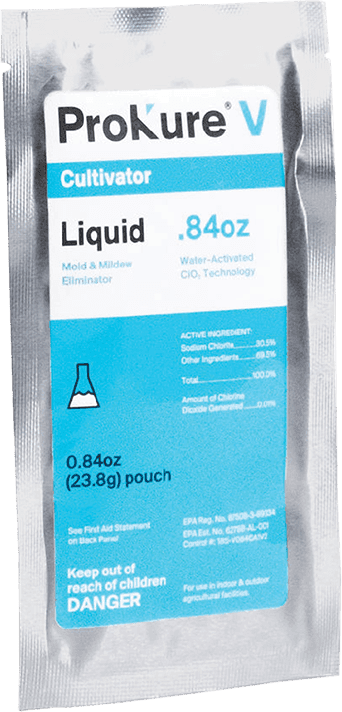
1. ProKure V, for surface disinfection with plants nearby
For the surface-disinfection job, ProKure V is the strongest cannabis-facility fit. It is a liquid surface disinfectant, EPA Reg. No. 87508-3-89334, that kills mold and mildew, is suitable for use with plants in the room, and leaves no residue. That combination is what makes it unusual: a disinfectant you can use on benches, tools, and hard surfaces whether or not a crop is present, without a residue that will sit where the next plant goes. For a facility manager whose pain is bleach fumes forcing a crew evacuation and no residue-free option they can use near plants, V is the answer to exactly that problem. It is the surface half of a sanitation program, and it earns the top of a cannabis shortlist because the plant-present labeling and residue-free finish are what bleach and quats cannot claim. The reason the plant-present labeling matters so much is practical: a surface disinfectant you have to clear the room for is a disinfectant you use less often, and inconsistent surface sanitation is how pathogen load builds between deep cleans. A product you can run on benches and tools without evacuating the crop is one your crew will actually use on the cadence the program calls for. For the cannabis facility, that usability is as much a part of the fit as the kill claim itself. See ProKure V liquid disinfectant for the product detail, with the label and safety data sheet on prokuresolutions.com.
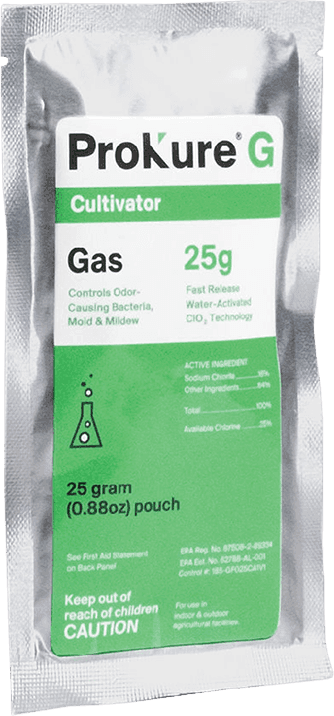
2. ProKure G, for the fast empty-room reset
For the between-cycle whole-room reset, ProKure G is the fit. It is a fast-release gas deodorizing delivery system, EPA Reg. No. 87508-2-89334, that works in 4 to 6 hours and controls mold and mildew, odor-causing bacteria, and chemical odors. As a gas it reaches the corners and crevices a wipe misses, which is why it belongs in the turnover window when the room is empty. Its label carries the disclaimer not for use with/on plants/crops/feed, so this is an empty-room product used during turnover with no crop present, not an in-room treatment around plants. That restriction is not a knock on the product, it is the correct use boundary, and a shortlist that flags it is doing the reader a service, because misusing a gas product in an occupied room is both an agronomic and a compliance error. The strength of a fast-release gas in a turnover is the reach a liquid cannot match: it fills the sealed empty room and treats the undersides, corners, and crevices a wipe never touches, then clears on a ventilation cycle before the next crop goes in. That is why the strongest turnover pairs the plant-safe liquid on surfaces with the empty-room gas for the whole-room reach, each used in its own window. On a shortlist, G is the product you reach for when the room is empty and you want a complete reset fast. See ProKure G fast-release gas.
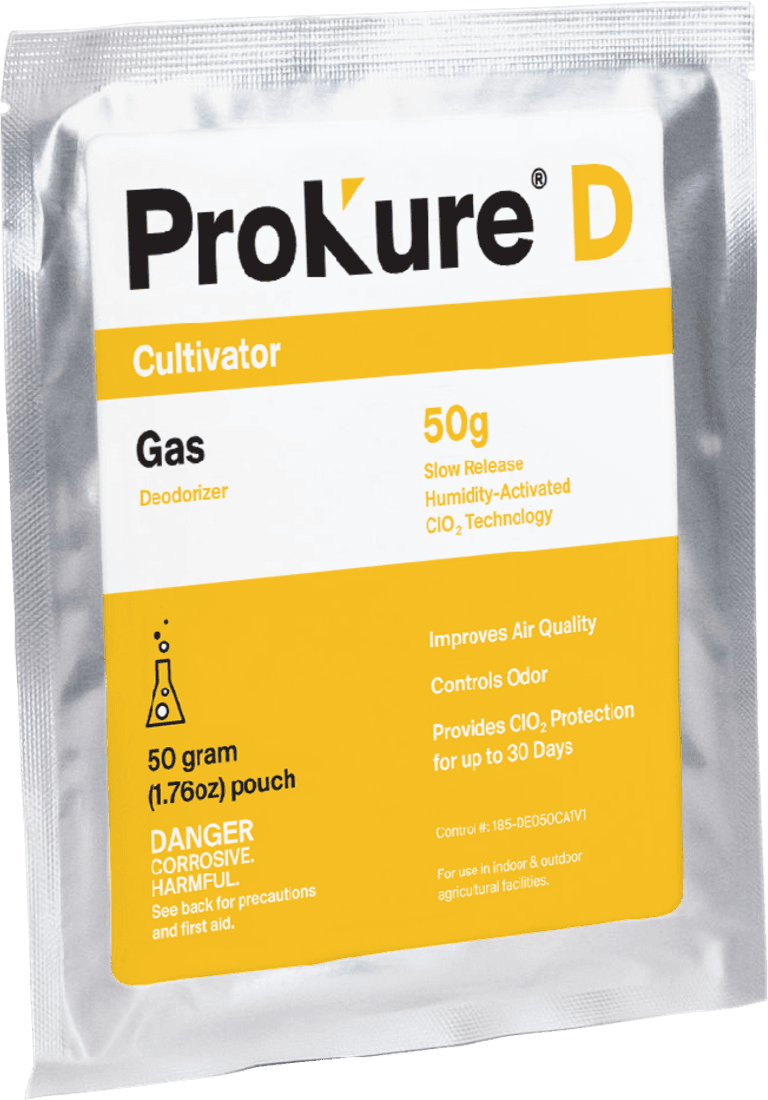
3. ProKure D, for sustained air and odor control
For the sustained air and odor job over a longer horizon, ProKure D is the fit. It is a slow-release gas that improves air quality and controls odors and provides ClO2 protection for up to 30 days. Its dosing horizon is what sets it apart: where G is a fast reset, D covers a 30-day window, which matches a seasonal or ongoing air-and-odor need rather than a quick turnover. One important label note belongs on any honest shortlist: ProKure D is not an EPA-registered product and not labeled for sale as a pesticide under 40 CFR, so it is positioned for air and odor control, not as a surface disinfectant or a kill-claim product. Keeping that straight matters, because the surface-disinfection and mold-kill job belongs to V, while D's job is the air and odor window. The place D fits on a shortlist is the operation that needs ongoing air and odor management, a facility holding product, a room between active uses, a space where odor control over weeks matters more than a fast reset. Its up-to-30-day horizon is the feature, so the buying question is whether your need is a one-time whole-room reset, in which case the fast gas fits, or a sustained air-and-odor window, in which case the slow-release gas does. Do not ask D to disinfect a surface or carry a mold-kill claim; that is not its job and not its label. Matched to the air-and-odor need, it is the third leg of a complete ClO2 program. See ProKure D slow-release gas.
The rest of the ClO2 category, and how to vet any product
A search for the best ClO2 product for cannabis surfaces a wide and uneven field: dry tablet kits packaged for home and small-business use, consumer odor-removal products aimed at vehicles and smoke remediation, ClO2 formats marketed for cleaning coco and growing media, and social-media product reels. Many of these are real ClO2 products, but most are not scoped to a commercial cannabis facility, and some are consumer-grade odor gadgets that will not carry the EPA claim or the documentation a cannabis operation needs. The SERP for this query is thin and under-supplied with cannabis-native comparison, which is why a careful buyer has to vet products themselves rather than trust a ranking built for a different audience. A result that ranks for best ClO2 product may be optimized for a vehicle-odor shopper or a home user, not a commercial cultivator, and its idea of best will reflect that audience's priorities, not yours. Treat the open field as a reason to apply your own screening rather than to defer to whatever ranked first.
Vet any ClO2 product against five questions. First, is it EPA-registered for the specific claim you need, and if it is a non-registered product, do you understand what that limits it to? Second, does its label permit the way you intend to use it, specifically, can it be used with plants present, or does it carry the not-for-use-with-plants restriction that confines it to empty rooms? Third, what is its residue profile, because a residue-free product is what you want where a crop will grow. Fourth, does it come in a format and pack size that fit a commercial facility rather than a home kit? Fifth, can you get the EPA label and safety data sheet for your QA binder, because a product you cannot document is a product you cannot defend at audit. Run any product on this query through those five questions and the consumer gadgets and off-label options fall away quickly, leaving the facility-grade options that actually belong on a procurement shortlist.
The format question is worth its own beat, because it is where a lot of search results fail quietly. A dry tablet kit packaged with two dozen one-gram tablets and instructions for household uses is a real ClO2 product, but it is scoped for home and small-business use, not for treating a commercial grow room or a between-cycle turnover at facility scale. A consumer odor product aimed at vehicles and smoke remediation is not built for the coverage or the documentation a cannabis operation needs. These products are not scams, they are simply the wrong tool for the scale and the compliance context, and a buyer who does not check format ends up with something that cannot cover the room or satisfy an auditor. Facility-grade means the pack sizes, the coverage math, and the documentation all fit a commercial operation, which the ProKure cultivation line is built for and most consumer ClO2 products are not.
The label question deserves one more emphasis because it is where buyers most often slip. A product being a ClO2 product does not tell you whether it is a surface disinfectant, an air treatment, or a non-registered deodorizer, and those are legally different things. Reaching for a non-registered air product when you needed a registered surface disinfectant, or using an empty-room product around a live crop, is the kind of mistake that fails an audit regardless of how well the chemistry works. The label is the authority, and matching the product to the job and the label is the whole discipline of buying ClO2 for a cannabis facility. For a QA or procurement lead, that discipline also means keeping the registration number and safety data sheet on file for every product before it enters a room, because an auditor will ask for them and a product you cannot document is a product you cannot defend. Build the approved-vendor list around products whose documentation you can actually produce, and the compliance half of the buying decision takes care of itself.
The comparison table and how to use it in procurement
The practical output of this guide is a shortlist a head grower or cultivation director can drop into a procurement document. Rank the candidates in a table with the columns that actually decide fit: the job the product does, its form factor, its EPA registration status for the claim you need, whether it is suitable for use with plants present, its residue profile, its pack format, and the availability of its label and safety data sheet. A row that cannot answer the EPA and plant-present columns is a row you can strike before you compare on price.
For the ProKure line, that table resolves cleanly: V is the plant-safe, residue-free surface disinfectant with a registration number; G is the fast empty-room gas with a registration number and the plants-absent restriction; D is the slow-release air and odor product positioned without an EPA registration. Match those rows to your jobs and you have your shortlist.
| Product | Job | Form | Plant-present use | EPA status | --- | --- | --- | --- | --- | ProKure V | Surface disinfection | Liquid | Suitable for use with plants in the room | Registered, 87508-3-89334 | ProKure G | Fast empty-room reset | Fast-release gas | Not for use with plants, crops, or feed | Registered, 87508-2-89334 | ProKure D | Sustained air and odor | Slow-release gas | Air and odor, not a surface or kill product | Not EPA-registered |
A table like that is what a head grower or cultivation director can screenshot straight into a procurement document, because it answers the questions that actually decide a buy, the job, the form, the plant-present eligibility, and the registration status, in one glance. Add columns for pack format and cost per treated area when you build your own version against real quotes, and strike any candidate that cannot fill the plant-present and EPA columns before you compare on price, because a product you cannot place on those two axes is one you cannot safely deploy. Price is the last column to look at, not the first, precisely because a cheaper product that fails the label or format screen is not actually cheaper once it fails an audit or cannot cover the room. Let fit and compliance filter the field, then let cost decide among the survivors.
For a multi-facility operator, the same table standardizes the buying decision across sites, so every facility orders the right product for the right job rather than improvising, and the documentation for each product lives in one place. That consistency is what keeps a crew in one state from quietly adopting a different product than a crew in another, which is the drift a cultivation director is trying to prevent. The transactional handoff, account pricing and reorders, runs through shop.groclarity.com, and the deep label and safety data sheet library lives on prokuresolutions.com. The sourcing and standardization side is covered further in cannabis procurement.
Frequently asked questions
These are the questions buyers ask when they are shortlisting a ClO2 product for a cannabis facility.
The best ClO2 product for cannabis in 2026 is not a single answer, it is a match between the job and the label. Decide whether you need surface disinfection, a fast empty-room reset, or sustained air and odor control, pick the form that does that job, and confirm the label permits the way you intend to use it: a plant-safe liquid for surfaces, a fast-release gas for the empty-room reset, and a slow-release gas for the air and odor window. Vet any product on registration, label, residue, format, and documentation, and the shortlist resolves to the one or two products that actually fit your facility. The reader who came looking for a single best product leaves with something more useful: a method for picking the right product for any job, which holds up even as products and formulations change. For most commercial operations that means a plant-safe surface disinfectant and an air product, matched to whether the pressing need is surfaces, a fast reset, or a sustained odor window, with the empty-room gas added when turnover reach matters. Decide the job, check the label, and buy for the work you actually have rather than the single product a best-of headline implies exists.
Related resources