
Cannabis Contamination Prevention: A Cultivator's Playbook for Mold, Mildew, and Pathogen Control
Cannabis contamination prevention is the upstream work that keeps mold, mildew, yeast, bacteria, and chemical residue out of a crop before harvest, rather than scrubbing a problem off finished flower. It runs on four layers that reinforce each other: environmental control that denies mold the humidity and still air it needs, residue-free surface and air sanitation during the between-cycle window, source-mapped protocols that stop contamination from entering on clones, workers, tools, and air, and a documentation trail that proves to a state auditor your grow stayed under its total yeast and mold (TYM) threshold. Prevention is cheaper than a failed test. It is also the only version that protects a license.
Why prevention is a revenue conversation, not a cost line
Talk to a grower who has lost a room and you stop hearing prevention described as overhead. A positive TYM result on a mature flower lot does not shave a few points off margin. It can take the whole lot off the market. On a full room, that is a loss that runs into six figures, and the plants were already paid for in light, labor, nutrients, and the ten or more weeks it took to grow them. Nothing about that cost is recoverable once the lab result lands.
Then comes the second cost. A compliance failure is not just a destroyed batch. In most regulated markets a pattern of failed tests becomes a licensing conversation, and a license is the business. Stack on the remediation spend, the retest fees that the operator pays out of pocket, the downtime while a room sits idle instead of producing, and the insurance posture that worsens with every incident on the record. The cost of prevention is a known, flat monthly number you can put in a budget. The cost of a failure is a variable that compounds in every direction at once.
The incumbent content gets this backwards. The top-ranked page on this topic treats prevention as a preamble and then pivots to post-harvest decontamination technology, writing that post-harvest decontamination is where the real solution comes in. That is a reactive posture dressed up as a prevention strategy. By the time a crop needs post-harvest treatment, the contamination already happened and the margin already eroded. The reframe that reads more true: contamination prevention is a revenue-protection program, and the cheapest dollar you will ever spend on it is the one spent before the plant is in the room. Prevention math is blunt. One failed harvest costs more than a full year of a disciplined ClO2 protocol. Everything below is how you run that protocol, backed by data you can hand an auditor.
The four contamination categories every facility manages
Contamination is not one problem. It is four, and a program that only solves one leaves the other three free to fail a test on their own.
Microbial contamination is the headline: mold, mildew, yeast, and bacteria. This is what TYM and species-level Aspergillus screens measure, and it is where humid grow rooms lose crops. It is also the category most sensitive to the environment, which means it is the one prevention controls can move the most. Chemical contamination is the quiet one: pesticide residue, solvent residue in extraction, and, the one growers forget, cleaner residue left on a surface that later touches product. A disinfectant chosen to solve a microbial problem can create a chemical-residue problem if it leaves a film, which is why residue profile is a selection criterion, not an afterthought. Physical contamination covers hair, dust, glove fragments, and foreign matter, the failures that come from housekeeping and PPE discipline rather than biology. Cross-contamination is the connective tissue that ties the other three together: a pathogen or residue moving strain to strain, room to room, and tool to tool until a localized problem becomes a facility-wide one.
A real prevention program addresses all four at once, because the state lab does. You do not get to pass microbial and quietly fail on residue; one failing analyte condemns the batch regardless of how clean the other panels came back. The categories also share root causes, high humidity, uncontrolled traffic, and inconsistent discipline, which is why a single integrated protocol beats four disconnected fixes bolted on as problems appear. Build the program around the shared causes and you knock down several categories with the same control.
There is a sequencing lesson here too. Growers tend to treat these categories in the order they get burned by them, reacting to the microbial failure that cost a crop, then the residue finding that cost the next one, then the cross-contamination that cost a whole cycle. Reacting category by category is how a facility ends up with four overlapping, half-trusted procedures that nobody can explain to an auditor. Designing for all four from the start, around humidity control, traffic discipline, and a residue-free chemistry, produces one coherent program instead. The upfront design costs a few planning hours. The reactive version costs harvests.
State thresholds, and what total yeast and mold actually measures
Every regulated market sets a microbial limit, and the number you have to clear depends on the state. Many markets use a total yeast and mold count with a common comparative ceiling near 10,000 CFU per gram, while others layer in a species-level Aspergillus screen for flavus, fumigatus, niger, and terreus that a single TYM number will never catch. States that test Aspergillus by species are the harder pass, because any one species over its action limit fails the batch even when the aggregate count looks clean. A grower who optimizes only for a good TYM number in an Aspergillus state is optimizing for the wrong test.
Total yeast and mold is an aggregate living-organism count, not a species identification. That matters for two reasons. First, two batches with the same TYM number can carry very different real risk, because the count does not tell you whether it is benign environmental yeast or a pathogenic Aspergillus load. Second, the lab method changes the number. Culture plating grows what is viable on a plate and reports colony-forming units; quantitative PCR counts genetic material whether the organism is alive or dead, and can therefore read higher on the same sample. A grower can see materially different results from the same flower depending on the method the state mandates. Confirm the method with your lab, not just the limit, and build your prevention targets to the method you will actually be judged on. A peer-reviewed review of cannabis contaminants in the National Library of Medicine underscores why the organism identity behind the count matters for human-health risk, not just the raw number.
The practical consequence for a prevention program is that your internal target should sit well under the legal ceiling, not at it. A batch that tests at 9,000 CFU per gram against a 10,000 ceiling passed, but it passed with almost no margin, and the next cycle's conditions are never identical. Humidity drifts, a filter loads up, a new strain behaves differently in flower. Running your prevention program to a self-imposed internal limit, comfortably below the state number, is what turns a pass from luck into a system. It also gives you room to absorb the method variance between plating and qPCR without a surprise failure when a state changes its mandated method mid-year, which several markets have done.
Where contamination enters your facility
Prevention gets cheaper when you stop treating a grow room as a sealed box and start mapping the doors contamination actually walks through. Clones and mothers are the first door. A pathogen on incoming genetics seeds every room downstream, which is why a clean-stock program and an inbound quarantine step pay for themselves the first time they catch an infected cut before it reaches the canopy. HVAC and outside air are the second door. Unfiltered intake carries spores in from outdoors, and condensation on coils and in ducts grows them inside the system, so a MERV 13 filtration baseline is the floor, not the ceiling, and coil hygiene belongs on the maintenance schedule.
Workers, PPE, and traffic flow are the door most operators underfund. People move spores on clothing, hands, and shoes from the dirtiest zones to the cleanest, which is why a one-directional clean-to-dirty traffic pattern and enforced PPE change-outs do more than most growers expect. Tools, trellis netting, tables, and drying racks carry microbial load between cycles whenever they are reused without sanitation, turning yesterday's problem into tomorrow's inoculation. Water systems and irrigation lines grow biofilm that quietly reintroduces organisms the surface protocol just removed, so line sanitation has to be part of the program, not an afterthought. Packaging materials close the loop, carrying contamination to product at the last step before it leaves your control. Map every one of these pathways, assign a specific control and a logged frequency to each, and the microbial math changes before a single disinfectant runs.
Sanitation chemistry, compared honestly
Growers deserve a straight comparison instead of a sales pitch, so here it is. Sodium hypochlorite (bleach) kills a broad spectrum and is cheap, but it leaves residue, corrodes equipment and fittings over time, forces crew evacuation because of the fumes, and cannot go near plants. Quaternary ammonium compounds (quats) are common in food plants and effective, but many carry a not-for-use-with-plants-crops-or-feed label restriction and leave a residual film that can later surface as a chemical-contamination finding. Hydrogen peroxide and peracetic acid have a useful kill spectrum and break down cleanly into water and oxygen, but contact time and material compatibility limit where and how they fit in a grow. Each of these has a place; none of them is a single answer.
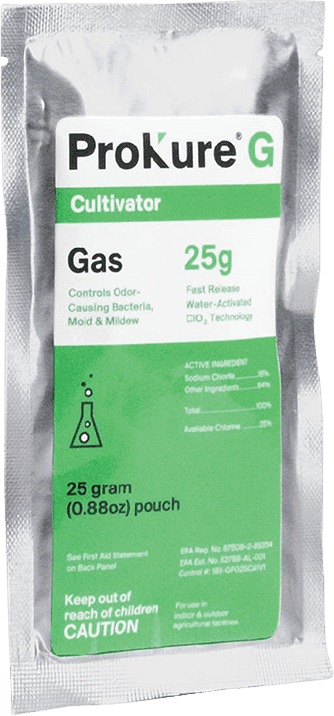
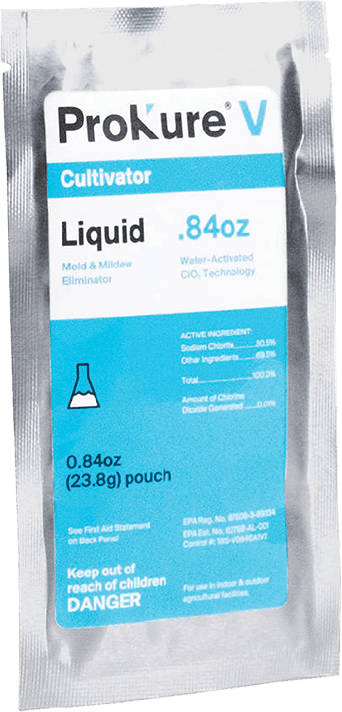
The #1 competitor on this query never gets this specific. Its cultivation-stage advice stops at good agricultural practices, careful monitoring, and regular testing, which is true and useless, because it names no chemistry a grower can actually deploy between cycles. That gap is the opening. Chlorine dioxide (ClO2) is the chemistry a growing number of cultivators move to, and the reason is the residue profile. Here the ProKure line splits by job, and the split is a compliance rule, not a marketing preference. ProKure V is a water-activated ClO2 liquid, a hospital-type disinfectant for hard, non-porous surfaces, suitable for use with plants in the room, that leaves no residue. That exact combination, a hospital-type surface kill you can run with plants present and no residue to rinse, is the one bleach and quats cannot claim, and it is why V owns between-cycle surface turnover. ProKure G is a different product with a different label: a fast-release ClO2 deodorizing delivery system that works in 4 to 6 hours and carries the required disclaimer, not for use with/on plants/crops/feed, so it runs strictly as an empty-room treatment with people and pets out. The two are not interchangeable, and matching V's surface role to G's empty-room role is how you stay inside each product's label.
Room turnover and air treatment as prevention layers
The between-cycle window is the one moment the room is empty and you can reset the microbial load before the next crop goes in. Spend it well and you buy both clean rooms and recovered production time. A standard bleach protocol eats that window alive. Dilution, application, dwell, rinse, fume ventilation, and crew evacuation routinely stretch a turnover across 3 to 5 days, and the residue question lingers after the crew comes back. A residue-free protocol compresses it. Clear the room and log the waste, then sanitize hard, non-porous surfaces (grow beds, tables, tools, drop-down hoses) with ProKure V at 100 ppm for a 10-minute contact time, keeping each surface visibly wet for the full window and reapplying if it dries early. Run the empty-room air reset with ProKure G, people and pets out, 4 to 6 hours, then ventilate one hour before re-entry per the label. Verify with ATP swabs, surface plating, or air sampling so you finish with proof, not a hunch. A disciplined reset can return a room in about 24 hours, and against a program where every room is scarce, that recovered time is real harvest capacity you can put on the production calendar.
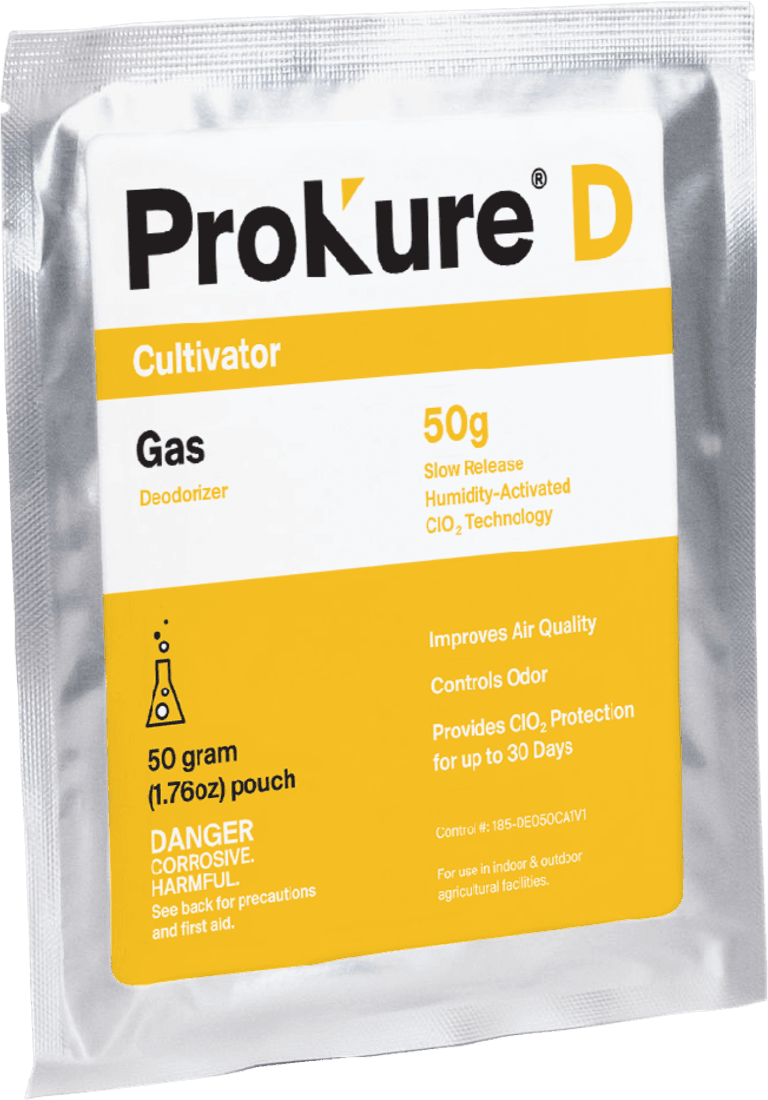
Surfaces are only part of the room. Spores live in the air and settle on everything a swab will never reach, which is why air treatment is a prevention layer in its own right, not a cleanup step after a problem appears. Surface sanitation handles what you can wipe; air treatment handles the volume between the surfaces where a swab never goes. While a crop is in the room, ProKure D provides ClO2 protection for up to 30 days and runs with plants present, which makes it the ambient air-quality layer for an active grow. ProKure D is not an EPA-registered pesticide and is not labeled for sale as a pesticide under 40 CFR, so it is positioned as an air-quality product, not a kill claim, and the honest framing keeps it that way. Dose by room volume and air-exchange rate rather than by habit, and respect worker re-entry safety on any gas treatment. ClO2 is effective precisely because it is a strong oxidizer, which is exactly why the label ventilation and re-entry steps are not optional. The prevention posture is to run air quality continuously so you flatten a spike before it ever shows up on a swab or a lab result.
Cross-contamination protocols by facility size
The same principles scale differently depending on how big the operation is, and a protocol written for one size fails at another. A single-room grow lives or dies on the basics: PPE worn and changed, tools sanitized between uses, and a traffic flow that always moves clean to dirty and never the reverse. At this size the owner is often the grower, so discipline is a personal habit more than a system, and the risk is complacency rather than coordination.
A multi-room grow adds coordination problems the single room never had. Now rooms have to be dedicated by stage or strain, shared spaces (dry rooms, trim rooms, hallways) need their own sanitation schedule, and a mistake in one room can migrate to the next through shared air, shared tools, or shared people. Room dedication and shared-space rules, written down and logged, are what keep a localized problem localized. The failure mode here is informal shortcuts: a trimmer who carries scissors from a hot room into a clean one, a maintenance tech who services two rooms' HVAC without a glove change, a drying rack rolled between zones. Each shortcut is small, and each one is a vector, which is why the rules have to be on paper and enforced rather than left to memory.
A multi-state operator running several facilities faces a third problem entirely: variance. Different states, different thresholds, different labs, and different crews pulling SOPs in different directions. The answer is standardization. Anchor one ClO2 chemistry and one core SOP across every facility, then vary only the two things that genuinely differ by jurisdiction, the state documentation and the lab panel. One chemistry and one protocol across the footprint is easier to train, easier to audit, and easier to defend than a patchwork a cultivation director cannot see end to end. It also turns procurement from a fragmented, per-facility scramble into a single reorder relationship, which is exactly the pain a procurement or QA lead feels when every site sources its own sanitation supplies from a different vendor with a different label and a different SDS to track at audit time.
Documentation, the audit-ready data trail, and where GroClarity fits
The layer most growers treat as paperwork is the one a state inspector asks for first. A prevention program you cannot document is, to a regulator, a prevention program that did not happen. What inspectors want is specific: environmental monitoring logs showing humidity and temperature held in range through the cycle, sanitation batch records tying each application to a product lot and a date, product lot tracking for traceability, and air-quality data captured across rooms and, for a multi-facility operator, across sites. The incumbent content on this topic never hands a cultivator that standard, which leaves the QA lead to guess at what an auditor will accept.
That guesswork is where GroClarity hands a QA lead a binder instead of a shrug: the EPA label, the SDS, the dilution log, and the application log for every room, mapped to the state's thresholds. The ProKure line maps to the three jobs cleanly, V for plant-safe hard-surface disinfection, G for the empty-room air reset, and D for up-to-30-day in-room air quality, and the air-test data closes the loop by proving the program worked rather than just asserting it. That proof is the trust driver in the grower relationship, not a slogan. Built on science, backed by results, is the posture, and the documentation is what makes it defensible. GroClarity builds these programs from its Phoenix, AZ headquarters at 5013 E. Washington St. Ste. 130, Phoenix, AZ 85034, 866.206.1301, pairing cultivation IPM expertise with the ProKure ClO2 line and the air-quality data to back it. Educate here, order on shop.groclarity.com, and find full labels and SDS on prokuresolutions.com. The science of biosecurity, built for growers.
Related resources