
How to Reduce Downtime Between Cannabis Harvests (Without Failing Your Next Mold Test)
If you run a commercial grow, downtime between harvests is a throughput number, not a trichome question. This page is for the cultivation director and facility manager counting days a room sits empty, not the home grower deciding when to chop. The compressible part of that downtime is the sanitation window, and a residue-free ClO2 gas reset shrinks it from the multi-day bleach-and-evacuate routine to a sealed overnight cycle. Run the fast-release gas in the empty room for 4 to 6 hours, ventilate one hour, verify the air, and replant, with no rinse and no crew evacuation. The fast-release gas is EPA-registered (87508-2-89334) and not for use with plants, crops, or feed.
Why downtime between harvests is the throughput lever nobody talks about
Every day a flower room sits between a strike and the next transplant is a day of fixed costs with no crop earning against them. Rent, power, and labor do not pause for a turnover. So the question a CFO or cultivation director actually asks is not how to harvest better; it is how many more cycles per room per year the operation can run if the dead zone between crops gets shorter.
The key move is to split downtime into two kinds. Some of it is unavoidable: the harvest itself, the trim, the teardown of the last crop. That work takes the time it takes. The other kind is compressible, and it is almost entirely the sanitation window, the stretch where the room is clean-in-progress rather than growing. That is the part a change in method can shrink, and it is where the throughput gain lives.
Name the baseline honestly. A conventional wet turnover, bleach or quats on every surface with crew in and out and a wait for fumes and residue, can hold a room out of production for a stretch of days. Compress that sanitation window from days to under a day and you have not changed the harvest or the trim at all; you have simply stopped paying for a room to sit while chemistry dries. Across a multi-room facility turning a dozen or more times a year, that recovered window is measured in whole extra cycles.
The reason nobody frames it this way is that turnover downtime is split across departments. Cultivation owns the grow, facilities owns the cleaning, and finance owns the throughput target, so the one line item that ties them together, the days a clean room sits waiting on a drying disinfectant, falls between the desks. Naming it as a single compressible number is the first step, because you cannot optimize a cost nobody is accountable for.
What is actually happening during a multi-day turnover
To see what is compressible, walk the stages of a traditional turn. Teardown and debris removal come first, hauling out spent media, trimming waste, and plant material. That is unavoidable work, and it is not where the days hide.
The days hide in surface sanitation with a wet chemistry and everything that chemistry drags behind it. Bleach or a quat gets applied to every surface, which means dwell time for the chemistry to act, then a rinse or wipe-down, then drying before anything living, mothers, clones, or transplants, can re-enter. A wet protocol does not finish when the spraying stops; it finishes when the room is dry and the residue is gone.
Then there is the drying step before anything living re-enters. Mothers, clones, and transplants cannot go back into a room still wet with a disinfectant or carrying residue, so the room has to dry and, for a residue-leaving chemistry, be rinsed first. That drying time is dead time, and it scales with how wet the application was and how well the room ventilates.
Then there is the crew. A bleach turnover drives fumes into the room, which forces an evacuation window or masks and limits who can work the space and when. Those are paid labor hours lost to the method, not to the cleaning itself. And the fumes do not stay neatly in one room; in a facility on a shared air handler, a wet chemistry can push odor and irritation into adjacent spaces, widening the disruption beyond the room being turned. The sanitation window, in other words, is not one task; it is a chain of dwell, rinse, dry, and evacuate, and every link adds hours. The compressible downtime is this entire chain, and a method that removes the rinse, the dry, and the evacuation removes most of it at once.
Each conventional chemistry extends that chain for its own reason, and seeing why is what makes the alternative obvious.
Bleach is corrosive and fume-heavy. It leaves residue that has to be rinsed, it drives crew out of the room, and it attacks the metals and surfaces of the room itself over time. Quats leave a residue by design, which is a problem in a space where plant material will soon touch those surfaces, and that residue means a rinse step before the room is crop-ready. Hydrogen peroxide fog is gentler but is largely a surface-and-near-air treatment with its own dwell time and limited air-path reach, and verifying the result is not straightforward. Ozone reaches the air but is aggressive toward rubber, wiring, and other materials and is strictly an empty-space treatment.
The common thread is that the wet and material-aggressive chemistries all add time on the back end: a rinse, a dry, an evacuation, or a materials-protection step. The sanitation window is long because the method, not the room, requires it. Set them side by side and the pattern is obvious.
| Method | Dwell + back-end | Residue | Plant-area compatible | Crew evacuation | Air-path reach | --- | --- | --- | --- | --- | --- | Bleach | Dwell, then rinse and dry | Corrosive residue, fumes | No, residue and corrosion | Yes, fumes drive crew out | Surface only | Quats | Dwell, then rinse | Leaves a residue by design | No, residue on plant-contact surfaces | Limited | Surface only | Hydrogen peroxide fog | Dwell, limited verification | Low residue | Varies by method | Usually yes | Surface and near-air | Ozone | Empty-space treatment | No residue, material-aggressive | No | Yes, empty space | Air, but attacks materials | Fast-release ClO2 gas | 4 to 6 hour sealed hold plus 1 hour vent | No film residue, by-products are table salt | Empty room only during treatment | Room empty for the turn anyway | Reaches the whole air path |
The gas is the one row that does not add a rinse or a dry and does not pull crew out of occupied space, because the space is already empty for the turn. If you want the detailed head-to-head, the bleach and quats comparison pages carry it; here the point is only that each wet or material-aggressive option builds the delay in by design, and the gas does not.
The gas-phase ClO2 alternative
Chlorine dioxide is a small, reactive oxidizer that works as a true gas, filling a sealed room evenly and reaching the cracks, crevices, and return-air paths a surface wipe never touches. Its by-products break down to ordinary table salt, so it leaves no film to rinse. That one property, no residue, is what removes the rinse-and-dry stage that stretches a wet turnover past a single shift. If you want the chemistry itself, the chlorine dioxide primer covers it; the throughput point is that a gas resets the whole room at once and leaves nothing behind.
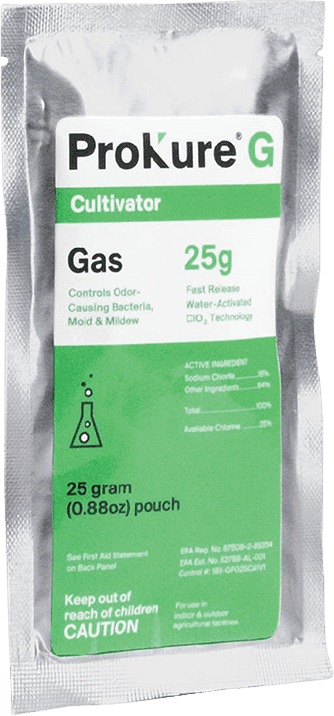
The fast-release form is the one built for a turnover. In the ProKure line that is ProKure G: you activate it with water, seal the empty room, and the label gives the system at least 4 to 6 hours to work, then one hour of ventilation before re-entry. That is a 5-to-7-hour unattended cycle that can run overnight while the building is empty anyway, so the crew loses no working hours to it. No rinse, no dry, no evacuation of occupied space, because the space is already empty for the turn.
Why the gas form beats a liquid for a whole-room turn comes down to coverage. A liquid or a wipe only treats the surfaces someone physically reaches, which in a grow room is never all of them: the tops of ducting, the backs of racks, the inside of return vents, and the gaps between equipment get missed. A gas fills the sealed volume and reaches those same hidden surfaces and the air itself in one pass, which is the difference between cleaning what you can see and resetting the whole room. For a turnover, where the goal is a uniformly clean room ready to replant, that whole-volume coverage is the point.
The no-residue property is what collapses the back end of the window. Because the by-products break down to table salt and there is no film left behind, there is nothing to rinse and nothing to dry before mothers, clones, or transplants re-enter. The step that most often stretches a wet turnover past a single shift simply is not in the sequence. That is the mechanical reason the sanitation window drops from a multi-day chain to a single sealed hold.
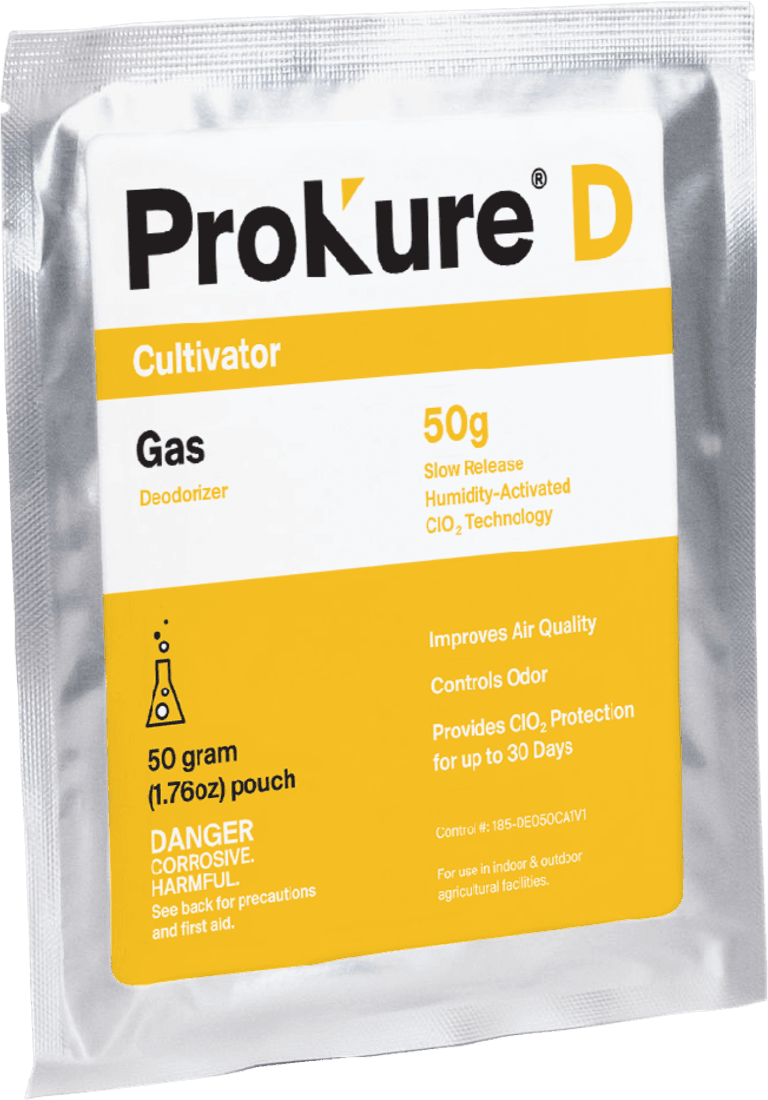
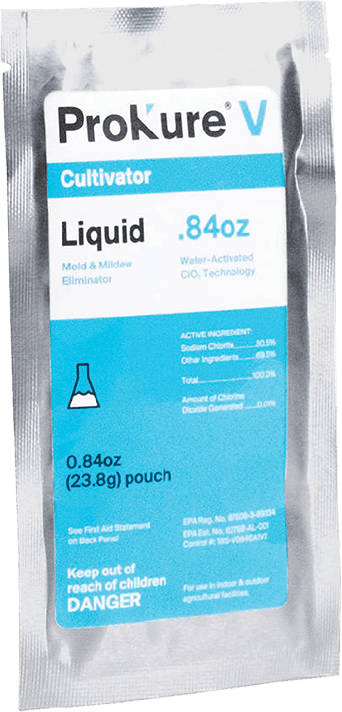
The EPA boundary is the line to get exactly right, because it is the biggest compliance worry on the purchase. ProKure G is EPA-registered (EPA Reg. No. 87508-2-89334), and its label states, verbatim, not for use with plants, crops, or feed. That is why it runs only in an empty room between crops, with people and pets out during treatment. It is a different product from ProKure V, the EPA-registered liquid surface disinfectant (EPA Reg. No. 87508-3-89334), and from ProKure D, the slow-release gas that is not EPA-registered and runs with plants present for ongoing air quality. The turnover job belongs to G; the live-room air-quality job belongs to D; the surface-kill job belongs to V. Keep them matched to the right moment and the protocol stays both fast and compliant.
The compressed turnover protocol
The operational version is short, and the full step-by-step lives on the room-turnover application page; here is the shape of it. Start with a pre-turn air baseline so you have a before reading to show against the after, and so you know what you are starting from rather than assuming. Prep the room: complete the teardown and debris removal, and address any wet surface source, a biofilm on drains or trays, with the liquid first, because gas treats the air, not a surface that is still producing contamination. Skipping that surface step on a room with a live biofilm source is the most common way a fast turn comes back short, so triage the room before you seal it.
Seal the room properly before activation, because a gas treatment is only as good as the enclosure. Cover smoke detectors so the gas does not trip them, close or recirculate any ventilation shared with other zones so you are not pushing gas into occupied space, and confirm the doors seal. A room that leaks loses gas to the rest of the building and under-treats itself, which is the kind of avoidable error that turns a clean overnight reset into a repeat.
Then run the gas. Size the fast-release packets to the room's cubic feet, activate them high and central so the heavier-than-air gas falls and spreads, seal the room, and let it hold its 4-to-6-hour window, ideally overnight. Ventilate and turn the lights on for one hour before re-entry. Verify with a ClO2 monitor that the air reads below the OSHA limits of 0.1 ppm over 8 hours and 0.3 ppm over 15 minutes before anyone goes back in without protection; smell is not a measurement.
Document the whole turn: the pre-turn baseline, the treatment start and the packet count, the ventilation and re-entry times, and the post-turn verification reading. That record is both a quality step and an audit artifact, and it is the thing that lets you prove the room was reset cleanly and on schedule. Keep the product label and SDS on file from prokuresolutions.com with it.
Two placement details decide whether the hold does its job. First, size the packet count to the room's true sealed air volume, length times width times ceiling height, and account for ceiling height rather than floor area, because a tall room holds far more air than its footprint suggests. Second, activate the units high and central with a fan running, so the heavier-than-air gas falls and distributes evenly instead of pooling near the floor at one end of the room. A correctly sized, well-circulated hold is what lets the single overnight window do what a wet protocol needs multiple passes to accomplish.
The reason to run the pre-turn baseline and post-turn verification every time, not just when an auditor is due, is that the data is only useful if it is continuous. A single reading proves nothing; a standing before-and-after record per room per turn builds the trend line that shows a room is consistently reset to the same standard. That trend is what turns a sanitation routine into evidence, and it is the piece that makes the compressed turnover defensible rather than just fast.
The cycle math, worked
Put numbers on it with a simple worked example. Take a four-room facility running a 63-day flower window with a veg carry, where the only variable you are changing is the turnover. If a wet turnover holds each room out for a stretch of days every cycle and a gas turnover holds it out for under a day, the recovered time per cycle is real, and it repeats every single turn.
Run your own figures rather than a blended industry number: take the days you currently lose to the sanitation window per turn, subtract the sub-day gas turnover, and multiply the difference by the number of turns per room per year, then by the number of rooms. Even a modest per-turn saving, compounded across rooms and cycles, adds up to recovered production time, and at some point that recovered time is a whole additional harvest off a room you already own. The point is not a headline figure that fits everyone; it is that the sanitation window is the one input you control, and shrinking it is pure throughput at no added capital cost.
The reason this lever is undervalued is that it does not look like a growth investment. Operators chasing more output tend to look at yield per plant, canopy density, or adding rooms, all of which cost capital or carry agronomic risk. Shortening the turnover adds cycles to rooms that already exist, with equipment already bought, without touching the grow itself. It is the rare throughput gain that is purely operational, and that is exactly why it hides: it sits in the facilities and sanitation budget, not the cultivation plan, so the people optimizing yield rarely look at it.
That recovered capacity is what a business director weighs against the spend. A room that produces meaningful value per day of production does not need many recovered days before the method pays for itself several times over, and the comparison that matters is recovered harvest value against the cost of the gas, not the per-packet sticker price.
There is a second lever in the math that the raw cycle count hides: confidence. Operators who do not trust their turnover re-clean rooms, sometimes twice, when a prior batch came back close to a state threshold. That rework is pure downtime with no output, and it is driven by uncertainty rather than by the crop. A documented, verifiable reset, a pre-turn baseline and a post-turn air reading on file, removes the reason to re-clean on a hunch. So the throughput gain is not only the shorter window per turn; it is also the turns you stop repeating because you can prove the room was clean the first time.
Factor in the labor, too. A wet turnover spends paid hours on scrubbing, waiting, rinsing, and working around fumes. A sealed gas hold spends zero attended hours: the room works overnight while the building is empty. For a facility manager who tracks labor against throughput, those reclaimed hours are as real as the calendar days, and they repeat every turn across every room. Add the recovered days, the avoided rework, and the reclaimed labor, and the per-turn saving is larger than the calendar alone suggests.
For multi-state operators: standardizing the turnover
For an operator running cultivation across several states, downtime compounds with inconsistency. When each facility sources its own sanitation products and writes its own turnover steps, procurement fragments, protocols drift, and an auditor visiting two sites finds two different stories. The throughput drag is not only the days; it is the overhead of running a different method in every building.
A single EPA-registered turnover method, applied the same way in every room, removes that drag. One documented SOP, one activation procedure, one hold-and-ventilate window, one verification step, and one reorder path across the footprint. A cultivation director can standardize the turn the way a manufacturer standardizes a line, and the uniformity is itself a compliance asset: the same protocol document answers an audit at any site.
Centralized air-test data closes the loop. When every room logs a pre-turn baseline and a post-turn verification into one system, the director has a facility-wide and footprint-wide record of air quality at turnover, which is exactly the data trail a state inspector and ownership both want. That standardization is the piece no single product page addresses and the reason an MSO consolidates onto one ClO2 program rather than a patchwork of local habits.
Procurement fragmentation is its own throughput drag that the single-method approach removes. When one facility runs bleach, another runs a quat, and a third runs a peroxide fog, purchasing reconciles multiple vendors, multiple SDS libraries, and multiple safety protocols, and a product that is run differently from site to site is harder to defend and harder to improve. Consolidating the turnover onto one registered method with one documented SOP means purchasing orders against one catalog, QA files one set of documents per product, and a process improvement made at one site propagates to all of them rather than being reinvented locally.
The standardization also protects against drift over time. A protocol that lives in one person's head at one facility degrades the moment that person leaves; a protocol written into a shared SOP, with the same activation, hold, ventilation, and verification steps everywhere, survives staff turnover and scales cleanly when the operation adds a room or a state. For a cultivation director answering to ownership on throughput, that durability is as valuable as the days saved on any single turn.
What this does not replace
A faster turnover is a throughput gain, not a substitute for the rest of the program, and pretending otherwise is how an operation talks itself into an outbreak. A clean reset between crops does not replace integrated pest management in the flower room, where the live-cycle controls do their work. It does not replace HVAC and dehumidification, which govern the environmental conditions mold needs to take hold. And it does not override genetics: a cultivar prone to dense, humidity-trapping canopy carries a mold susceptibility no turnover method erases.
The honest frame is that compressing the sanitation window removes a scheduling cost, not a biological risk you still have to manage every day the crop is alive. The ongoing air-quality layer during flower is a separate job handled by the slow-release product, and the surface and IPM work continues on its own cadence. The turnover method buys you days; the rest of the program protects the crop in those days. Both have to run.
Saying this plainly is also what builds trust with a skeptical operator. A cultivation director who has been sold a miracle before will discount a page that claims one. Drawing the line clearly, here is the scheduling problem this solves, here is what it does not touch, makes the throughput claim more credible, not less. The compressed turnover is a real, bounded operational win, and bounding it honestly is what lets a buyer act on it. An operation that treats a fast reset as license to relax its live-cycle controls is setting up the exact mold failure the faster turnover was supposed to help it avoid.
Frequently asked questions
How long does a ClO2 gas room turn actually take? The gas holds for at least 4 to 6 hours in the sealed empty room, then one hour of ventilation before re-entry, a 5-to-7-hour unattended cycle that can run overnight, versus the multi-day window a wet protocol can require. Do you have to evacuate the whole facility? No, only the room being treated has to be empty of people, pets, and plants; the treatment is sealed to that space, and the crew works elsewhere or off-shift. Can you use the fast-release gas with plants in the room? No, its label states it is not for use with plants, crops, or feed, so it runs only in an empty room; for air quality with the crop present, that is the slow-release product. Is it EPA-registered? Yes, EPA Reg. No. 87508-2-89334, so it must be used strictly as the label directs. What state mold and yeast thresholds does this help with? A documented clean reset plus a logged air trail supports the environment behind your pre-sale total yeast and mold testing, though it does not by itself clear a count and is not a registered pesticidal claim. Does this replace your IPM program? No, it compresses the turnover window and is one layer; IPM, HVAC, and genetics still carry the live-cycle risk. You came in asking how to recover downtime between harvests, and the answer is to compress the one window you control. To order or restock, go to shop.groclarity.com; for the full label and SDS, prokuresolutions.com; for a multi-room or multi-state turnover program with account-level pricing, reach a GroClarity specialist at 866.206.1301.
Related resources