
The Cannabis Room Turnover Checklist: A 48-Hour SOP for Between-Cycle Sanitation
A cannabis room turnover is the between-cycle reset of an empty grow room, and this checklist runs it as a timed, five-stage sequence that fits inside 48 hours: strip-out, gross cleaning, disinfection, verification, and reset. The goal is to compress the three-to-five-day downtime most facilities lose per turnover without cutting the steps that actually matter, and without leaving residue or crossing an EPA label condition that would hit the next crop. This is not a daily maintenance routine for a running room, and it is not a remediation workflow after a failed test. It is the ordered task list for a facility manager standing in a stripped room who needs it turned fast and turned clean.
What room turnover actually means, and who this is for
Turnover versus daily maintenance versus remediation
Three workflows get confused because they share the word cleaning. Daily maintenance is the in-cycle inspection and tidy of a running room, plants present, done every day. Remediation is the forensic response after a positive yeast and mold test, which adds quarantine and investigation. Turnover is neither: it is the empty-room reset between harvest and the next plant-in, and it is the only one of the three where you have a clean shot at the whole room with no crop to work around. If you landed here because you just failed a microbial test, your workflow is remediation, not turnover, and it starts with mold prevention protocols rather than this checklist.
The three-to-five-day problem
The reason turnover eats three to five days at most facilities is that it runs as an improvised scramble rather than a timed sequence. Someone strips the room, someone else cleans when they get to it, disinfection happens whenever the product shows up, and nobody verifies anything, so the room sits idle while the work happens in no particular order. Every idle day is a day the room is not growing a crop, which for a commercial operation is direct lost production. The fix is not working faster, it is working in order, with each stage time-boxed so the whole turnover fits a predictable window.
What a 48-hour turnover looks like
The sequence below time-boxes the reset into five stages across roughly 48 hours: strip-out in the first four hours, gross cleaning through hour ten, disinfection with dwell time through hour 24, verification through hour 36, and reset and handback through hour 48. The hours are a template, not a mandate, and a smaller room moves faster, but the order never changes. The one constraint you cannot compress is the disinfectant dwell and the re-entry ventilation window, which are fixed by the product label; everything else is a function of how fast your crew works a fixed sequence. Running it as a sequence is what turns a lost week into two days, because the time savings come from eliminating the idle gaps between unordered tasks, not from rushing any single task.
Stage 1: Strip-out (hours 0 to 4)
Strip-out clears the room so the cleaning that follows can actually reach every surface. Remove all plant material first and dispose of it, because debris is the spore and pest bank that seeds the next crop. One competing checklist is right that you should sweep up all debris after harvest, since insects shelter in plant matter while fungi and bacteria feed on it and multiply. Then pull every loose item, pots, trays, stakes, netting, and clips, so nothing is left to shadow a surface during disinfection.
The growing medium gets its own decision. The honest options are to throw it away, reuse it, or treat it, and the choice follows your last cycle's history. If the last crop had a soil-dwelling pest or a root disease, discard the medium rather than carry the problem forward; reusing a medium that harbored fungus gnats or a root pathogen is how you reinfect the next crop on day one. If the last crop came through clean, reuse is defensible with amendment: add organic matter to replace spent nutrients and let the microbial life work it for a couple of weeks before you transplant into it. If you have no replacement and the last crop struggled, treating the medium is the fallback, not the first choice, and it is the weakest of the three because you are trying to clean something porous rather than starting fresh.
Strip-out also includes the items that are easy to leave behind. Door sweeps, drain covers, the netting clipped to a trellis, the sensors mounted on a wall, all of these either come out or get flagged for cleaning in place, because any item left in the room is a surface the disinfection stage has to reach around. The discipline of strip-out is completeness: an empty room cleans faster and more reliably than a nearly empty one. When strip-out is done, the room should be bare enough that gross cleaning has nothing to work around. The stage is fast, physical, and decisive, and rushing it only moves the delay downstream to a disinfection pass that cannot reach what strip-out should have cleared.
Stage 2: Gross cleaning (hours 4 to 10)
Disinfection does not work on a dirty surface, so gross cleaning comes before any chemistry. Work top to bottom so debris falls onto surfaces you have not yet cleaned, not the reverse: ceiling and fixtures first, then walls and benches, then floor, then drains. A HEPA-filtered vacuum is the right tool for the dust-and-spore pass, because it captures fungal spores and bacteria instead of blowing them back into the air. Then run a soap-and-rinse pass over all hard surfaces to lift the grime a disinfectant cannot penetrate.
Do not skip the HVAC. Coils, filters, and the return plenum collect exactly the spores and particulates a turnover is meant to remove, and a freshly disinfected room fed by a dirty return is reinfected on the first fan cycle. Pre-clean or replace filters, wipe accessible coils, and address the ducts that serve the room. This is the single most commonly skipped part of a turnover, because the HVAC is out of sight and the room looks clean without touching it, which is exactly why it is where reinfection hides.
Pay the same attention to drains. A floor drain is a standing reservoir of moisture and organic matter, which makes it a biofilm factory that seeds the room every time water moves through it. Flush and treat drains as part of gross cleaning, not as an afterthought. The gross-cleaning stage is unglamorous and it is where most of the pathogen load actually leaves the room; the disinfection stage that follows is the finish, not the substitute. A grow that treats disinfection as a replacement for cleaning, spraying a product onto grime, gets neither a clean room nor an effective treatment, because a disinfectant cannot reach a pathogen sitting under a layer of soil.
Stage 3: Disinfection (hours 10 to 24)
Choosing chemistry for a plant-adjacent facility
This is the stage where the EPA label matters most, and where the incumbent advice is weakest. The common turnover chemistries each carry a tradeoff. Bleach is corrosive, leaves residue, and drives crews out of the room on fumes. Concentrated hydrogen peroxide has handling and safety concerns. Quaternary compounds leave residue you do not want where the next crop grows. Chlorine dioxide, ClO2, is the chemistry that addresses the residue and reach problems at once: as a true gas it fills a space evenly and reaches cracks and crevices a wipe misses, it works at low concentrations so it is less corrosive, and the right product leaves no residue on a treated surface.
The category comparison, briefly
Across the category, the axes that matter for a turnover are residue, crew safety and re-entry, material compatibility, and whether the product is labeled for use near plants. Bleach and quats fall down on residue; concentrated peroxide on handling; and all of them on reach, because a wipe only touches what someone physically wipes. An EPA-registered ClO2 product scores well on reach and residue, which is why it fits a plant-adjacent facility, provided you read the label for the specific product.
The reach axis is the one growers underweight. A disinfectant that is wiped onto surfaces, no matter how effective the chemistry, treats only the surfaces a person actually touches with the rag. A grow room is full of places a rag never reaches: the undersides of benches, the backs of fixtures, the throat of a drain, the gaps where panels meet. A true-gas treatment fills the sealed room and reaches those places on its own, which is why the strongest turnover disinfection pairs a wiped liquid on the obvious surfaces with a gas treatment for the whole-room reach. Judging a product only on how well it kills on a flat test surface misses the question that actually decides a turnover: did it reach everywhere.
Matching the product to the label
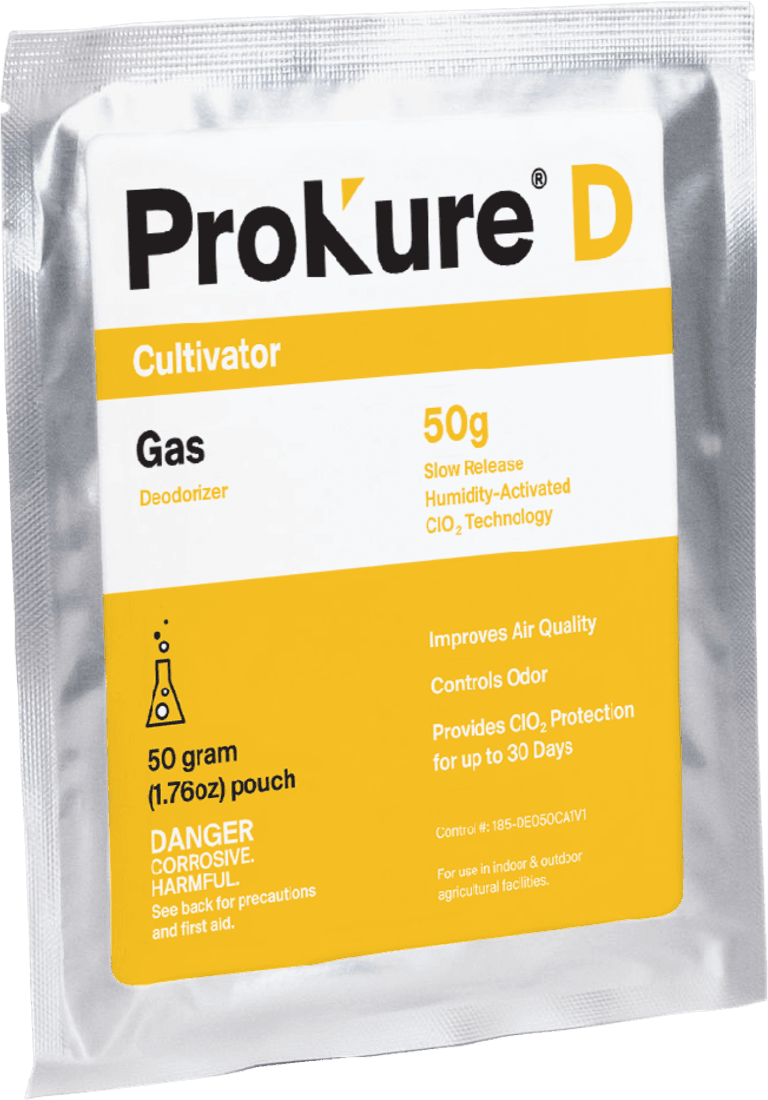
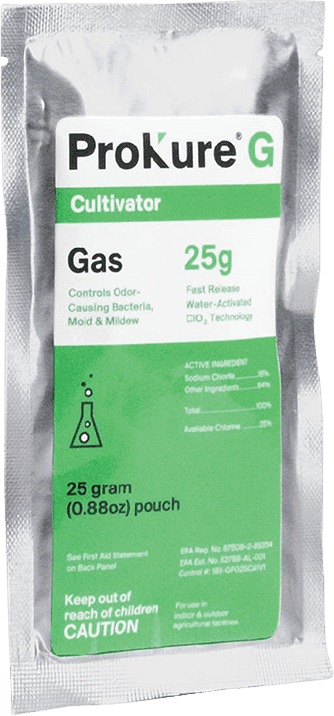
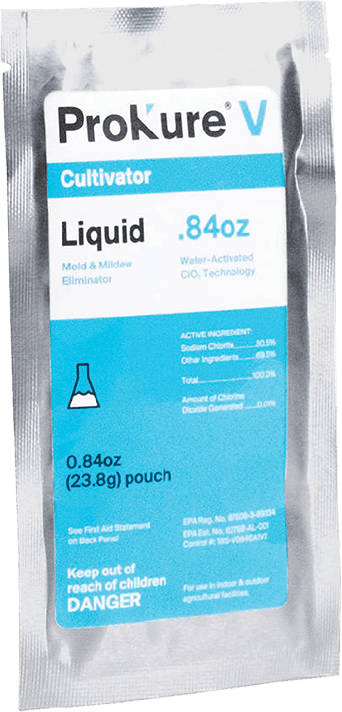
The label rule is strict and it decides which ClO2 product you use when. ProKure V is a liquid surface disinfectant, EPA Reg. No. 87508-3-89334, that kills mold and mildew, is suitable for use with plants in the room, and leaves no residue, which makes it the surface-disinfection choice. ProKure G is a fast-release gas whose label carries the disclaimer not for use with/on plants/crops/feed, so it is an empty-room gas treatment, which a turnover is, used while no crop is present. In a turnover you can run both: the plant-safe liquid on surfaces and the empty-room gas for whole-room reach. The product overviews sit at ProKure V liquid disinfectant and ProKure G fast-release gas, with labels and safety data sheets on prokuresolutions.com.
Dwell time, re-entry, and crew safety
The mistake that undoes this stage is cutting dwell time to save an hour. A disinfectant needs its labeled contact time to work, and a gas treatment needs its full dwell plus a ventilation window before re-entry. For the fast-release gas, that is a multi-hour dwell followed by ventilation and relighting before anyone goes back in, with people and pets out of the room during treatment. Honor the label's dwell and re-entry intervals exactly; they are the difference between a reset that worked and one that looked like it did.
Sequence the two applications correctly. The plant-safe liquid surface disinfectant handles the surfaces you can reach and wipe, and the empty-room gas treatment handles the whole-room reach, the corners and crevices a wipe misses. Because the room is empty during turnover, the gas product's plants-present restriction does not apply, which is exactly the window that makes a gas reset usable. Seal the room for the gas dwell, keep everyone out, and do not shortcut the ventilation before re-entry.
The crew-safety payoff of ClO2 over bleach is real here. A residue-free gas reset does not leave the harsh fumes that force a crew to evacuate mid-shift the way a heavy bleach application can, which is a direct hit on the facility manager's bleach-fume pain. It still demands the room be empty and ventilated per label, so the safety gain is about residue and lingering fumes, not a license to skip PPE or the re-entry window. Train the crew on the specific label for the product you run, and keep the safety data sheet on hand during the stage.
Stage 4: Verification (hours 24 to 36)
Verification is the stage every competing checklist omits, and it is what turns a reset from an act of faith into evidence. Bracket the disinfection with measurement: take swab points on representative surfaces and an air sample for yeast and mold, and compare them against a pass threshold you set in advance. ATP swabs give a fast read on surface cleanliness; air-plate or air-sample counts give the microbial picture the next crop will face. If a point fails, you re-treat that area before the room moves on, rather than discovering the miss in a compliance test six weeks later.
Choose your swab points deliberately rather than randomly. Hit the surfaces that matter most and the ones most likely to fail: benches and trays where plants will sit, the drain, the return plenum, door sweeps, and any corner that the disinfection pass had to reach into. A pass on an easy flat wall tells you little; a pass on the drain and the return tells you the reset actually worked where contamination hides. Set the pass threshold against your state's pre-sale yeast and mold limit with margin to spare, so a room that clears verification is comfortably inside the number you will be tested against months later. The few hours verification adds are the cheapest insurance in the whole turnover.
The verification record is also the data trail an auditor and your own QA lead want. Logging the pre- and post-treatment results against the room and date proves the sanitation reduced the load, which is a far stronger position than asserting the room is clean. For the continuous air-side version of this, feeding results into an ongoing monitoring program, see air quality management. Verification adds a few hours to the turnover and removes the single biggest source of next-cycle surprises.
Stage 5: Reset and handback (hours 36 to 48)
The final stage brings the room back to growing condition and hands it off cleanly. Restart the HVAC and ramp the environment to the targets the incoming stage needs, higher humidity for clones and young plants, the tighter bands for later stages, so the room is stable before plants arrive. Give the environment time to settle into band rather than dropping plants into a room still equalizing, because a plant's first hours in an unstable environment are a stress event you created for no reason. Stage the clones or transplants and inspect them at intake, because the cleanest room in the world is reinfected by a carrier plant, and intake is your last chance to catch one. A room reset perfectly and then planted with an infected clone is a wasted turnover, so the intake inspection is not a formality, it is the final gate of the whole sequence.
Then hand the room back with a signed turnover log. The log closes the loop: it records who ran each stage, the dwell times honored, the verification results, and the sign-off that the room is cleared for planting. That document is what makes the turnover auditable and repeatable, and for a facility running multiple rooms it is what lets a manager trust that a room reset by one crew meets the same standard as a room reset by another. A turnover without a signed log is a turnover you cannot prove happened.
The handback is also the moment to feed the data forward. The verification numbers from this turnover, logged against the room, become a baseline you can compare the next turnover against, so over several cycles you learn which rooms run hot and whether a change to your procedure actually moved the result. A room that repeatedly needs a re-treat at the same swab point is telling you something about its construction or its HVAC, and the log is how you notice the pattern instead of treating each turnover as a fresh start. Reset is not just the end of this turnover, it is the setup for a better next one.
Common mistakes, and standardizing across rooms and states
The mistakes that cost you a cycle
Four mistakes recur. The first is skipping dwell time to save an hour, which produces a room that looks reset but is not; the clock you are racing is downtime, but the clock that matters is the label's contact time, and you cannot cheat it. The second is using a product not labeled for a plant-adjacent facility, which is both an agronomic and a compliance error, and it usually happens because a crew grabbed whatever was on the shelf rather than the product the SOP specifies. The third is no verification and no data trail, which means you find your failures in the lab instead of the room, at the worst possible time and the highest possible cost. The fourth is forgetting the hidden surfaces, the drain, the return plenum, and the door sweeps, where contamination hides from a surface-level wipe and reseeds a room that looked clean. Each of these is cheap to avoid in the sequence and expensive to discover later, and all four are prevented by running the written sequence rather than improvising.
Standardizing across multiple rooms or states
For an operation running several rooms, or a multi-state operator running several facilities, the value of the checklist is that it is identical everywhere. One written SOP, one set of dwell times, one verification standard, and one signed log format mean a room reset in one facility meets the same bar as a room reset in another, which is exactly what a cultivation director coordinating across a state footprint needs. State rules vary, so confirm product shipment and use conditions per market, but the turnover sequence itself is portable. Standardization is also what makes the downtime win durable: a sequence every crew runs the same way is a sequence you can trust and improve. Without it, each facility drifts into its own habits, and a cultivation director cannot tell whether a room in one state was reset to the same standard as a room in another, which is exactly the inconsistency a multi-state operator is trying to eliminate. A single signed-log format across the footprint turns a pile of individual room resets into a program a director can audit from a dashboard. The broader program this sits inside is covered in cultivation IPM expertise.
Frequently asked questions
These are the questions facility managers ask when they sit down to run or tighten a turnover.
That is the turnover: five stages, roughly 48 hours, run in order, verified, and signed off. The reason it beats the three-to-five-day scramble is not speed for its own sake, it is that a timed sequence with dwell times honored and verification built in produces a room you can prove is clean, cycle after cycle. Strip it, clean it, disinfect it with the right labeled product, verify it, reset it, and hand it back with the log. Do that every turnover and the between-cycle window stops being the place your next crop's problems get locked in.
Related resources