
A cannabis mold remediation protocol between cycles is the written, empty-room procedure a grow facility runs during turnover, after the plants are out and before the next crop goes in, to drive the surface and air bioburden down so the incoming cycle does not inherit the last one's mold. It is not flower remediation. It does not treat harvested bud. It treats the room: surfaces, equipment, and the HVAC that moves spores between zones. This guide gives you the 72-hour version a facility manager can actually run, the chemistry choices and their EPA restrictions, and the verification steps that prove it worked.
Before you read further, a scope check so you do not waste the next twenty minutes. If you still have plants in the room and are fighting powdery mildew in canopy, this is the wrong page: start with the ProKure V liquid surface disinfectant overview, the product rated for use with plants in the room. If your question is humidity, airflow, and odor control rather than turnover, read air quality management between cycles. The broader program this protocol sits inside is covered under mold prevention protocols. Everyone turning a room between harvests, stay.
What between-cycle remediation actually means
The word remediation gets used for two completely different jobs, and buyers blur them. One industry guide draws the line cleanly: "Remediation typically refers to the process of recovering dried cannabis flower batches that have failed state-mandated quality tests due to microbial contamination. In contrast, decontamination is a proactive step integrated into the cultivation process to reduce bioburden." That distinction matters, because the flower path and the room path use different tools and answer to different rules.
This page is the room path. The flower, the harvested product, is out of scope here, because recovering failed flower is an X-ray, e-beam, gamma, or ozone problem handled by third-party processors, not something you do with a facility sanitizer. What you do with a facility sanitizer is bring the empty room's bioburden down before the next crop. Think of it as decontamination between cycles, whether or not a visible mold event happened last round.
Why the empty-room distinction changes everything
Plants-out is not a detail. It is the whole reason this protocol unlocks chemistry you cannot legally use with a crop in the room. The moment the room is empty, products labeled "Not for use with plants, crops, or feed" become available to you, and those are often the fastest air-and-surface deep-clean tools in the building. Run the protocol with plants present and you have broken a federal label restriction. Run it empty and you have used the right tool for the turnover window.
When to run this protocol
Four triggers put a room into this SOP. The first is routine: standard cycle turnover, no known event, you simply do not want the next crop inheriting the last one's load. The second is a failed yeast and mold test on the outgoing crop, which tells you the room environment was already pushing product over the line. The third is a visible mold event during the last cycle: Botrytis cinerea (bud rot), powdery mildew, or Aspergillus, each of which leaves spores on surfaces and in the air handler. The fourth is an environmental excursion: an HVAC failure, water intrusion, or a humidity spike that let conditions sit in the growth range.
Any one of these is enough. Two or more and you treat the turnover as a hard reset, not a routine wipe-down, which mostly means you do not skip the HVAC step and you do not shorten the contact times.
The distinction between a routine turnover and a response to a confirmed event is worth writing into the SOP as a branch, because the two call for different rigor. A routine turn with no prior test failure can run the standard clock and standard verification. A turn following a failed yeast and mold test, a visible Aspergillus or Botrytis event, or an HVAC failure gets the full treatment: longer contact times logged, the HVAC step mandatory rather than optional, and verification sampling on every surface class instead of a representative subset. Writing both paths into one document means the facility manager is not guessing which version of the protocol today's room needs; the trigger tells them.
The 72-hour turnover SOP
The facility-manager pain is specific: a bleach-based turnover eats 3 to 5 days, often because the crew has to evacuate for fumes and the steps run end to end instead of overlapping. The protocol below compresses a single flower-room turn into roughly 72 hours by overlapping surface prep with HVAC prep and letting contact time run while other work happens. Scale the clock up for larger rooms or multi-room runs.
Hour 0 to 4: plant-out and gross-soil removal
Get every plant, tray, and piece of loose media out. Then remove gross soil. Sanitizers do not work through a layer of dried sap, leaf litter, and dust; the soil load shields the organisms and consumes the active before it reaches them. Dry-brush and vacuum first, wet-wipe the heavy deposits second. This is the step crews rush and the step that wastes the most chemical when they do. A good rule: if a surface still looks dirty, it is not ready to be disinfected, no matter how much sanitizer you put on it. Capture the gross debris into sealed bags rather than sweeping it around the room, because dry material is exactly how spores become airborne and settle somewhere you already cleaned.
Hour 4 to 12: surface cleaning
Clean before you disinfect. A detergent pass on benches, walls, floors, drains, and fixtures lifts the organic film so the disinfection step actually contacts the surface. Pay attention to the places spores hide: corners, drain traps, the undersides of benches, and anywhere condensation pools.
Hour 12 to 24: surface disinfection with a contact-time table
Now disinfect the hard, non-porous surfaces. This is where product choice and logged contact time matter, and where the chemistry section below earns its keep. Whatever you choose, the SOP records the product, the concentration, the start time, and the stop time, because a disinfection step with no logged dwell is a step you cannot defend at audit. Work systematically around the room so no zone is missed: a common pattern is to run walls top to bottom, then benches and equipment, then floors and drains last, so gravity carries runoff toward the surfaces you clean at the end rather than recontaminating finished work.
Hour 24 to 36: HVAC decontamination
The air handler is the spore highway, and it is the step every competitor names in a bullet and nobody details. Clean the coils, change the filters, address the ductwork, and sanitize the condensate pan, which is a standing-water reservoir that reseeds the room if you skip it. The HVAC checklist later in this guide breaks this out.
Hour 36 to 48: whole-room air-phase deep clean
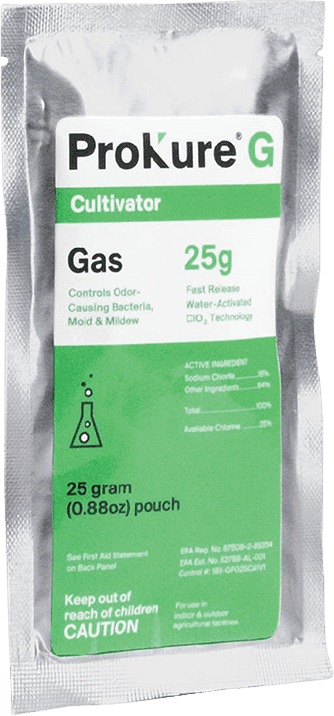
With the room empty, sealed, and the surfaces already disinfected, run the empty-room air-phase step. This is the ProKure G use case, covered in the chemistry section: a gas-phase deep clean that reaches the surfaces and air volume a wipe cannot, in an unoccupied room, with the mandatory ventilation window before anyone goes back in.
Hour 48 to 60: verification sampling
Do not trust a clean-looking room. Sample it. ATP swabs on surface classes, plus settle plates or air-cassette sampling for the air volume, give you a pass or fail number instead of a hopeful glance. If a surface fails, re-clean and re-disinfect that zone before you move on.
Hour 60 to 72: dry-down, buffer, and re-entry
Let the room dry fully, clear any required ventilation interval for the products used, confirm re-entry conditions, and only then stage the next crop. The buffer at the end is not slack; it is the margin that keeps a rushed turn from carrying moisture or residual activity into the new cycle. It is also the window where you confirm the environmental controls are back in range before plants go in, so the fresh room does not immediately drift into the conditions that caused the problem you just spent 72 hours clearing.
Chemistry selection for between-cycle work
The buyer usually has four or five options on the shelf, and the SERP does not compare them on the thing the facility manager actually cares about: residue and plant adjacency for the next cycle. Here is the honest comparison.
Chlorine dioxide (ClO2): the GroClarity product path
Chlorine dioxide is the chemistry GroClarity builds the turnover around, and it splits across two ProKure products with distinct, label-separated jobs.
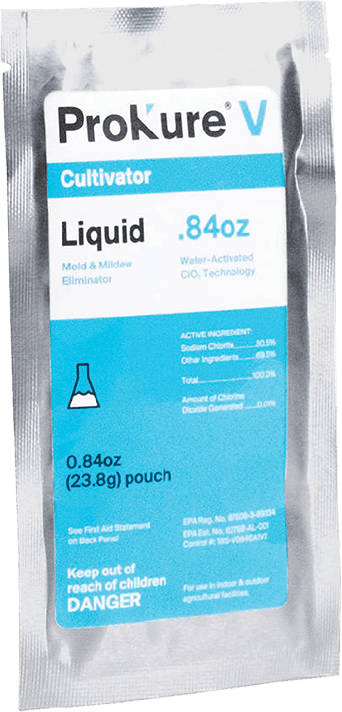
ProKure V is the liquid surface disinfectant (EPA Reg. No. 87508-3-89334). You add water to activate it, apply it directly, and it leaves no residue: no wipe, no rinse. It is suitable for use with plants in the room, which makes it the surface tool you can keep using once the next crop is in. On its label kill list, used at 100 ppm for a 10-minute exposure on hard, non-porous surfaces, V disinfects against Fusarium solani (ATCC 36031), Botrytis sp., Penicillium digitatum (ATCC 201167), Aspergillus niger (ATCC 9642), and MRSA (ATCC 33591), among others, and it kills SARS-CoV-2 on hard, non-porous surfaces in 30 seconds. That combination, a broad surface kill list plus plant-safe and residue-free, is the thing bleach and quats cannot claim.
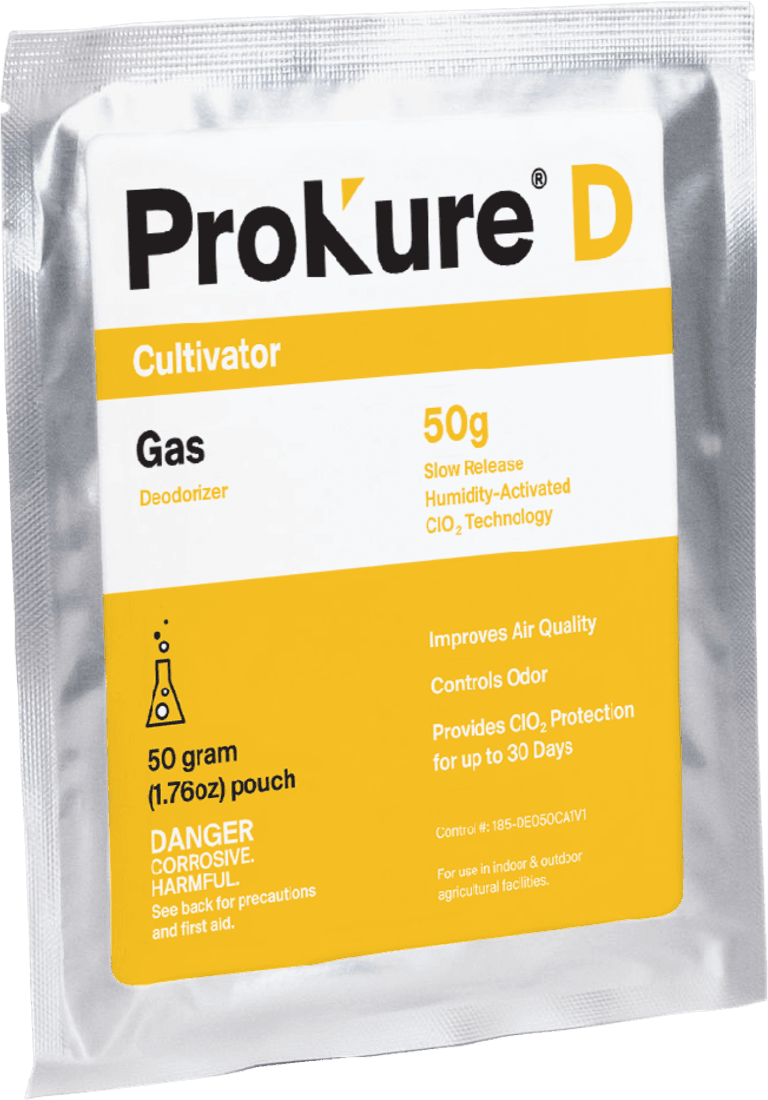
ProKure G is the fast-release gas deodorizer (EPA Reg. No. 87508-2-89334), and it is the empty-room half of the turnover. It is the solution for mold and mildew, odor-causing bacteria, and chemical odors between harvests: a deep-penetrating ClO2 vapor that works in four to six hours and reduces downtime. G carries the required disclaimer, verbatim: "Not for use with/on plants/crops/feed." That is why it runs only during turnover, with the room empty and the crew out, followed by at least one hour of ventilation before re-entry. Do not apply G with plants present, and do not use it as a surface-contact-time disinfectant; its job is the fast air-and-surface deep clean in an unoccupied room.
For how the empty-room gas step fits the turnover, see ProKure G fast-release gas for the empty-room deep clean; the full product detail, labels, and SDS live at the deep-detail source, prokuresolutions.com, and to order, go to the store at shop.groclarity.com.
Quats, bleach, and the peroxide family
Quaternary ammonium compounds (quats) disinfect but leave a residue, which is the problem when the next crop's roots and foliage will touch the same surfaces. Sodium hypochlorite (bleach) is cheap and familiar, but it off-gasses fumes that force the crew out, corrodes stainless over time, and leaves its own residue. The hydrogen peroxide and peracetic acid family breaks down to less persistent byproducts than bleach, which helps on residue, but efficacy depends heavily on concentration and contact time and the stronger formulations bring their own handling hazards.
The comparison that matters for a between-cycle SOP is not which one disinfects, because most of them do at the right concentration and dwell. It is residue and plant adjacency. A residue-free, plant-safe surface chemistry (V) lets you keep sanitizing surfaces once the crop is back in; the empty-room gas step (G) handles the air-phase reach while the room is unoccupied. That pairing is what the bleach-and-quat shelf cannot match, and it is why the turnover does not have to mean a five-day evacuation.
One more practical note on sequencing the chemistry. Do not mix products or run them back to back without reading their labels on compatibility; chlorine dioxide chemistry in particular should never be combined with acids or other cleaners, and several of the alternatives off-gas in ways that make combining them hazardous. Finish one chemistry's job, ventilate, then move to the next. The SOP should name the order of operations explicitly so an operator under turnover pressure does not improvise a combination that is unsafe or that cancels one product's efficacy with another's residue.
HVAC decontamination checklist between cycles
Ventilation is the spore-distribution vector, and a room is only as clean as the air handler feeding it. The SERP pages list "HVAC system decontamination" as a bullet and publish zero specifics. Here is the specific list.
- Coils: clean the evaporator and condenser coils, where biofilm and dust accumulate and moisture collects.
- Filters: change them, do not just inspect them, and record the MERV rating installed.
- Ducts: address the duct runs, because surface cleaning a room while the ducts hold spores reseeds the space on the first fan cycle.
- Condensate pan: sanitize it. It is standing water, and standing water is a reservoir that puts organisms back into the airstream.
Run the HVAC steps in parallel with the room's hour 24 to 36 block so the air handler is clean before the whole-room air-phase step, not after. Sequencing matters here: if you run the air-phase deep clean and then clean the ducts, you have pushed the room's spore load into a dirty air handler that will blow it back out on the next startup. Clean the handler, then treat the room, then verify, in that order.
There is a documentation angle to the HVAC step most facilities miss. Record the MERV rating of the filter you install and the date, because filter change intervals are one of the first things a thorough auditor asks about when microbial contamination is in question. A filter log that shows a consistent change cadence is evidence the air handler was maintained, not just cleaned once in a panic after a failed test. Tie the filter change to the same turnover record as the rest of the protocol so the whole event reads as one documented sequence.
Verification, documentation, and EPA compliance
A protocol you cannot prove you ran is a protocol an auditor treats as not run. This section is the proof layer, and it is the one the competitor pages skip entirely.
ATP swabs, sampling, and the records a QA lead files
Use ATP swabs to verify surface cleanliness, reading results in relative light units against a pass or fail target you set per surface class. Back that with settle plates or air-cassette sampling to check the air volume, not just the benches. Keep a photo log of before and after, the sanitizer product and lot, the SDS on file, and a chain-of-custody that ties the sanitation event to the room and the incoming batch. State regulators already require retesting of a product after its remediation; facility sanitation record requirements vary by state, so build your documentation to the strictest one in your footprint and it passes everywhere looser.
The verification step is also where the between-cycle protocol separates itself from a hopeful wipe-down. A surface that looks clean under the lights can still carry a bioburden an ATP swab will flag, and the air volume of a sealed room is invisible to inspection entirely. Setting a numeric pass or fail target per surface class, and acting on a fail by re-cleaning that zone before re-entry, is what turns the protocol from a ritual into a measurement. If you cannot hand a QA lead a number, you have not verified anything; you have only cleaned and hoped. The sampling records, paired with the product and contact-time log, are the packet a Cultivation Director standardizes across a multi-facility footprint so every room's turnover reads the same way to the same auditor.
EPA compliance: what the label class actually means
This is the biggest worry cultivators name, so it belongs in the body, not a footnote. The reason a between-cycle SOP exists as its own document is that an empty room unlocks products a crop room cannot use. ProKure G carries "Not for use with/on plants/crops/feed" precisely because it is an empty-room product; that single label restriction is why the turnover window, not the grow cycle, is when G runs. ProKure V, the liquid surface disinfectant, is suitable for use with plants in the room, so it spans both. Writing the restriction into the SOP, at the step where the product is named, is what keeps the document a shield instead of a liability.
The practical consequence is a two-column mental model your SOP should make explicit. In the crop-present column sit the products cleared for use with plants in the room, where ProKure V's residue-free surface disinfection lives. In the empty-room-only column sit the products carrying the plants, crops, or feed restriction, where the ProKure G gas step lives. An operator should never have to interpret a label mid-turnover; the SOP has already sorted each product into its column and named the room condition required before it comes off the shelf. That single piece of up-front sorting is what turns EPA compliance from a worry into a checkbox.
PPE, re-entry, and the cost of downtime
Match the respirator and PPE to the chemistry in the step, not to a generic "wear a mask" line. Bleach and the stronger peroxide formulations demand real respiratory protection and ventilation. For the ProKure G gas step, nobody is in the room during treatment, and re-entry waits for the ventilation window: ventilate and turn on lights for one hour before anyone goes back in, with the treatment and safe re-entry times recorded. Post a caution placard at the door that carries the treatment start time and the cleared re-entry time, so a worker on a different shift cannot walk into a room mid-cycle. The placard is cheap and it is the kind of visible control an inspector reads as a facility that takes re-entry seriously.
The owner's math is the close. A turnover that drops from 5 days to roughly 72 hours is harvests per year recovered off the same square footage, and a documented between-cycle protocol is a small recurring labor line against the cost of a failed test on a six-figure crop. One industry decision guide puts a single failed concentrate batch at "$10,000 to $100,000+ in raw material, labor, and processing costs depending on scale." Prevention priced against that number stops being a cost line and starts being insurance. For the broader program this turnover protocol sits inside, see mold prevention protocols.
Related resources