
A cannabis grow room sanitation SOP is the written, sequenced procedure a facility hands a crew lead so the same cleaning, disinfection, and verification happen the same way in every room, every cycle, with a record to prove it. It is a document, not a blog about documents: it has a purpose, a scope, named roles, a materials list, numbered steps, a verification method, and a log. This guide gives you the eight sections every sanitation SOP needs, a zone-by-zone frequency framework, the between-cycle turnover sequence, the EPA-compliant chemistry notes most guides skip, and a verification trail an auditor accepts.
One scope note. This page owns the SOP document itself, not chemistry selection or pathogen biology. For the broader cultivation program, see cultivation IPM expertise; for the mold thresholds the SOP keeps you under, mold prevention protocols; for the air side, air quality management. A facility manager should leave here with an SOP outline they can staff-train against by Friday, not another article explaining why sanitation matters.
What a sanitation SOP is, and what it is not
A cannabis grow room sanitation SOP is a controlled, written document that specifies how the facility is cleaned, disinfected, and verified, by whom, on what cadence, and recorded in what form. That is different from a cleaning checklist, which is a task list with no roles or verification, and different from a cGMP protocol, which is the broader quality framework the SOP sits inside. The SOP is the operational middle: specific enough to train a crew against, documented enough to show an auditor. That dual job is why most of what ranks for this query misses: a product catalog or a student explainer teaches the idea of sanitation but gives a facility manager nothing to hand a crew on Monday. The test of a real SOP is whether a crew lead who has never seen the room could execute it from the page, and whether an inspector who has never met the staff could verify it from the record. Everything below is built to pass both tests.
The three terms it has to get right are cleaning, sanitizing, and disinfecting, because they are not interchangeable and a regulator knows it. Cleaning removes visible soil. Sanitizing reduces microbial load to a safe level. Disinfecting kills a defined set of organisms on a hard surface. An SOP that uses them loosely invites a finding; one that uses them precisely, with the right product at the right step, reads as a controlled process. Who owns it also belongs in the document: the facility manager owns the SOP, the head grower and crew execute it, and the QA lead audits it. Naming the owner matters more than it sounds, because a sanitation step with no named owner is the step that falls into the gap between "someone should" and "someone did," which is exactly where an auditor finds a hole and where an outbreak starts. The document is also the thing that lets the standard survive staff turnover: an SOP a new crew lead can read and follow on their first Monday keeps the operation consistent in a way institutional memory never does, because the person who held that knowledge eventually leaves.
The eight sections every sanitation SOP needs
The SERP is full of articles about sanitation and nearly empty of actual SOPs. A real one has eight sections, and leaving any out is the gap an auditor finds.
Purpose through materials
- Purpose: what the SOP is for and the outcome it protects, keeping the room's microbial load below the state's pre-sale threshold.
- Scope: exactly which rooms, which growth stages, and which crews it binds.
- Roles and responsibilities: who cleans, who verifies, who signs off, named by position.
- Materials and PPE: the products, tools, and protective equipment, each with the gloves, eye protection, and respiratory protection the chemistry requires.
Procedure through revision history
- Procedure steps: the full sequence, in strict order, because order matters (clean before you disinfect, or the disinfectant is wasted on the soil).
- Verification: how you confirm the step worked, with a defined method and a pass or fail threshold.
- Recordkeeping and audit log: the fields captured per event and where they live.
- Revision history and training sign-off: version control and proof the crew was trained on the current version.
Publishing the structure openly lets a reader confirm it covers their state's inspection before downloading the editable version. A document with all eight is auditable; one missing verification or recordkeeping is a chore list with a title page.
The two sections facilities skip most are verification and revision history, and they are the two an auditor weighs heavily. A procedure with no verification step cannot prove it worked, only that it was attempted; a document with no revision history and training sign-off cannot prove the crew was running the current version rather than one that cited a product you stopped using a year ago. Those are not bureaucratic flourishes. They are the difference between an SOP that protects the facility and a laminated card on the wall that an inspector reads as decoration.
The zone-by-zone frequency framework
The single artifact facility managers come for is a matrix: which surface, in which zone, at what cadence, verified how. One facility-wide frequency is the mistake, because a flower room and a cure vault do not share a risk profile.
Build the table with zones down the side (mother, clone, veg, flower, dry, cure, trim, airlock, hallway) and for each surface class (floors, walls, benches, tools, drip trays, reservoirs, HVAC intake and return) assign a cadence and a verification method. Daily tasks are fast, the fifteen-minute-per-room pass: wipe high-touch surfaces, clear debris and standing water, check drip trays and reservoirs for the biofilm and pooling that quietly feed a mold problem. The daily pass is the cheap, high-frequency work that keeps the environment from drifting into the range where spores germinate, and it is the pass crews skip first when they are busy, which is exactly why it belongs on the checklist with a sign-off rather than left to habit. Weekly tasks go deeper: benches, tools, walls, and a documented surface sanitation pass with the product and contact time logged, the cadence that catches the slow buildup a daily wipe leaves behind. The between-cycle turnover is the full sanitation event, covered in its own section below. Quarterly and annual tasks reach the HVAC coils and ducting that daily work never touches, the spore reservoirs a wipe-down never sees, which is why they need their own cadence rather than being folded into the routine pass that will always deprioritize them. Pair each cell with a verification method, visual for routine, ATP swab or air sampling for the deep passes, so the table is not just a schedule but a proof plan.
The frequency table is also where clean-to-dirty discipline gets encoded. Sequence the daily pass so a crew works from the lowest-pressure room to the highest and not back, and specify that tools do not cross between zones, so the cleaning routine itself does not become the vector that carries a flower-room problem into the clone room. A table that only lists tasks and cadences misses this; a table that also fixes the order of rooms and the handling of shared tools turns the schedule into a containment control. That is the difference between a facility that cleans and one that cleans without spreading what it is trying to remove.
The between-cycle turnover SOP, step by step
This is the section that attacks the facility manager's biggest pain: the three-to-five-day downtime a bleach turnover costs. The turnover runs with the room empty, which is what makes a fast, residue-free reset possible and what unlocks the empty-room chemistry a crop room cannot use. Write it as numbered steps a crew lead can follow without interpretation, because the turnover is the highest-stakes sanitation event in the cycle: it is the moment the next crop's starting bioburden is set, and a rushed or out-of-order turn hands the new cycle the last one's problems.
The sequence: remove all plants and media; remove gross soil with a wet vacuum and sweep, capturing debris into sealed bags so it does not go airborne; wash with detergent to lift the organic film, because no disinfectant works through dried sap and dust; rinse and let surfaces reach the state the disinfectant needs; apply the disinfection step; hold the required dwell time; verify with a swab; and sign off before re-entry and setup.
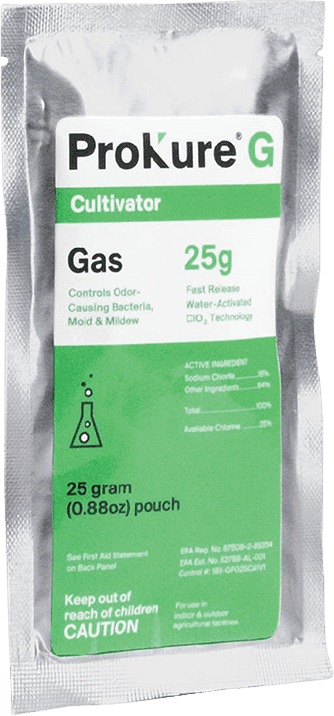
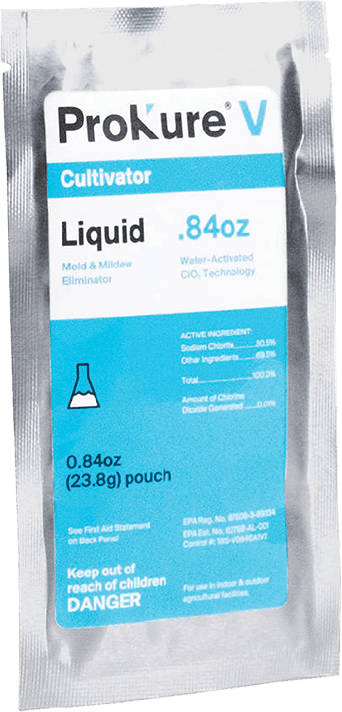
The disinfection step is where chemistry and room condition meet. For the hard-surface disinfection step itself, ProKure V is a hospital-type liquid surface disinfectant (EPA Reg. No. 87508-3-89334) that works at 100 ppm for a 10-minute exposure, leaves no residue, no wipe and no rinse, and is suitable for use with plants in the room, which also makes it the surface tool you can keep using once the next crop is in. For an empty-room air-and-surface fog during the turnover, where the gas phase reaches what a wipe cannot, ProKure G is a fast-release gas deodorizer (EPA Reg. No. 87508-2-89334) that works in four to six hours and carries the verbatim restriction "Not for use with/on plants/crops/feed," so it runs only with the room empty and the crew out, followed by at least one hour of ventilation before re-entry. Log the product, the concentration, the dwell time, and the cleared re-entry time at each step. A residue-free workflow like this is what pulls a multi-day turn toward a same-day one, because there is no evacuation for lingering fumes and no rinse before the next crop touches the bench. The chemistry comparison in depth lives under mold prevention protocols.
Do not skip the HVAC in the turnover. The air handler is the spore highway, and a room surface-cleaned while the ducts and the condensate pan still hold spores reseeds itself on the first fan cycle, so the turnover SOP sequences the coil clean, filter change, and condensate-pan sanitation before the air-phase step, not after. And sequence the whole turn so the slow steps, contact times and ventilation windows, run in the background while hands-on work continues elsewhere. A turnover is a scheduling problem as much as a cleaning one, and the operations still losing five days are usually running every step in series instead of overlapping the waits. Never combine ClO2 with acids or other cleaners; finish one chemistry, ventilate, then move to the next.
Disinfectant chemistry inside the SOP, with EPA compliance
The biggest worry compliance leads name is EPA, and it belongs in the SOP body at the step where a product is named, not in a footer. The SOP has to state which products are registered, for what site of use, and under what room condition.
Registration and the label boundary
Under FIFRA, a product making a hard-surface disinfection claim carries an EPA registration number, and the label is enforceable, governing where it may be used and whether plants may be present. That distinction sorts the shelf. Bleach (sodium hypochlorite) disinfects but off-gasses fumes that force the crew out, corrodes surfaces, and leaves residue that has to be wiped. Hydrogen peroxide breaks down more cleanly but efficacy swings with concentration and contact time. Quaternary ammonium compounds leave residue the next crop contacts. Chlorine dioxide (ClO2) is the chemistry that answers the residue-and-plant-adjacency problem, split across ProKure V and ProKure G as described above, plus ProKure D for ongoing air quality.
The product rule the SOP encodes
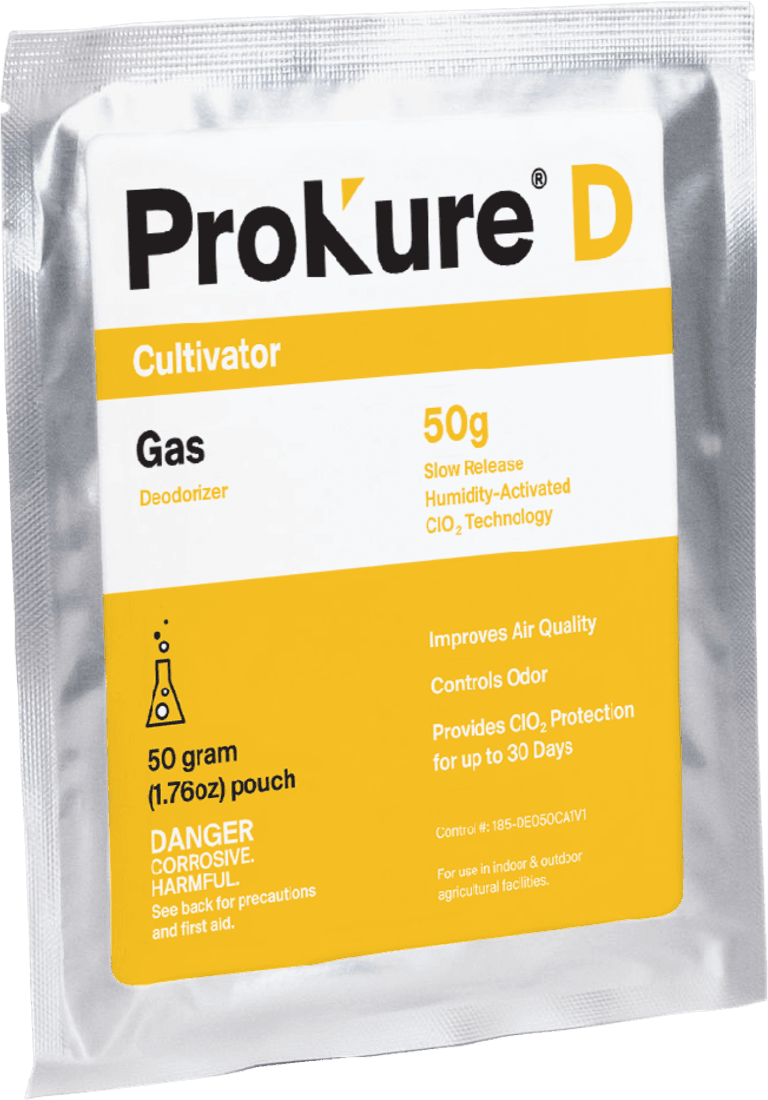
ProKure V is suitable for use with plants in the room and leaves no residue. ProKure G carries "Not for use with/on plants/crops/feed" and is empty-room only. ProKure D is a slow-release gas that provides ClO2 protection for up to 30 days and runs with plants present, but it is not an EPA-registered product, carries the verbatim disclaimer "Not an EPA-registered product and not labeled for sale as a pesticide under 40 CFR," and makes no kill claim. Do not attach G's plant restriction to V or D, and do not treat V as a gas. Name each product at its step with its registration status and room condition, and keep the SDS and label on file for every product the SOP names. The product specs live at ProKure V liquid surface disinfectant and ProKure G fast-release gas. Write the procedure chemistry-agnostic where you can (name the function and the dwell, then the approved product), so a procurement swap does not require rewriting the whole SOP.
The practical model the SOP encodes is a two-column sort an operator never has to interpret under pressure. One column holds the products usable with plants present, where V's residue-free surface disinfection and D's ongoing air layer sit; the other holds the empty-room-only products carrying the plants, crops, or feed restriction, where G sits. Pre-sorting every product into its column, with the room condition named at the step, turns the single most common compliance error, the right product used at the wrong time, into a checkbox rather than a judgment call at the end of a long shift. It also matters that an EPA registration is for a hard-surface disinfectant, which is a separate thing from a state-approved pesticide for use on plants; the SOP keeps those in different rows, because a product legal as a surface disinfectant is not automatically permitted as a crop treatment, and the state cannabis allowed list is a check distinct from federal registration.
Verification and the audit trail
An SOP you cannot prove you ran is an SOP a regulator treats as unrun. Verification and recordkeeping are the two sections that turn the procedure into evidence.
Verify with the right method for the step: ATP bioluminescence swabs confirm surface cleanliness against a pass, caution, and fail threshold set per surface class, and spore traps or air samples confirm the room volume, not just the bench. Both feed the data trail a head grower hands an auditor to prove air quality was controlled, which is the exact gap most operations have: they clean diligently and can prove almost none of it, because the verification step was never written into the SOP. Setting the ATP thresholds once with your supplier and holding them makes the readings comparable over time, so the trend, not just the single number, tells you when a surface class is slipping before an outbreak does. The sanitation log captures, per event, the date, room, task, product and lot, dwell time, operator, verification method, result, and sign-off. Keep the SDS binder and EPA label file current and in one retrievable location, because an inspector who asks for the label of a product named in the SOP expects to be handed it. The SOP is upstream of the state pre-sale yeast and mold test: it exists to keep the microbial load under the state's CFU per gram cap, which is why the verification thresholds should be set with that cap in view.
Continuity is the part operations underweight. The most common documentation failure is not a missing log but a log that runs for a month, lapses, and resumes the week before an inspection, which an auditor reads as a period the facility went unmanaged, whatever actually happened. A continuous log of ordinary, in-range readings is more persuasive than a polished binder with gaps, because it shows the SOP ran on the unremarkable days, not just the day someone remembered the audit was coming. Store it where it is retrievable in minutes and tie each record to the room and the harvest batch, so a positive test can be traced to exactly which room, product, and cycle in minutes rather than days.
Portability across facilities, and the economics
Two audiences need the last section: the multi-state director and the owner.
For a multi-state operator, write the SOP portable: a master document holding the universal procedure, verification, and recordkeeping, plus a per-state appendix for each state's allowed-product list, testing thresholds, and record-retention window. Write the procedure language chemistry-agnostic so a facility that sources a different approved product does not need a new SOP, only an updated materials line. Centralize the SDS and label management and the training sign-off so corporate QA audits every facility against one standard. For the state-by-state regulatory variance, cross-reference cultivation IPM expertise. Build the appendix structure from the start even in a single state, because retrofitting it after several facilities have each drifted into their own SOP is far more work than designing for it up front, and it is the difference between corporate QA auditing one standard and chasing five divergent ones. It also compresses training: a cultivator who transfers between facilities relearns only the appendix, not the whole document.
For the owner, the economics close the case. A written SOP is a small recurring labor line against three large downside costs: a failed pre-sale yeast and mold test on a six-figure harvest, a licensing action from a failed audit, and the lost production of a multi-day turnover. A residue-free turnover that recovers days of downtime is more harvests per year off the same square footage, and a documented program is what keeps a facility financeable and licensed. Framed per avoided loss, the SOP is not a cost line; it is the cheapest insurance in the building.
The download that pairs with this page is the editable version: the eight-section template, the zone-by-zone frequency table, the between-cycle turnover steps, the sanitation log, and the EPA label card, formatted so a facility manager can adapt the room names and setpoints and train a crew against it the same week. Everything above is visible on purpose, so you confirm the structure fits your state's inspection before giving up an email. You now know what a complete sanitation SOP contains, which means you can build or audit your own before an inspector does, and the program it plugs into lives under cultivation IPM expertise.
Related resources