
A cannabis facility sanitation SOP is the written, facility-wide standard operating procedure a licensee adopts and submits or shows at inspection, specifying what chemistry is used (by EPA registration number), which surfaces are treated, at what frequency, by whom, and how each treatment is documented. It is a licensing requirement in many state programs, and an inspector compares it to what they observe. A document that describes a program you are not running is a liability; one that matches your real program is an asset. This guide gives you the seven-step sanitation sequence, the sections inspectors check, the EPA citation format they expect, and the verification log that makes it defensible.
One scope note. This page owns the SOP document itself, facility-wide, not the single-room walk-through, the printable checklist, the chemistry debate, or the remediation response. For the broader program, see cultivation IPM expertise; for mold thresholds, mold prevention protocols; for the air side, air quality management. A compliance lead should leave here with the full document architecture an inspector reads for, section by section.
What a facility sanitation SOP is
Sanitation standard operating procedures, sometimes written SSOPs, are the documented procedures governing how an entire licensed facility, not just the grow rooms, is cleaned and disinfected: cultivation, propagation, drying and cure, trim and packaging, extraction and processing where present, waste handling, and the shared spaces between them. Whether an SSOP is required, and in what detail, varies by jurisdiction, so the first move is always to check your state program's application and inspection standards. What does not vary is the inspector's test: does the written document reflect the program actually running on the floor.
The term SSOP comes from food safety, where sanitation standard operating procedures are a long-established part of a food plant's quality system, and cannabis regulators increasingly borrow the same expectation. That lineage is useful, because it means the structure a cannabis facility needs is not novel; it is a well-worn framework adapted to a new crop and a new set of state rules. Borrowing the food-industry discipline, a named chemistry, a logged cadence, a verification step, a trained crew, is exactly how a cannabis SOP earns an inspector's confidence rather than reinventing a shakier version.
The gap most facilities fall into is specificity. Most SOPs describe sanitation in general terms, while inspectors are looking for specific chemistry, a documented cadence, verifiable logs, and evidence that the people executing the procedures were trained on them. The single most common finding is a mismatch between the frequency the SOP states and the frequency the log shows. The rule that avoids it is blunt: write the SOP around what you actually do, not what you aspire to do, then raise the operation to meet the document rather than the other way around. The failure mode is counterintuitive: the operator who writes the most rigorous-sounding SOP, daily treatment of every surface, hourly logs, often creates the biggest compliance exposure, because the floor cannot sustain it and the logs fall behind the document. An honest SOP that specifies a cadence the crew actually hits, and a log that shows they hit it, beats an aspirational one every time. The document is a promise to the inspector; keep it to a promise you can keep.
The seven-step sanitation sequence every SOP is built on
Underneath the document architecture is a physical sequence, adapted from food-safety sanitation practice, that every procedure step should follow. Naming it keeps the SOP from skipping the step that makes the next one work.
The seven steps: inspect the surface and the area; remove gross debris by dry sweeping or vacuuming; pre-rinse where appropriate to loosen remaining soil; wash with a detergent to lift the organic film; post-rinse to clear the detergent and loosened soil; inspect again to confirm the surface is visibly clean; and only then sanitize or disinfect, because a disinfectant cannot work through a layer of soil, sap, and dust. The order is not negotiable, and the most expensive mistake is jumping from a quick wipe straight to disinfection, which wastes the chemistry on the soil and leaves the surface no cleaner than it looked. The shorter five-step framings people ask about collapse the two inspection steps into the adjacent ones, but the logic is identical: clean thoroughly first, verify, then disinfect.
Writing the sequence into the SOP does two things. It gives the crew an unambiguous order of operations so a new hire does not improvise, and it gives the inspector a recognizable framework that signals the facility understands sanitation as a process, not a spray. The step most operations shortchange is the pre-clean, the debris removal and detergent wash, because it is the unglamorous part and the disinfectant feels like the real work. But the disinfectant is only as good as the clean beneath it, and an inspector who sees a disinfection log with no corresponding cleaning step reads a program that is treating soil, not surfaces.
The document architecture inspectors check
A defensible facility sanitation SOP is built from the same sections regardless of state, because they map to what an inspector verifies. Build it from these and nothing an inspector asks for is missing.
Chemistry, surface scope, and method
Chemistry identification names the specific registered product by trade name, EPA registration number, and active ingredient. "EPA-registered disinfectant" is not enough; the citation has to be specific enough that an inspector can look it up. Surface scope is an enumerated list, benches, floors, walls, HVAC returns, irrigation hardware, tools, containers, door handles, PPE, not the word "all surfaces," because a named list proves you thought about each. Application method and concentration specify how the product is applied (spray, wipe, dip, flood), at what concentration, and the dwell time before the surface counts as treated, matching the label.
Frequency, responsibility, and documentation
Frequency states when each surface type is treated: daily during production, between batches, between crop cycles, after a contamination event, specific per surface rather than "as needed." Responsibility names the role, not the person, so the SOP survives staff turnover. Documentation names the log created when a task is done, where it lives, and how long it is retained. Two more sections round it out: a revision history with training sign-off, proving the crew runs the current version, and a post-contamination escalation that triggers the full between-cycle decontamination regardless of crop stage, because an SOP covering only routine sanitation is incomplete.
The escalation section is the one most SOPs omit and the one that matters most when it is needed. Routine sanitation assumes nothing has gone wrong; a contamination event is precisely the moment the routine was not enough. The SOP should state that a positive test or a visible event triggers the full decontamination sequence immediately, that adjacent rooms are assessed for exposure, and that the event and response are documented as a deviation with a corrective and preventive action. An inspector reading an SOP with a contamination-escalation section sees a program that planned for the bad day; one without it sees a program that only works when nothing happens.
Facility-wide scope, zone by zone
A facility SOP is broader than a grow-room one, and the scope section has to say so, because the query and the licensing requirement are facility-level, not room-level. Each zone carries a different risk and gets its own cadence and chemistry, and the scope section is where you enumerate them rather than implying a single blanket procedure covers the building.
Production and propagation rooms get daily floor and high-touch surface treatment during production, with benches and rooting-tray hardware sanitized before each new batch, any tray or dome that contacted the previous batch cleared, and cutting tools sanitized per plant, not per batch. Drying and cure rooms get sanitized before product enters and logged through the dry, because this is where a clean grow still fails a lab test: the biomass is giving up moisture, a crowded or under-ventilated dry room climbs above target within hours, and contamination introduced at this stage rides onto a sellable harvest that cannot be cleaned afterward. Trim and packaging, where product is handled most, get food-contact-grade surface sanitation and gowning. Extraction and processing areas, where a facility has them, align the sanitation schedule to the production runs and carry their own equipment-cleaning validation, because solvent-contact surfaces and closed-loop hardware are a different cleaning problem than a grow bench. Waste handling and the shared hallways and airlocks get their own rows, because waste is an active reservoir that can reseed the clean rooms and the airlock is the exclusion boundary that keeps outside contamination from walking in on a shoe or a cart. Both are easy to leave out of an SOP written room-first, and both are exactly where an inspector looks when the grow-room sections check out. Between crop cycles, every production room gets full decontamination, walls, floors, fixtures, HVAC returns, bench frames, and irrigation lines, emitters, and reservoir interiors. The irrigation hardware is the piece routinely skipped, because it is out of sight, but lines, emitters, and a reservoir interior that carried the last crop's water are a biofilm reservoir that reseeds the new crop the moment flow starts. The HVAC returns are the other blind spot: a room surface-sanitized while the returns still hold spores reseeds on the first fan cycle, which is why the between-cycle rows have to reach the parts a daily wipe never touches. For the pathogen and threshold specifics each zone protects, see mold prevention protocols.
The reason a facility SOP cannot just be a grow-room SOP with the title changed is that the non-grow zones carry risks the cultivation rooms do not. Extraction and processing introduce solvents and equipment with their own cleaning validation; packaging is the last human touch before product leaves the building; waste is an active reservoir that can reseed the clean rooms if it is not isolated and handled on a schedule. A facility SOP that covers the grow rooms in detail and waves at the rest leaves exactly the gaps an inspector walks toward, because the unglamorous zones are where the undocumented shortcuts accumulate. Give each zone its own rows, its own cadence, and its own responsible role.
Chemistry and EPA citation inside the SOP
The biggest worry compliance leads name is EPA, and the SOP has to carry it in the body, product by product, in the format an inspector reads. An inspector knows which chemistries are EPA-registered for use in a cannabis cultivation environment, so an SOP naming an active ingredient not registered for its intended application creates a question.
The citation format and the ProKure products
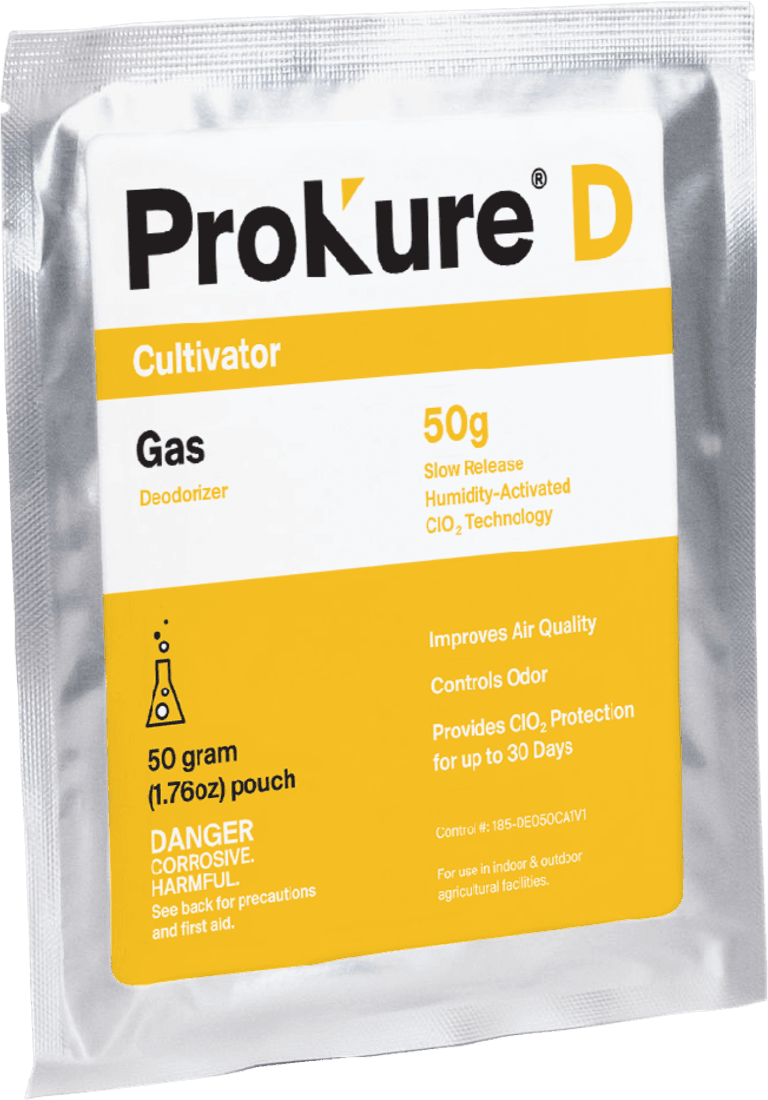
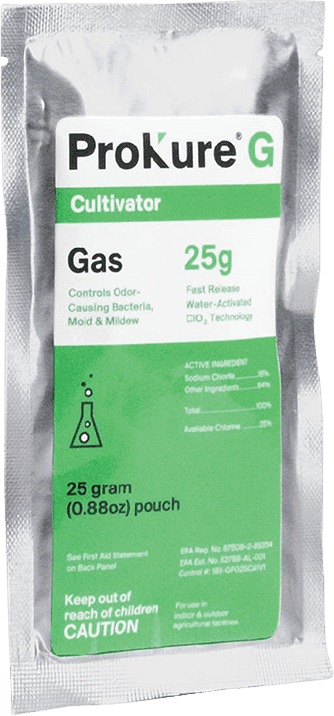
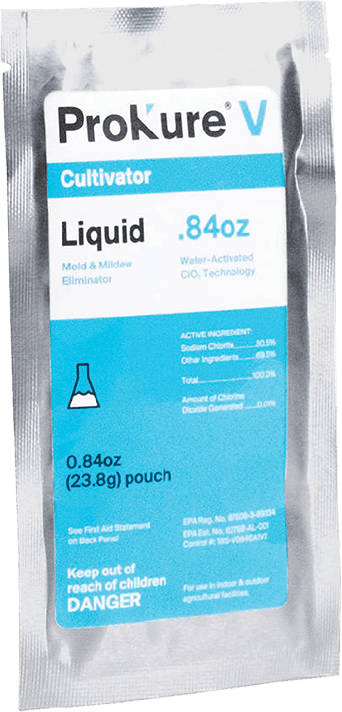
Cite each product as trade name, EPA registration number, and active ingredient. Applied to the ProKure line: ProKure V, EPA Reg. No. 87508-3-89334, chlorine dioxide, a liquid surface disinfectant that works at 100 ppm for a 10-minute exposure on hard, non-porous surfaces, leaves no residue, and is suitable for use with plants in the room, which makes it the surface tool usable in occupied zones. ProKure G, EPA Reg. No. 87508-2-89334, chlorine dioxide, a fast-release gas deodorizer that carries the verbatim restriction "Not for use with/on plants/crops/feed" and runs only in an empty room with a ventilation window before re-entry. And ProKure D, a slow-release gas that provides ClO2 protection for up to 30 days and runs with plants present, which is not an EPA-registered product and carries the verbatim disclaimer "Not an EPA-registered product and not labeled for sale as a pesticide under 40 CFR," and makes no kill claim. Do not attach G's plant restriction to V or D, and do not treat V as a gas. The specs live at ProKure V liquid surface disinfectant and ProKure G fast-release gas.
The two-column sort and the state layer
The SOP encodes a sort an operator never has to interpret: products usable with plants present (V for surfaces, D for ongoing air) in one column, empty-room-only products carrying the plants, crops, or feed restriction (G) in the other, with the room condition named at each step. That keeps the most common compliance error, the right product used at the wrong time, off the record. And an EPA registration for a hard-surface disinfectant is a separate check from a state's cannabis pesticide allowed list, so the SOP verifies both: federally registered and permitted by the state program where the facility operates. Keep the SDS and label on file for every product named, because an inspector who asks is handed the document rather than watching a search.
The citation discipline is worth getting right because it is a fast credibility signal. An inspector who sees "EPA-registered disinfectant" in an SOP has to go verify what you mean; one who sees the trade name, the registration number, and the active ingredient can confirm it in a minute and move on. The specific citation also protects you against the scenario where a product is reformulated or a registration changes: the SOP points to a verifiable number, not a vague category, so the refresh is a line edit rather than a rewrite. Print the registration number where the product is named, not buried in an appendix, so the claim and its proof sit together on the page the inspector is reading.
Verification, recordkeeping, and the audit trail
The SOP is the plan; the logs are the proof, and an inspector reads the proof against the plan. The single rule is that the two must match: an SOP specifying daily floor treatment has to produce daily log entries, and a gap between the stated frequency and the documented frequency is a finding.
Verify with the right method: ATP bioluminescence swabs confirm surfaces against a pass and fail threshold set per surface class, and spore traps or air samples confirm the room volume. The sanitation log captures, per event, the date, room, task, product and lot, concentration, dwell time, operator, verification method, result, and sign-off. Keep it continuous, because a log that lapses for weeks and resumes before an inspection reads as a period the facility went unmanaged, and store it where it is retrievable in minutes. Train the crew on the current SOP and keep the training records, because many state programs require documented training and an untrained procedure is a gap that surfaces in the employee-interview portion of an inspection, whether or not the procedure itself is sound. Tie records to the room and the harvest batch so a positive test traces back fast, and set the verification thresholds with the state pre-sale yeast and mold cap in view, since the SOP exists to keep the facility under it.
The verification method is also what separates a sanitation program from a cleaning habit. A crew that wipes a bench and moves on has cleaned; a crew that wipes, swabs, and records a result against a threshold has verified, and only the second produces evidence. ATP thresholds should be set once with your supplier and held so the readings are comparable over time, because the trend across weeks tells you a surface class is slipping before a single reading or an outbreak does. The air-side verification, spore traps or viable air samples on a cadence, covers the room volume a surface swab cannot, and it is the data a head grower hands an auditor to answer the one question routine logs do not: was the air itself under control.
Standardizing across facilities, and the download
For a multi-state operator, the SOP standardizes the way the program does: one master document holding the universal sequence, sections, and verification, plus a per-state appendix for each state's allowed-product list, testing thresholds, record-retention window, and corrective-action clock. Write the procedure chemistry-agnostic where you can, naming the function and dwell before the approved product, so a procurement swap updates a materials line rather than the whole document. Centralize the SDS and label management and the training sign-off so corporate QA audits every facility against one standard. Build the appendix structure from the start even in a single state, because retrofitting it after facilities drift into their own versions is far more work than designing for it. The state-by-state framework is part of cultivation IPM expertise.
The standardization payoff is both compliance and speed. Compliance, because a director can defend one consistent program to an auditor in any state rather than explaining why each facility does it differently. Speed, because a cultivator who transfers between facilities relearns only the appendix, not the whole document, and corporate QA pulls any site's records in the same shape rather than deciphering five formats. The master-plus-appendix structure also makes a rule change a contained edit: when one state revises its allowed list or its testing threshold, you update that state's appendix and every facility there inherits the change, while the master and the other states stay untouched.
Everything above is visible so you can confirm the structure fits your state's inspection before you give up an email. The gated download is the editable version: the full section template, the seven-step sequence, the zone-by-zone frequency table, the EPA citation format, the sanitation log, and the contamination-escalation procedure, formatted so a compliance lead can adapt it and train against it the same week. You now know what an inspector reads an SOP for, which means you can write or audit yours before they do.
If you take one principle from this, make it the match between the document and the floor. Every other detail, the seven steps, the citation format, the zone scope, the verification log, serves that one test, because the inspection is not really a review of your writing; it is a comparison of your writing to your practice. A modest SOP the facility actually follows beats an ambitious one it does not, every time. Build the document around the program you run today, hold the crew to it, keep the records continuous, and the inspection becomes a confirmation rather than a cross-examination.
Related resources