
A cannabis facility mold prevention audit checklist is the document a QA or compliance lead uses to verify, zone by zone, that the controls preventing mold are in place and recorded, so the facility can hand it to a state inspector, a third-party auditor, or corporate QA and pass. It is not a growing guide and not a remediation plan. It is a control system with inspectable evidence: environmental readings, EPA-compliant sanitation inputs, air and surface sampling, and a corrective-action loop. This page gives you the zone checklist, the EPA rules that govern which sanitizer goes where, the sampling an auditor expects, and a free downloadable version.
One scope note. This page is the audit artifact, not the growcraft behind it. For prevention taught as cultivation, start with the hub, mold prevention protocols; for the IPM framework, see cultivation IPM expertise; for HVAC and air specifics, air quality management. If you have an active outbreak right now, you need remediation first, not an audit, and the two serve different moments. QA and compliance leads preparing for an inspection or running an internal self-assessment, read on.
What a mold prevention audit checklist is, and is not
Three documents get confused, and an auditor cares about the difference. An IPM plan is the prevention strategy. A remediation SOP is what you do after a mold event. An audit checklist is the verification layer: it does not teach prevention or fix a problem, it confirms that the controls exist, are being followed, and are documented. The checklist is what proves the other two are real.
Who runs it: internal QA on a schedule, a third-party GACP or EU-GMP auditor, an MSO corporate QA team, and ultimately a state inspector. They are all asking the same question in different words, show me that your mold controls are in place and that you can prove it. And they run it on a cadence, not once: pre-cycle before a room fills, mid-cycle during the active grow, post-harvest around the dry and the cure, and quarterly as a full facility self-assessment. A checklist pulled out the week before an inspection is a checklist that fails, because the records behind it have gaps.
The reframe that matters here is treating prevention as a documented control system rather than as growcraft. A skilled grower can keep a room clean by instinct and still fail an audit, because the auditor cannot grade instinct, only evidence. Flip it around and the point of the checklist becomes clear: it exists to make the invisible discipline visible, to turn what a good operator already does into something a stranger can verify in an afternoon. That is why every item on it pairs a control with the record that proves the control ran.
The audit also protects the operator in a way a growing guide never does. When an inspector arrives, the facility with a current, zone-by-zone checklist and the records behind it controls the conversation; the facility without one is reconstructing its own history under pressure while the inspector forms an impression. The checklist is as much a shield as a chore.
The four pillars of a defensible mold prevention audit
Every item on the zone checklist rolls up to one of four pillars. Frame the audit around these and no control falls through a crack.
The first pillar is environmental controls with evidence: humidity, temperature, airflow, and differential pressure held in range and logged, not just set. The second is EPA-compliant sanitation inputs: the right disinfectant for each zone, named with its registration status and label condition. The third is a sampling and testing trail: air and surface sampling on a defined cadence with the results stored for review. The fourth is documentation and a corrective-action loop: training records, deviation reports, and a CAPA (corrective and preventive action) process that shows the facility catches and fixes its own problems. A checklist that covers all four is auditable; one that covers only cleaning is a chore list.
The pillars also map to the four questions an inspector actually asks, which is why they are the right spine. Did you hold the environment in range (pillar one)? Did you use a legal product where it was legal (pillar two)? Can you show the room was actually clean, not just wiped (pillar three)? And when something went wrong, did you catch it and fix it (pillar four)? A facility that can answer all four with records rather than assurances passes. A facility that can answer only the first two is a facility that cleans but cannot prove it worked or that it learns from a miss, which is exactly the gap an auditor probes.
The zone-by-zone audit checklist
This is the core artifact. A single facility-wide list misses that a mother room, a flower room, and a cure vault carry different mold risks and need different checks. Audit each zone against its own controls.
Mother, clone, and vegetative rooms
The entry point for contamination. Verify quarantine for incoming clones and mother stock, hop latent viroid testing before anything joins production, scouting on a logged cadence, humidity held to the veg target, and surfaces sanitized with a plant-safe disinfectant between transplants. These rooms set the bioburden the rest of the facility inherits, which is why a weak clone-intake control shows up three zones downstream as a flower-room problem nobody can trace. The audit treats quarantine and HLVd testing as hard gates here, with the release decision recorded, because an untested clone is the cheapest contamination to prevent and the most expensive to chase once it has moved into production.
Flower rooms
The highest-value zone and the powdery mildew and botrytis pressure peak. Verify canopy humidity dropping on schedule through late flower, airflow reaching the dense canopy and not just the room reading, early-botrytis scouting in the thickest colas where the rot starts hidden, and surface sanitation on tools and benches that can run with plants present without leaving residue. The flowering-stage specifics are under mold prevention protocols. Because this zone holds the most crop value, it is also where an operator is most tempted to skip a sanitation step to avoid disturbing the plants, which is exactly why a plant-safe, residue-free surface disinfectant matters: it lets the surface controls keep running with the crop in place rather than being deferred to turnover.
Dry room, cure, and vault
Where a clean grow still fails. Verify the dry room was sanitized before anything hung, humidity and airflow held so the biomass does not push the room above target, a burping and hygrometer routine on cure jars, water-activity records on cure batches, and storage held in the finished-flower band. Contamination here rides straight onto a sellable harvest, and it is the stage where the lab test actually happens, so a miss in the dry or cure zone is a miss that fails a batch rather than one that stays a plant-health problem. The audit weights these zones accordingly: a sanitized dry room verified before the crop hangs, airflow and humidity logged through the dry, and water activity recorded per cure batch, because this is the last place to catch a problem before product moves to the vault and then to sale.
Trim, packaging, HVAC, and entry
Trim and packaging handle product most, so verify food-contact-grade surface sanitation, clean-tool control, and gowning, because this is the zone where human contact with finished flower is highest and a contamination introduced here cannot be cleaned off the product. The HVAC plenum and return-air path are the spore highway, so verify coil cleaning, filter changes with the MERV rating logged, duct attention, and condensate-pan sanitation. The entry airlock and gowning station verify that people and visitors do not carry contamination in, which is the control most often implied and least often documented, so the audit makes it explicit with a gowning log and a visitor protocol. Each zone gets its own checklist page so an auditor can walk the facility and tick controls room by room.
The discipline the zone structure enforces is clean-to-dirty flow and zone-appropriate chemistry. A mother room and a cure vault should never share tools, a crew should move from low-pressure zones to high-pressure ones and not back, and the surface disinfectant that runs in an occupied flower room is not the empty-room gas that runs during a turnover. Writing the checklist per zone forces those distinctions onto the page, so an operator cannot accidentally carry a flower-room problem into the clone room or reach for an empty-room product while plants are present. The zones are not just a convenient layout; they are the control.
EPA compliance: which sanitation products go where
This is the biggest worry compliance leads name, and the largest gap in the pages that rank for this query: none address the EPA restriction that decides which sanitizer is legal in which zone. The audit checklist has to, because an inspector reads it first.
EPA-registered disinfectants versus the label boundary
Under FIFRA, a product making a hard-surface disinfection claim carries an EPA registration number, and the label governs where it may be used, including whether plants may be present. That single distinction sorts the sanitation shelf, and the audit verifies each product is used only where its label allows. It also matters that an EPA registration is for a hard-surface disinfectant, which is a different thing from a state-approved pesticide for use on plants; conflating the two is a common finding. The audit keeps them separate, because a product legal as a surface disinfectant is not automatically permitted as a crop treatment, and a state's cannabis pesticide list is a separate check from federal EPA registration.
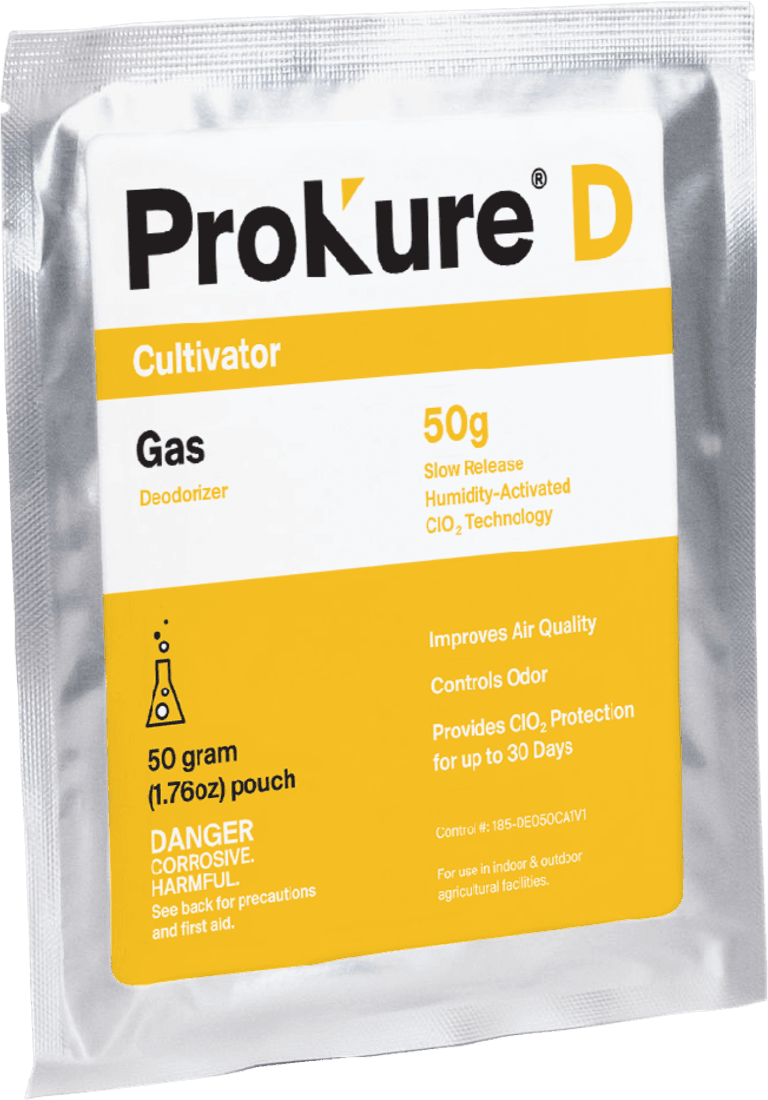
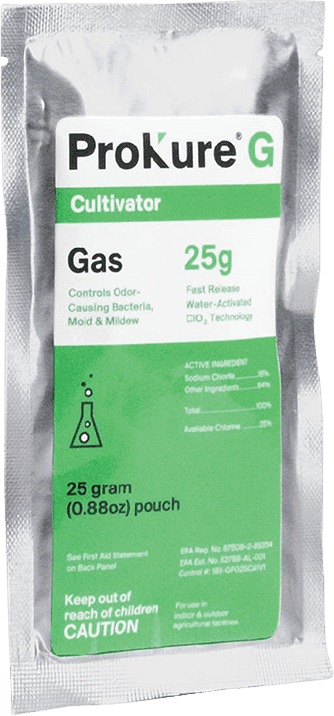
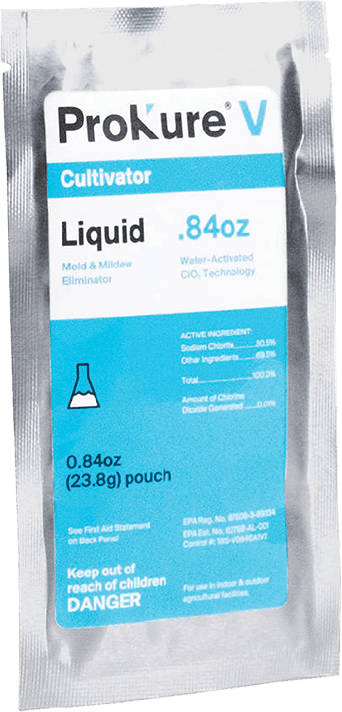
Chlorine dioxide (ClO2) appears in the audit as three distinct products. ProKure V is a liquid surface disinfectant (EPA Reg. No. 87508-3-89334) that works at 100 ppm for a 10-minute exposure on hard, non-porous surfaces, leaves no residue, naturally dissipates, and is suitable for use with plants in the room, which makes it the surface tool usable in occupied zones. ProKure G is a fast-release gas deodorizer (EPA Reg. No. 87508-2-89334) carrying the verbatim restriction "Not for use with/on plants/crops/feed," so the audit confirms it is used only in empty rooms with a ventilation window before re-entry. ProKure D is a slow-release gas that provides ClO2 protection for up to 30 days and runs with plants present, but it is not an EPA-registered product, carries the verbatim disclaimer "Not an EPA-registered product and not labeled for sale as a pesticide under 40 CFR," and makes no kill claim. Do not attach G's plant restriction to V or D. The specs are at ProKure V liquid surface disinfectant and ProKure G fast-release gas.
The audit's job with these three is a two-column verification an operator never has to interpret mid-shift. One column holds the products usable with plants present (V for surfaces, D for ongoing air); the other holds the empty-room-only product carrying the plants, crops, or feed restriction (G). The auditor confirms each zone's sanitation step pulled from the correct column and that the room condition matched. This is where the single most common compliance finding, the right product used at the wrong time or in the wrong zone, gets caught on the self-audit instead of by the inspector.
Residue, and the documents on file at audit
The residue question is why the chemistry matters near a crop: bleach and quaternary ammonium compounds leave residue the next crop contacts, where a residue-free surface disinfectant does not. The audit verifies the residue-appropriate product was used in each zone. And it verifies the paperwork: a current SDS and the EPA label (or the 40 CFR disclaimer for the non-registered air product) on file for every sanitation product named in the SOP, with the registration number printed where the product is named, so an inspector who asks is handed the document rather than watching a search.
Sampling and evidence: what auditors ask to see
The checklist is only as strong as the evidence behind it, and this is where good intentions fail an audit. Specify the evidence, do not leave it implied.
Air sampling: a defined frequency, a method, and a location map so the same points are sampled each time and the air volume is covered, not just the benches. Surface sampling: ATP swabs on high-touch surfaces read against a pass, caution, and fail threshold set per surface class, with the trend tracked because a surface creeping up week over week warns before an outbreak does. Water activity: Aw records on cure batches, because water activity is the number that predicts cure-room mold risk better than a room humidity reading. Environmental logs: temperature, relative humidity, and differential pressure captured continuously per zone. Store all of it where it is retrievable in minutes and keep it continuous, because an auditor reads a gap in the record as a period the zone went unmanaged, whatever actually happened in it.
Water activity deserves a closer look because it is the number most cure-room programs miss. Room relative humidity tells you about the air; water activity (Aw) tells you about the product itself, which is what actually gates mold growth in cured flower. Two batches at the same room humidity can carry very different water activity depending on how they dried, and the one running high is the one that molds in the jar weeks later. An audit that logs Aw per cure batch catches that risk before it ships, where a program watching only room humidity does not. It is a defensible technical control that also happens to be the kind of depth an EU-GMP auditor rewards.
The location map for air sampling matters as much as the frequency. Sampling the same convenient spot every time proves that spot is clean; a map that covers each zone, the returns, and the known dead pockets proves the facility is clean. Auditors notice when the sample points are chosen for coverage rather than convenience, because it signals the program is looking for problems rather than for a passing number.
CAPA when the audit finds a mold hit, and multi-state standardization
An audit that finds a problem and has no process for it is an audit that scares ownership instead of protecting them. The corrective and preventive action loop is what a mature facility shows.
When a hit is found: quarantine the affected batch and place the inventory on hold in the track-and-trace system, document the deviation, run the root-cause analysis (microbial contamination is almost always an environmental or sanitation failure, a waterlogged root zone, a dry room that ran too humid, a sanitation step skipped), take the corrective action, and add the preventive change to the SOP so the same gap does not recur. The two halves of CAPA are easy to conflate and important to separate: the corrective action fixes this batch and this room, while the preventive action changes the system so the cause cannot produce the same failure again. A facility that only ever takes corrective action keeps hitting the same problem; a facility that closes the preventive loop stops. An auditor reading the CAPA log can tell the difference, because a recurring deviation with repeated corrective actions and no preventive change is a visible sign the quality system is treating symptoms. The CAPA record, dated and closed out, is what turns a finding into evidence of a working quality system rather than evidence of a broken one.
The counterintuitive part is that auditors are reassured by a facility that has CAPA records, not alarmed by them. A clean record with zero deviations ever logged reads as a facility that is not looking, because every real operation hits the occasional out-of-range reading or missed step. What an auditor wants to see is that the facility caught it, documented it, found the cause, fixed it, and prevented the recurrence. A closed CAPA loop is the single clearest signal of a mature quality culture, which is why the audit checklist treats the CAPA process as a control to verify, not an embarrassment to hide.
For a multi-state operator, the checklist itself standardizes. Keep one master audit checklist plus a per-state appendix holding that state's allowed-product list and testing thresholds, so a rule change updates one appendix and corporate QA audits every facility against the same master. That is also how the checklist maps cleanly onto the inspection forms state cannabis divisions publish: the master covers the universal controls, the appendix covers the state-specific line items. The IPM framework behind the whole system is cultivation IPM expertise. Build the appendix structure from the start even if you operate in one state today, because retrofitting it after several facilities have each drifted into their own checklist is far more work than designing for it up front, and it is the difference between a corporate QA team auditing one standard and chasing five divergent ones.
Download the audit checklist
Everything above is visible so you can confirm the structure fits your state's inspection before you give up an email. The gated download is the working version: a zone-by-zone checklist with the four pillars built in, the sanitation-chemistry table with EPA status and room conditions, the sampling specification, and a CAPA template. The form asks only for email and facility footprint, so the follow-up fits your operation. Run it as a self-assessment first, on the quarterly cadence, and treat every item you cannot immediately evidence as a finding to close before an inspector finds it for you. A self-audit that surfaces its own gaps is cheap; the same gap found during a state inspection is a citation. The point of owning the checklist is to be the one who finds the problems. You now know what a defensible mold prevention audit contains, which means you know enough to run your own self-assessment before an inspector runs theirs, and the hub for the whole bucket is mold prevention protocols.
Related resources