
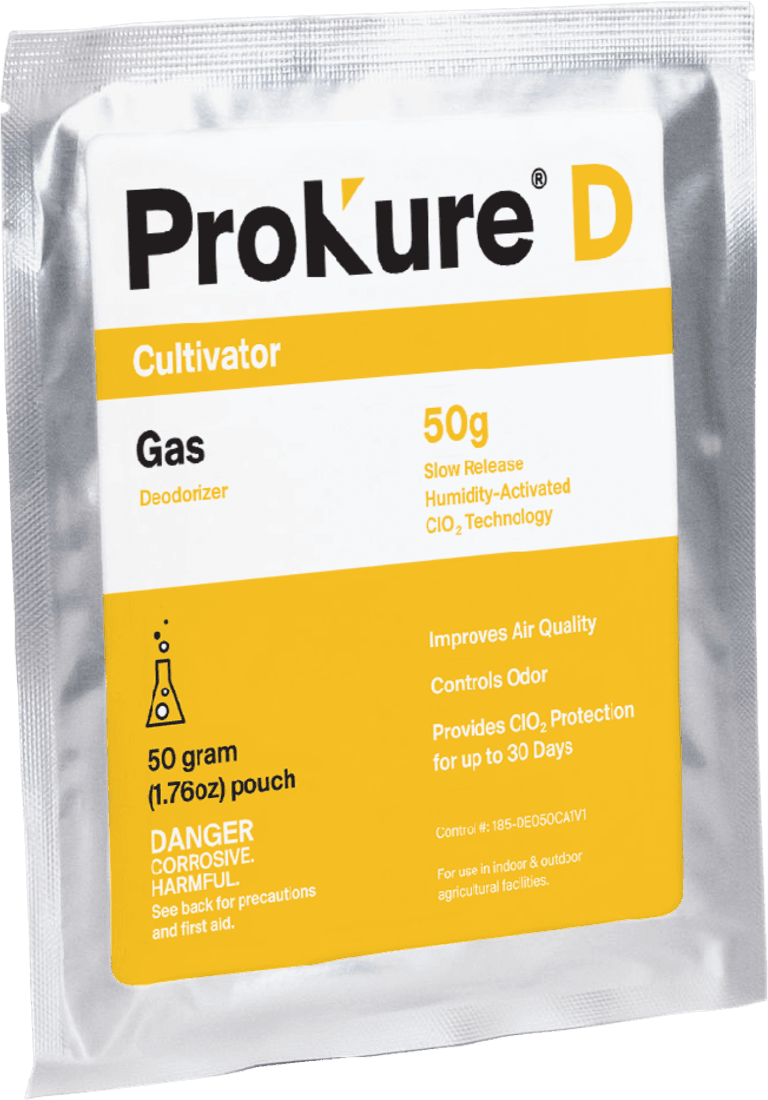
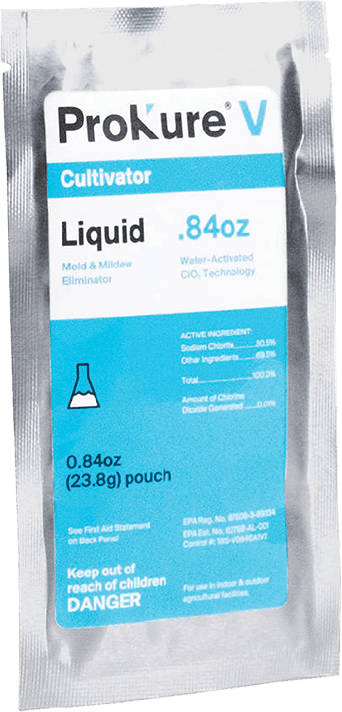
Chlorine Dioxide and Metal Corrosion: What Cannabis Growers Need to Know About Benches, Trellis, and HVAC
You own $180K of stainless benches and $40K of aluminum trellis, and a grower forum told you chlorine dioxide eats metal. The fear is not baseless, the published corrosion studies are real, but they describe a use case that is not yours. Continuous immersion of a water pipe for eight weeks at 70 C is not the same as wiping a bench for ten minutes at room temperature. This page separates the two, goes metal by metal through a grow-room inventory, and tells you where ProKure V sits in the safe envelope. The short version: at label concentration, on periodic contact, on the metals in a typical grow room, corrosion risk is low.
The short answer for growers in a hurry
Chlorine dioxide can corrode metal, but whether it corrodes yours comes down to three variables: concentration, contact time, and the pH of the finished solution. The published studies that scare people run one or more of those variables far past anything a grow-room surface protocol uses.
ProKure V is a liquid hospital-type disinfectant used at 100 ppm with a 10-minute contact time at ambient temperature, and it leaves no residue. That is periodic contact at a modest concentration, followed by evaporation, on surfaces you can wipe and dry. It is not continuous immersion, and it is not the strongly acidified chlorite generation chemistry that the oldest corrosion study on this topic used. Those two distinctions are the whole argument, and the rest of this page unpacks them so you can hand the reasoning to your maintenance team.
Why chlorine dioxide corrodes some metals and not others
ClO2 is an oxidizer, not an acid
The first thing to get straight is the mechanism. Chlorine dioxide damages metal by oxidation, by pulling electrons from the metal surface, not by the acid attack most people picture when they hear corrosion. That matters because the passive oxide layer on stainless steel, the same layer that makes stainless stainless, is itself an oxide, and under the right conditions it holds up well against an oxidizer. The British Stainless Steel Association puts the exposure distinction plainly: as a dry gas chlorine dioxide does not tend to be aggressive towards stainless steels, but as either a damp gas or dissolved in water it can be a corrosion hazard. Form and contact decide the outcome.
What oxidizing actually does to a metal surface
When ClO2 does attack a metal, it changes the surface chemistry. The clearest published picture comes from the Vertova 2019 pipe study: after eight weeks of continuous dosing, copper pipe had turned to porous cupric oxide and galvanized steel had undergone partial dezincification, losing zinc from the surface. Those are oxidation outcomes, not dissolving-in-acid outcomes. The takeaway for a grower is that the damage accumulates with sustained wetted contact. Remove the sustained contact and you remove most of the mechanism.
The three variables that decide corrosion
Every credible source converges on the same three levers. Concentration: higher concentrations are more corrosive, and the industrial studies that show rapid attack use far higher sustained levels than a 100 ppm surface solution. Temperature: metals compatible at room temperature can begin to corrode at elevated temperatures, and the pipe studies run hot (70 C) while a grow-room wipe-down is ambient. Contact time: a disinfection dwell measured in minutes is a different world from pipes held wet for weeks. Control those three and corrosion stops being the risk the forum made it out to be.
The three exposure regimes, and why they get confused online
Most of the fear comes from reading one exposure regime and applying it to another. There are three, and they are not interchangeable.
Continuous immersion
This is the water-treatment and cooling-loop world. The Vertova study held copper and galvanized steel pipes in a semi-closed system with ClO2 dosed continuously, water at 70 C, 5 bar pressure, for eight weeks, and reported strong surface degradation even at a mild 1 mg/L concentration. That is the harshest regime in the literature, and it is a plumbing scenario. Your benches are not submerged in flowing treated water for two months. If you find a corrosion horror story online, check whether it is a pipe study. It usually is.
Generation chemistry
The second regime is the industrial generation of chlorine dioxide from acidified sodium chlorite. The classic finding, from the sciencedirect corrosivity study, is that 304 and 316 stainless corroded rapidly when exposed to acidified chlorite solution, while chlorine dioxide near neutral pH was noncorrosive. Read that carefully: the rapid corrosion tracked the strong acidification of the chlorite, not chlorine dioxide at a normal use pH. A finished disinfectant use-solution is not the strongly acidified generation bath. Confusing the generation chemistry with the finished solution is the single most common error on this topic.
Finished use-solution surface disinfection
The third regime is yours. ProKure V is activated with water into a finished solution, applied to hard non-porous surfaces at 100 ppm for a 10-minute exposure at ambient temperature, then it dissipates and leaves no residue. Contact is periodic, concentration is modest, temperature is ambient, and the surface is dried rather than held wet. This is the regime none of the top-ranking pages describe, because none of them is written for a grow room. It is the regime that matters for your equipment.
Metal-by-metal breakdown for a cannabis facility inventory
Growers do not care about titanium heat exchangers. You care about the specific metals in your room. Here is the inventory.
304 and 316 stainless steel (benches, sinks, rolling tables)
Stainless is the industry standard around chlorine dioxide for a reason: it forms a passive oxide layer that resists attack, and 316L in particular is the most commonly used metal in ClO2 systems. The caution from the sciencedirect study applies to strongly acidified chlorite generation chemistry and to sustained exposure, not to a periodic 100 ppm wipe. For benches and rolling tables, a label-concentration surface protocol with a dry-down afterward sits comfortably in the safe zone. Wipe spills, do not let solution pool in seams or under clamps for hours.
Aluminum (trellis netting frames, HVAC fins, light frames)
Aluminum is more reactive than stainless and is the metal to handle with the most care. Aluminum relies on its own thin oxide film, and an oxidizer plus standing moisture can pit it over time. The rule here is simple: do not let ProKure V solution pool on aluminum, and wipe trellis frames and fin surfaces dry after contact. Periodic contact followed by a dry-down is fine; a puddle left in a trellis corner overnight is the thing to avoid.
Galvanized steel (bench legs, structural framing, some fan housings)
Galvanized steel is zinc-coated, and zinc is exactly what the Vertova study watched degrade through dezincification under continuous dosing. On your equipment the coating is the sacrificial layer, so treat galvanized surfaces like aluminum: wipe, do not soak, and dry. The eight-week immersion outcome does not transfer to a ten-minute surface dwell, but the direction of risk is real enough to respect.
Copper (irrigation fittings, some plumbing)
Copper oxidizes readily, and the pipe study turned copper to porous oxide under sustained contact. Copper irrigation fittings should not be left wetted with disinfectant solution. If a fitting gets oversprayed, wipe it and move on. Brief, periodic contact is tolerable; standing contact is not.
Brass (hose bibs, valve bodies)
Brass is a copper-zinc alloy and inherits both metals' sensitivities, including dezincification risk. Same protocol: avoid pooling, wipe dry. Valve bodies and hose bibs rarely need direct disinfection anyway, so the easiest control is to keep solution off them.
Powder-coated and zinc-plated hardware (racks, shelving, fasteners)
Intact powder coat is a barrier and generally shrugs off periodic surface contact. The weak points are chips and scratches where bare metal shows through, and cut edges on zinc-plated fasteners. Keep solution out of damaged coating and dry exposed hardware. Coated racks are usually the least of your worries.
The grow-room compatibility reference
Use this as the one-page summary for a maintenance binder. The pattern is consistent across every metal: at label concentration on periodic contact, risk is low; at prolonged or pooled contact, risk climbs; at above-label concentration, do not go there.
- 304 and 316 stainless: low risk at 100 ppm periodic contact; low to moderate if solution is left pooled for hours; wipe and dry.
- Aluminum: low risk with a dry-down; moderate to high if pooled; never leave standing solution.
- Galvanized steel: low risk periodic; moderate if pooled (dezincification); wipe and dry.
- Copper and brass: low risk periodic; moderate to high if wetted continuously; keep solution off fittings.
- Powder-coated and zinc-plated hardware: low risk if coating is intact; address chips and scratches; dry exposed metal.
No competitor page on this query gives a grower-specific table like this. The ranking pages are water-treatment and academic sources, and none of them lists a bench, a trellis, or an HVAC fin. That gap is the reason this page exists.
How ProKure V sits inside the safe envelope
Finished use-solution, not generation chemistry
The corrosion that scares people in the sciencedirect study came from strongly acidified chlorite. A ProKure V finished use-solution is a different animal: you add water to activate, apply it, and it leaves no residue. It is a mildly acidic disinfectant solution used at a controlled concentration, not the aggressive low-pH generation bath. If your maintenance team wants the exact finished-solution pH for a materials sign-off, pull it from the ProKure V SDS on prokuresolutions.com rather than quoting a number off a marketing page; the SDS is the document a warranty conversation will reference.
Label concentration and contact time
ProKure V is used at an exposure time of 10 minutes at 100 ppm to disinfect hard non-porous surfaces. That is the number the EPA label controls, and it is the number that keeps the exposure regime in the periodic-contact zone described above. Do not improvise higher concentrations in the belief that stronger is better, going above label is both a compliance violation and the fastest way to move a metal from the low-risk column to the moderate one.
EPA registration, and why compliance equals material safety
ProKure V is EPA registered under EPA Reg. No. 87508-3-89334. It is a violation of Federal Law to use the product in a manner inconsistent with its labeling, which means the label concentration and contact time are not suggestions. Here is the part competitors miss: following the label is also the material-safety protocol. The label concentration is a tested, bounded exposure. Stay on it and you stay inside the corrosion envelope at the same time. Compliance and equipment protection are the same conversation.
A practical protocol to protect your equipment
Rinse or dry stainless after disinfection
For stainless benches and tables, let the 10-minute dwell complete, then wipe surfaces dry. ProKure V leaves no residue as it dissipates, but a dry surface is the one that is not holding any oxidizer against the metal. Drying is a thirty-second habit that removes the pooling risk entirely.
Handle aluminum with a no-pooling rule
For trellis frames, light frames, and HVAC fins, the rule is no standing solution. Spray or wipe, respect the contact time, then dry the metal. Never let solution collect in a trellis corner or a fin channel overnight.
Log your dwell times
Keep a record of concentration, contact time, and surfaces treated for each cleaning. That log does double duty: it is the data trail a compliance auditor wants, and it is the record a maintenance warranty conversation needs if a surface ever shows wear. A head grower answering to ownership and an MSO cultivation director standardizing protocol across facilities both need this written down.
If you over-concentrate by accident
If a batch gets mixed stronger than label, do not use it on your equipment. Dilute to the label 100 ppm before application. ProKure V activated solution also has a handling window: stored finished solution should be used within 15 days of activation and then discarded, so do not keep an old batch around to stretch it.
Related questions, and where to confirm the spec
Corrosion is a surface-materials question, separate from two concerns growers often fold in. If your question is residue on plants, that is its own topic: ProKure V is suitable for use with plants in the room and leaves no residue, and the residue detail belongs on the dedicated residue page. If your question is re-entry time and breathing safety, that belongs on the occupant-safety page. Keep the questions separate so you get the right answer to each.
Growers also ask why not just use bleach, since bleach is corrosive too. That head-to-head comparison against bleach and quaternary disinfectants belongs on the comparison pages. The short point: bleach leaves residue and carries its own metal-corrosion profile, and a residue-free disinfectant applied at a controlled concentration on periodic contact behaves differently than chlorine bleach left on a surface.
For a materials sign-off, the ProKure V SDS and label live on prokuresolutions.com. To reorder ProKure V for surface disinfection, shop.groclarity.com is the buy path. If you run a multi-facility footprint and need the compatibility reasoning standardized across every state, use the groclarity.com contact form to talk through your bench and trellis inventory. No other ClO2 source is writing this for grow rooms. Built on science, backed by results.
Frequently asked questions
These answer the questions growers and their maintenance teams actually search, grounded in the published studies and the ProKure V label.
Related resources