
ClO2 Gas PPM for Grow Rooms: Concentration, OSHA Limits, and EPA Compliance
A QA lead typing this query needs three numbers, not one: the exposure ceiling that governs re-entry, the ceiling on the treatment, and the boundary between an empty-room gas treatment and anything run with plants present. Here is the honest version. Chlorine dioxide gas for a grow-room reset is run in an empty, unoccupied room. OSHA sets the permissible exposure limit at 0.1 ppm over an 8-hour average and 0.3 ppm over 15 minutes, which is the re-entry ceiling. The ProKure G label caps ventilation-system use at 500 ppm and requires an empty room with no plants, crops, or feed. This page separates the safety numbers from the marketing ones and shows how to verify what you ran.
Solution ppm and gas ppm are not the same number
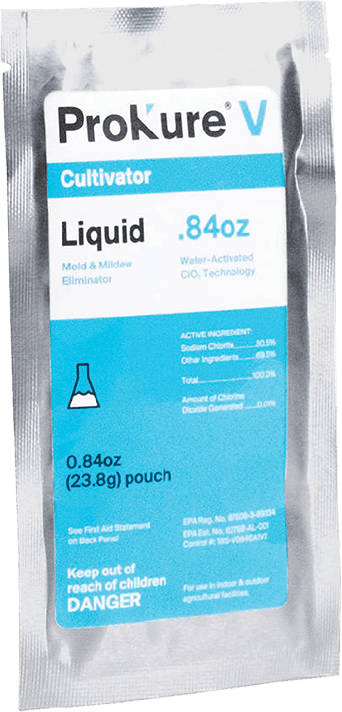
The first thing to clear up, because the search results blur it constantly, is that a surface-spray solution concentration and an airborne gas concentration are different measurements governed by different parts of a product label. A liquid chlorine dioxide used on surfaces is dosed in solution ppm: in the ProKure line, that is ProKure V, the EPA-registered liquid (EPA Reg. No. 87508-3-89334), used at a defined 100 ppm for a 10-minute contact time to disinfect hard, non-porous surfaces, and diluted to 5 ppm for food-contact sanitizing. Those are wet-surface numbers for a product you apply with a mop, sprayer, or dip.
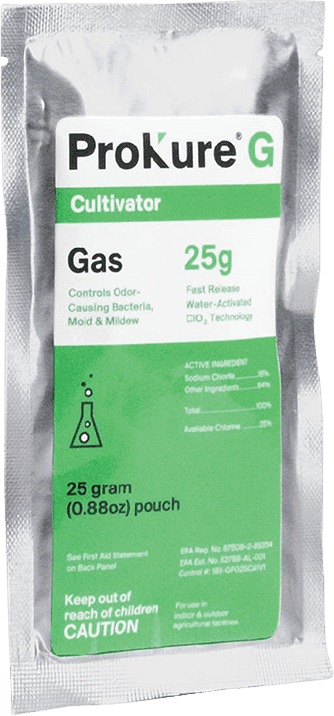
An airborne gas treatment is a different thing entirely: a concentration of ClO2 in the air of a sealed room, which is how ProKure G works, the fast-release gas (EPA Reg. No. 87508-2-89334). When a page quotes a figure like 50 ppm for spraying a plant, that is a solution number, and it tells you nothing about the gas concentration in a fumigated room. Do not carry a solution ppm into a gas SOP or the reverse. The two live in different label sections because they are physically different applications, and conflating them is the single most common error in the material that ranks for this query.
It helps to hold a simple mental table. On the solution side are the wet-surface numbers: a defined use concentration applied to hard, non-porous surfaces, tool soaks, and process water, measured in the solution with a colorimetric kit, and in the ProKure line that is the V liquid. On the gas side are the airspace numbers: a concentration suspended in the air of a sealed, empty room, measured with an airspace monitor, and in the ProKure line that is the G fast-release gas for an empty room and the D slow-release gas for a room with plants. Two sides, two instruments, two label sections. The moment you find yourself quoting one side's number for the other side's job, stop, because you have crossed a line the label draws for a reason.
The numbers that actually govern a gas treatment
For a gas reset the governing numbers are a safety ceiling and a label ceiling, not a published effective dose from the manufacturer. Take them in order.
The safety ceiling is OSHA's. The permissible exposure limit for chlorine dioxide is 0.1 ppm as an 8-hour time-weighted average, with a short-term exposure limit of 0.3 ppm over 15 minutes (source: OSHA). That is the concentration a worker can be exposed to, which makes it your re-entry gate: the air has to be below those figures before anyone goes back in without respiratory protection. For context on what those low numbers feel like, published chlorine dioxide safety data puts the odor threshold around 0.1 to 0.3 ppm and notes the gas becomes irritating above roughly 0.5 ppm (source: OxyChem chlorine dioxide health and safety). So you can often smell it well below the point it becomes irritating, but smell is not a measurement, which is why verification matters.
The label ceiling is ProKure's. For the deodorizing treatment of ventilation systems, the ProKure G label instructs the user not to exceed 500 ppm and to allow one hour to ventilate prior to re-occupation. Treat 500 ppm as a labeled maximum for that use, not a target to chase. Separately, peer-reviewed work on fungi has reported that a chlorine dioxide concentration of 500 ppm is high enough to inhibit fungal growth (source: NCBI PMC), which is the kind of category science remediation vendors cite, but that is a research figure, not a ProKure operating instruction. The operating instruction is the label: run G in a sealed, unoccupied room for the labeled dwell, do not exceed the labeled ceiling, and ventilate before re-entry. GroClarity does not publish an invented target ppm for a ProKure G room reset, because the label does not, and a precise number with no label behind it is exactly what a QA reviewer should reject. The discipline here is the whole point: the two numbers you can stand behind are the OSHA re-entry ceiling, which is a published occupational standard, and the ProKure G labeled maximum, which is on the product label. Build the SOP on those two and you are citing authorities a reviewer can check, rather than a figure scraped from a vendor page that may be a solution number, a chlorine number, or a research datapoint lifted out of context.
The EPA boundary: empty room, no plants
This is the line Phase 1 flagged as the biggest compliance worry, so it gets stated plainly rather than buried. A ProKure G gas treatment is for an unoccupied space: no people, no pets, and no plants in the room during treatment. The label states, in these words, that it is not for use with plants, crops, or feed. Plants come out before activation, and they go back in only after the room has been ventilated and verified below the OSHA re-entry limits. ProKure G is EPA-registered, and on a registered product it is a violation of federal law to use it in a manner inconsistent with its labeling, so this is not a cautious suggestion; it is the compliance boundary.
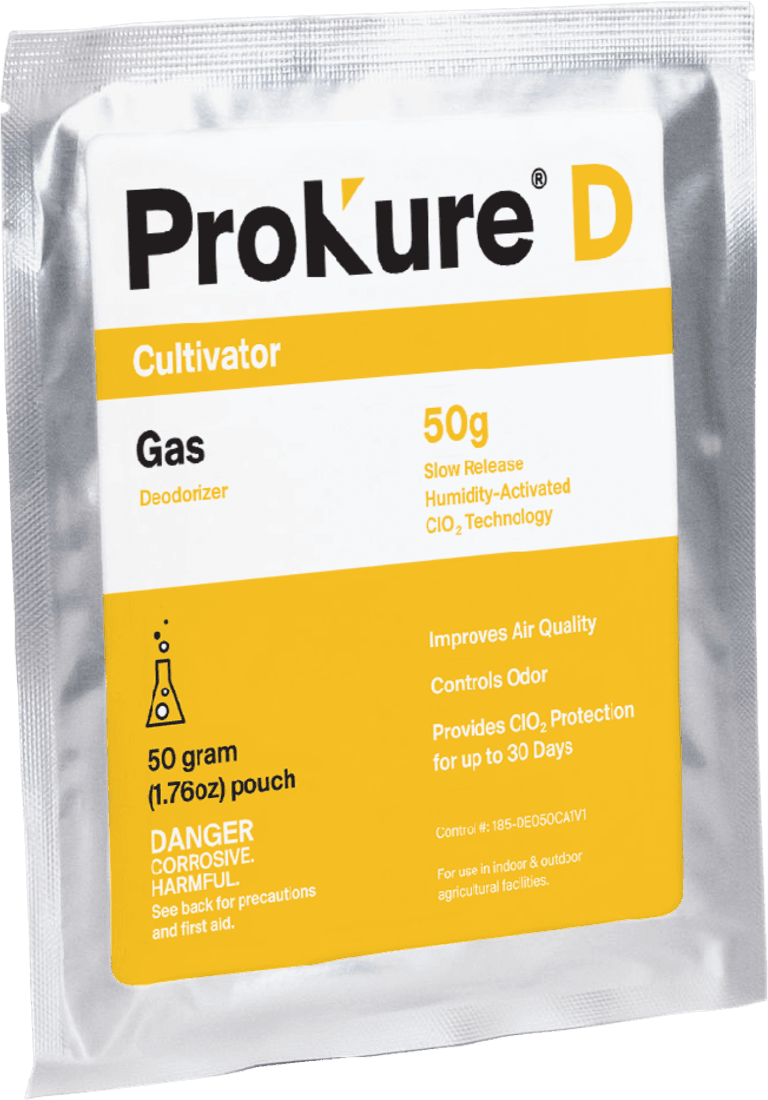
That boundary is also why the gas-ppm question and the plants-present question are different products. If what you want is a chlorine dioxide presence in a room with a live canopy, that is ProKure D, the slow-release gas, which runs at a trace level with plants present for up to 30 days and is a deodorizer, not a fumigant. ProKure D carries no published ppm and makes no kill claim, and it is not an EPA-registered pesticide. Do not try to bridge the two by running a fumigation concentration around plants; the empty-room product and the plants-present product are engineered and labeled for opposite room states. For the plants-present side, see the ProKure D slow-release gas overview; for the surface-disinfection side, the ProKure V liquid disinfectant overview covers the solution numbers.
The practical workflow that keeps the boundary intact is a turnover sequence, not a shortcut. Plants and harvested material come out of the room. The room is sealed and the gas is activated and held for the labeled dwell with no one inside. The room is ventilated for at least the labeled hour. The airspace is measured and confirmed below the OSHA re-entry limits. Only then do people and any new plant material go back in. Each step maps to one of the three numbers from the intro: the label ceiling governs the treatment, the OSHA ceiling governs re-entry, and the empty-room rule governs the whole thing. A protocol written that way passes an internal EHS review because every step cites the authority behind it rather than a round number from a vendor page.
Why a gas reaches what a sprayer cannot
The reason growers reach for a gas at all, despite the empty-room requirement, is coverage. A true gas is a very small molecule that fills a sealed space evenly and reaches into places a liquid never touches: the interiors of HVAC plenums and ductwork, above-ceiling voids, the undersides of fixtures, wall penetrations, mini-split cassettes, and the structural cracks and crevices where spores settle. A sprayer reaches the surfaces a person can point it at; a gas reaches the whole air volume and the hidden geometry around it. That is the case for a between-cycle gas reset in a room you can empty, and it is why the treatment is specified as a room volume (cubic feet) rather than a surface area.
That same physics is why placement and sealing matter more than any humidity setting. Chlorine dioxide gas is heavier than air, so you place the activated unit high and central, no closer than 18 to 24 inches from fabrics, leather, electronics, mirrors, metals, or plated surfaces, and you run a fan or air mover to distribute it through the sealed space. Seal the room: if a ventilation system serves only that space you can recirculate to help distribution, otherwise shut it off and close the ducts. Even distribution in a sealed volume is what gets the gas everywhere the spray missed, and it is a mechanics problem, not a concentration problem.
Think about where spores actually hide in a flower room and the case gets concrete. A sprayer reaches the bench tops, the walls within arm's reach, and the floor. It does not reach the inside of the supply and return ducting, the dead space above a dropped ceiling, the interior of a mini-split cassette, the back of an electrical box, or the hairline gap where a wall panel meets a header, and those are exactly the humidity-holding, air-moving voids where airborne contamination circulates between cycles. A gas fills all of it because it goes where the air goes. That is the reason a room reset is specified as a sealed-volume gas treatment rather than a wipe-down: the wipe-down handles the surfaces you can see, and the gas handles the volume and the geometry you cannot. The two are complementary, which is why the full protocol pairs a surface step with a gas step rather than choosing between them.
Verifying the ppm you ran
The part no ranking page walks through is how you prove the concentration, which is the whole point of a compliance SOP. You verify a gas treatment two ways, during and after. For the airspace, a direct-reading ClO2 instrument or colorimetric detector tube (for example a Draeger tube or a portable electrochemical ClO2 monitor) reads the concentration in the room, and the monitor you choose must read down to the OSHA range, because a device that bottoms out at 1 ppm cannot confirm you are below the 0.1 ppm re-entry limit. For a wet-surface or process-water step on the solution side, colorimetric test kits read the solution ppm.
The SOP language that satisfies an audit is simple to state: activate in the sealed, empty room; hold for the labeled dwell; ventilate for at least the labeled one hour; then measure the airspace with a monitor that reads to 0.1 ppm and confirm it is below the OSHA re-entry limits before re-entry; log the date, the room, the dwell, the vent time, and the final reading. Keep that log with the product label and SDS. A QA lead who can show a dated reading below the OSHA limit at re-entry has closed the exact finding an EHS review raises, and it is a stronger record than any concentration a vendor prints, because it is a measurement of your own room. Use the caution placards included with the product to mark treatment and safe re-entry times so no one walks in during the hold.
Calibration and detection range are the two places verification quietly fails. A monitor reading only to whole ppm cannot resolve the difference between 0.05 ppm and 0.25 ppm, which is the difference between safe re-entry and a short-term-limit exposure, so the instrument has to be specified for the low OSHA range, not a general industrial range. Calibrate it on the manufacturer's schedule and note the calibration date in the same log, because an auditor who sees a reading will reasonably ask when the device was last calibrated. Build the log as a reusable template so every room reset produces the same fields in the same order; a consistent record across rooms and dates is what turns individual treatments into a program an inspector can trust at a glance.
Cost framing for the ROI conversation
An owner or business director approving the chemistry is usually running a cost conversation, and the honest framing is a comparison of magnitudes rather than a single quoted price. A between-cycle gas reset of a defined room consumes a quantity of product sized by the room's cubic footage, which is a modest, repeatable line item per turnover. Set that against the downside it is meant to reduce: the revenue loss from a single harvest that fails a state microbial test, which runs into five or six figures on a mature crop. You do not need an exact per-treatment figure to see the shape of the decision; a reset priced in the low hundreds against a failed-test loss priced in the tens of thousands is the argument, and it is the argument an owner recognizes because it is a prevention-versus-loss ratio rather than a feature list. Price the specific SKUs for your room sizes from the product pages, and tie the cadence to your turnover schedule so the recurring cost is predictable in the budget.
Two corrections, and where this fits your program
Two pieces of noise circulate on this topic and are worth correcting directly. First, chlorine dioxide is not chlorine. They are different molecules with different chemistry and different behavior, and threshold numbers written for chlorine do not transfer to chlorine dioxide. If a forum post is quoting chlorine tolerances for a ClO2 decision, it is answering a different question, and borrowing a chlorine number into a ClO2 SOP is the same category error as borrowing a solution ppm into a gas plan. When you read a ppm figure anywhere, check three things before you use it: is it chlorine or chlorine dioxide, is it a solution or a gas number, and does a label or a cited standard stand behind it. A figure that fails any of those three checks does not belong in your SOP.
Second, the packet-versus-generator debate. Sachet and activated-concentrate systems like ProKure G are a controlled-release delivery sized for the room volumes they are rated to, dosed by cubic feet, while large continuous-generation rigs are a different scale of system built for continuous industrial dosing. Neither is universally better; they are built for different jobs. For a between-cycle reset of a defined room you can seal and empty, the activated-concentrate gas is sized for exactly that use, and the controlled-release format is a feature, not a limitation, because it delivers a known quantity into a known volume. Pick the delivery to the room and the job rather than to a slogan.
Where this lands for a program is that the ppm question is really a safety-and-compliance question, and the defensible answer is a labeled, verified, empty-room process rather than a single magic number. Run the gas in an empty room per the ProKure G label, do not exceed the labeled ceiling, ventilate, verify below the OSHA re-entry limits, and document it. If you also need state microbial-testing context, note that yeast-and-mold action limits vary by state, so tie your sanitation protocol to the specific limit your state lab tests against rather than a generic figure. For the full reset workflow and sizing, the grow-room air-quality management guide carries the deployment detail, and the fast-release gas ProKure G comparison covers when a gas reset is the right call versus the slow-release and liquid options. When you are ready, order from ProKure Solutions or on shop.groclarity.com, pull the master label and SDS from prokuresolutions.com for your file, and for a facility EHS review reach a GroClarity specialist at 866.206.1301. You came for a ppm; you leave with the safety ceiling, the label ceiling, the empty-room boundary, and a verification step that turns a number into a defensible record.
Related resources