
Chlorine Dioxide at 100 PPM for Disinfection: What the Concentration Means, What It Kills, and When to Use It
You already decided chlorine dioxide is the chemistry. The open question is whether 100 ppm is the right, defensible, label-backed concentration for hard-surface disinfection, how long you have to leave it on, and where the label says you cannot use it. Short version: 100 ppm is the registered hard-surface disinfection concentration, and it is the strength the EPA-registered ProKure V liquid (87508-3-89334) activates to, applied for a 10-minute contact time on hard, non-porous surfaces. The CDC data behind the number is strong. This page covers the dose, the kill rate, the label boundary, and the room protocol, not the underlying chemistry; for that, start with what chlorine dioxide is at the molecular level.
What "100 ppm chlorine dioxide" actually means
A concentration number is only useful if you know what it counts and why that count and not another. For a QA lead signing off on a protocol, 100 ppm has to mean one specific, verifiable thing.
PPM and mg/L are the same number here
Parts per million and milligrams per liter are interchangeable for a dilute water solution like an activated ClO2 disinfectant, because one liter of water weighs about one kilogram and a milligram per kilogram is a part per million. So when the CDC writes 100 ppm and a peer-reviewed review writes 100 mg/L, they are describing the same working strength. That equivalence matters when you are reading a label against a study: you are not converting between two scales, you are reading one number written two ways. A 2022 systematic review in the Journal of Medicine and Life found chlorine dioxide is a safe and effective disinfectant even at concentrations as low as 20 to 30 mg/L, which sets the floor; 100 ppm sits comfortably above it for the harder hard-surface disinfection job.
Activated solution versus the precursor packet
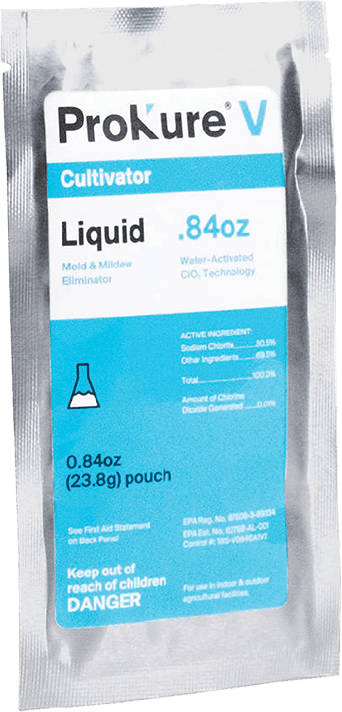
The 100 ppm figure describes the activated solution, the working liquid in your sprayer, not the dry packet it came from. Chlorine dioxide is not shelf-stable at high strength; it dissociates in light and heat, which is why it is not sold as a strong liquid in a jug. A registered product like ProKure V ships as a precursor packet you add to a measured volume of water. The reaction generates ClO2 in the water, and after full activation the solution sits at 100 ppm. You do not open the inner precursor pouch, and you record the activation time, because the working solution has a limited life once activated.
Why 100 ppm, and not 20, 50, or 500
If 20 to 30 mg/L already disinfects in the lab, why does the hard-surface label call for 100 ppm? Because a real grow-room surface is not a lab coupon. It carries soil, biofilm, and a higher and messier organic load than a controlled study, and the registered concentration is set to clear that real-world load within a practical contact time, with margin. Going higher than 100 ppm does not buy you a better disinfection claim; it is simply off-label, wastes product, and raises the gas exposure you have to ventilate. Going lower drops you to a different registered use. The number is not a dial you turn to taste. It is a registered dose matched to a registered contact time, and the discipline is to hit it, verify it, and log it.
What a concentration says and does not say
One more point that trips up buyers reading spec sheets. A concentration is a potential, not a guarantee of outcome on its own. 100 ppm describes how much active chlorine dioxide is dissolved in the water in your sprayer; the disinfection result also depends on contact time, surface cleanliness, temperature, and coverage. This is why a label pairs a concentration with a contact time rather than quoting a concentration alone. A 100 ppm solution left on for ten seconds is not doing the registered job; a 100 ppm solution held for the full contact time on a pre-cleaned surface is. When you evaluate a competing product that quotes a higher ppm, ask what contact time and what organisms that number is tied to, because a bigger concentration with no stated contact time and no named organisms is marketing, not a claim. The registered combination of concentration, time, and organism list is the thing you are actually buying, and 100 ppm at a 10-minute contact time with a named kill list is a complete, enforceable specification.
Temperature and the activation window
Activation is not instant and it is not temperature-indifferent. A precursor-activated ClO2 solution reaches full strength over roughly an hour of agitation at intervals, and the label specifies a temperature band for that activation to run correctly. Activate too cold and the reaction lags; the solution has not reached 100 ppm when you think it has. This is one more reason the verification strip is not optional: it confirms the chemistry actually got where the math says it should, under the real conditions of your room, not the ideal conditions of a spec sheet.
Where the 100 ppm figure comes from across the SERP
It is worth knowing that 100 ppm is not a ProKure-specific invention; it is the concentration the broader disinfection literature converges on for the hard-surface job, which is exactly why it is the registered figure. The CDC's guideline uses 100 ppm as its stated spore-kill concentration. An industrial post-rinse sanitizing reference recommends a 100 active ppm solution of chlorine dioxide for its process. A consumer-facing ClO2 reference points buyers toward diluting to 100 to 200 ppm for general disinfection. The number recurs because it is the practical sweet spot: strong enough to clear a real surface load within a short contact time, low enough to stay well under the handling and corrosion problems of a high-concentration solution. When a registered product sets its hard-surface disinfectant use at 100 ppm, it is landing on the same figure the independent sources landed on, which is the kind of convergence a QA lead likes to see before adopting a protocol.
What 100 ppm ClO2 kills, and how fast
This is the section a Head Grower reads to decide whether the dose actually earns its place in a mold-prevention protocol. The evidence is specific and it is federal.
The CDC spore benchmark: greater than 99.9% in 5 minutes
The single most citable line on this topic comes from the CDC's Guideline for Disinfection and Sterilization. In its words, a concentration of 100 ppm will kill greater than 99.9% of Bacillus atrophaeus spores within 5 minutes and destroy mycotic agents in under one hour. Bacterial spores are among the hardest targets in disinfection; they are the benchmark for a reason, because an agent that clears spores clears almost everything softer. A greater-than-99.9% spore kill in 5 minutes at 100 ppm is a strong result from a primary government source, and it is the number every weaker page on the search results echoes without the attribution. Cite it with the source, because the citation is what makes your protocol defensible at audit.
Vegetative bacteria on hard surfaces
For the ordinary bacterial load on a surface, the kill is faster and easier than the spore case. The systematic review covering 33 studies concluded that chlorine dioxide is a safe and effective disinfectant, with efficacy mostly independent of pH, confirming it works against resistant Mycobacterium, H1N1, and other influenza viruses. Independence from pH is a practical advantage a grower feels: you do not have to pH-correct your water to a narrow window to get the disinfection you paid for, the way some oxidizers demand. The agent performs across the pH range a facility's water actually sits at.
The ProKure V disinfectant kill list on hard, non-porous surfaces is broad and named, which is what a registered claim looks like. It includes methicillin-resistant Staphylococcus aureus (MRSA) (ATCC 33591), Staphylococcus aureus (ATCC 6538), Pseudomonas aeruginosa (ATCC 15442), Listeria monocytogenes (ATCC 19111), Salmonella enterica (ATCC 10708), and Mycobacterium bovis (ATCC 35737), among others, all at 100 ppm for the 10-minute contact time. For a cultivation facility the organisms that matter most are the fungal ones, but the breadth of the bacterial list is what qualifies the product as a hospital-type disinfectant rather than a narrow single-target agent, and that breadth is part of why a 100 ppm registered solution outperforms a vague high-ppm competitor on everything except the headline number.
Resistance and why ClO2 holds up
A real advantage the science literature flags: microbes do not develop resistance to chlorine dioxide the way they do to some agents, because ClO2 works by oxidative disruption of cell structures rather than by a specific biochemical pathway a microbe can mutate around. The systematic review's confirmation that ClO2 is effective against resistant Mycobacterium speaks to this. For a facility running the same disinfectant turnover after turnover, that matters: you are not training a resident population to shrug off your sanitation the way a single-mode chemical on a fixed schedule can. It is one more reason the hierarchy-minded approach to IPM favors an oxidizer like ClO2 for the surface-disinfection layer.
Viruses and the SARS-CoV-2 datapoint
Beyond bacteria and fungi, the registered ProKure V label carries a virucide claim list on hard, non-porous surfaces, and its headline virucidal datapoint is a 30-second kill of SARS-CoV-2 at 100 ppm. That is a faster contact time than the 10-minute disinfectant window, because the registered time varies by target: the harder the organism, the longer the time at the same concentration. For a facility that also cares about staff safety and general surface hygiene beyond mold, the virucide list is a bonus on a product bought mainly for its fungicide performance, and the systematic review's confirmation that ClO2 is effective against H1N1 and other influenza viruses backs the category claim with independent evidence.
Reading a kill claim correctly
A kill claim is only as good as its three parts: the organism, the concentration, and the contact time. A page that says a product kills mold without naming the organism, the ppm, and the minutes is making a marketing statement, not a registered claim. The ProKure V disinfectant claim is complete in all three parts: named organisms including Aspergillus niger (ATCC 9642) and Fusarium solani (ATCC 36031), at 100 ppm, for a 10-minute contact time. When you compare products, line up those three parts, not the headline adjective. A competitor quoting a higher ppm with a vaguer organism list and no contact time has given you less information, not a stronger product.
Fungal agents in under an hour
The CDC line also states 100 ppm destroys mycotic, meaning fungal, agents in under one hour. For cultivation that is the headline, because mold and fungal pressure is the crop killer and the compliance failure. On the registered ProKure V label specifically, the hard-surface disinfectant use at 100 ppm for a 10-minute contact time carries a fungicide claim that includes Aspergillus niger (ATCC 9642) and Fusarium solani (ATCC 36031). That is the difference between a general-science statement and an enforceable product claim: the CDC gives you the category evidence, the product label gives you the named organisms at the named contact time.
Why pH independence matters in a real facility
The systematic review's finding that efficacy is mostly independent of pH deserves its own paragraph, because it is the quiet operational advantage that separates ClO2 from some alternatives. Hypochlorite-based disinfectants lose potency as pH rises, so a facility with hard or alkaline source water can be applying a weaker dose than the label implies without knowing it. Chlorine dioxide does not swing that way across the ordinary range, so the 100 ppm you activate is the 100 ppm you apply, regardless of whether your water sits a little acidic or a little basic. For a multi-site operator pulling water from different municipal sources, that consistency is what lets one protocol hold across facilities without a per-site pH correction step.
The selectivity point, and why it lowers the required dose
Chlorine dioxide is a selective oxidizer. It preferentially attacks the electron-rich sites in microbial cells and in biofilm rather than reacting indiscriminately with every bit of organic matter in the room, which is why it works at lower concentrations than a broad oxidizer and is less corrosive to equipment at working strength. That selectivity is the mechanistic reason 100 ppm ClO2 can stand against 1000 ppm bleach: it is not that ClO2 is ten times stronger molecule-for-molecule in some abstract sense, it is that it spends less of itself on side reactions and more on the target. For a grower, less corrosion means pumps, lines, and stainless benches take less punishment per turnover, which is a maintenance cost the bleach number never shows.
Reconciling the 5-minute CDC figure with the 10-minute label
Readers who compare sources will notice the CDC cites a 5-minute spore kill while the ProKure V label specifies a 10-minute contact time, and that apparent mismatch deserves a plain answer rather than a hand-wave. They are not in conflict. The CDC's 5 minutes is a laboratory result for a specific spore under controlled conditions; the label's 10 minutes is the registered, enforceable contact time the product carries for its broad disinfectant claim across its full organism list on real surfaces. A registered label is deliberately conservative, setting the time that reliably covers the whole claim under field conditions, not the fastest time achievable against the easiest-measured organism. The operational rule is simple: follow the label's contact time for the product you are using. The CDC figure tells you the chemistry is fast and effective; the label number tells you exactly how long to hold it to earn the registered claim. Hold the 10 minutes.
What 100 ppm does not do fast, stated honestly
A credible page names the limits. At 100 ppm, hard-surface ClO2 is a surface disinfectant, not a magic bullet. It does not penetrate heavy visible soil, which is why physical cleaning comes first. It is not a produce wash at that strength; food-contact sanitizing is a different, lower-concentration use. It is not a gas-phase whole-room fog; that is a different delivery and a different SOP entirely. And its working solution does not hold strength indefinitely once activated. Knowing the edges of the claim protects you from misapplying it and from making a claim the label does not support. It also is not a residual: a surface disinfected today is not protected against recontamination tomorrow, which is why air-quality maintenance and recontamination control are separate jobs from the turnover disinfection this dose performs.
The EPA label boundary (the biggest-worry section)
This is the part cultivators get wrong, and it is the part an auditor checks. Getting the concentration right means nothing if you use it where the label forbids.
100 ppm ClO2 is a hard, non-porous surface disinfectant
The registered 100 ppm use is for hard, non-porous surfaces: benches, trays, tools, floors, walls, and the equipment a grow room runs on. It is applied to visible wetness, left for the contact time, and that is the scope of the claim. It is a surface treatment, full stop. It is not a treatment you apply to the plant, the growing medium, or anything you harvest.
The not-for-use-with-plants-crops-feed line
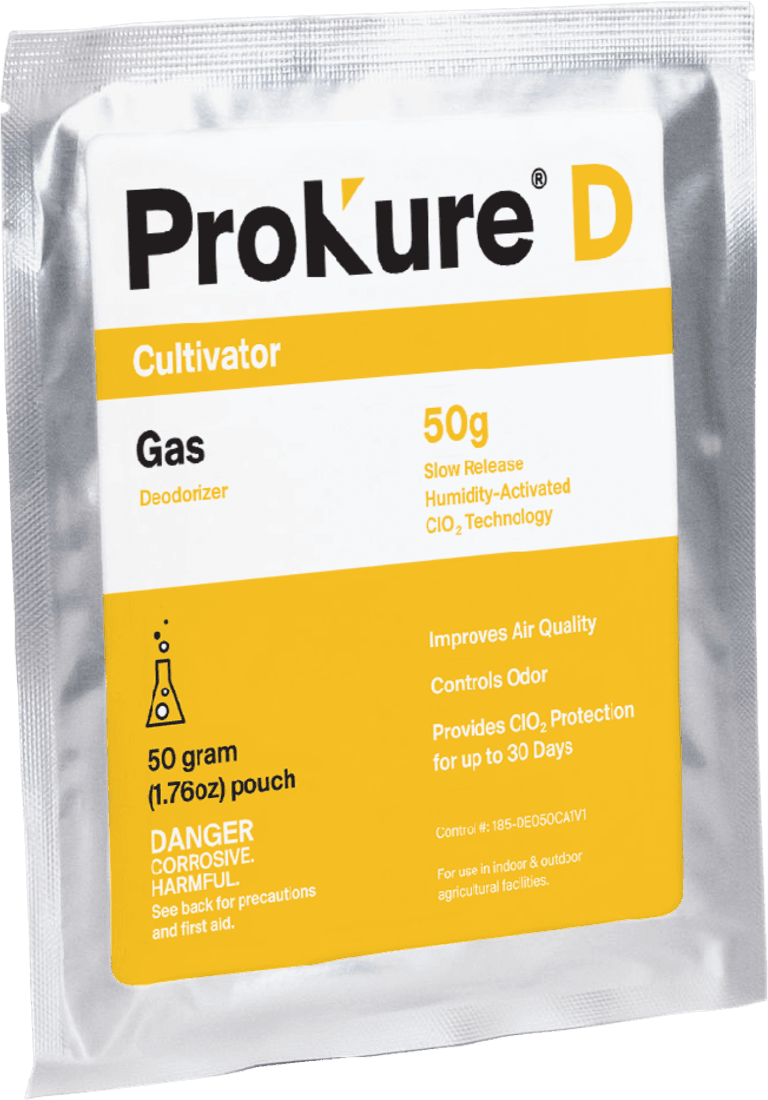
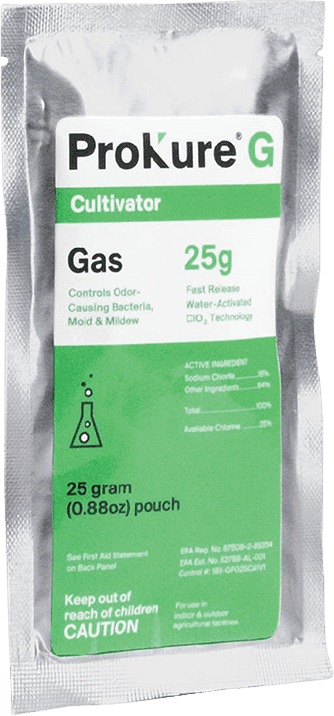
Here is where product and dose get tangled in most grower conversations. The restriction not for use with/on plants/crops/feed belongs to the ProKure G gas product, which runs in an empty room; the ProKure V liquid at 100 ppm is labeled suitable for use with plants in the room, because you disinfect the hard surface, not the crop. Read that carefully, because it is the exact opposite of what growers assume. V, the 100 ppm liquid, can be used with plants in the room on surfaces; G, the empty-room gas, carries the plants-crops-feed restriction. Attaching the restriction to the wrong product either over-restricts the liquid you could be using around the canopy or under-restricts the gas you must only run in an empty room. When you recommend a product, put the correct disclaimer next to that product, not in a generic footer.
When 100 ppm is right, and when a lower dose is
Concentration follows use. The ProKure V label carries more than one registered use at more than one strength: the 100 ppm, 10-minute hard-surface disinfectant use, and a separate 5 ppm, 1-minute food-contact-surface sanitizer use against organisms like E. coli (ATCC 11229) and E. coli O157:H7 (ATCC 43895). Those are two different jobs. Disinfection at 100 ppm is the hard-surface, broad-kill job for room turnover. Sanitizing at 5 ppm is the lighter food-contact job. You do not use the disinfectant strength on a food-contact surface, and you do not use the sanitizer strength to do a turnover disinfection. The label assigns the number to the job; you follow it.
The horticultural low-dose uses, for context
The same label extends to even lower concentrations for horticultural tasks that are outside this page's turnover focus but worth knowing exist, so you do not reach for the 100 ppm disinfectant where a 5 ppm dip is the registered use. The label describes 5 ppm applications for controlling microbes in process water and for dips to suppress bacteria, algae, and fungi on cuttings and cut flowers. The lesson for a dose-verification reader is that a single ClO2 concentrate spans a wide registered range, and the number you pick is dictated by the specific use site and target, not by a general sense that more is safer. Disinfecting a bench is 100 ppm; a cut-flower dip is 5 ppm; mixing those up is both ineffective and off-label.
Why the plants-crops-feed line confuses buyers
It is worth naming why this confusion is so common. Growers hear chlorine dioxide, think of the gas products and the pesticide-style restriction, and assume every ClO2 product carries the plants-crops-feed boundary. It does not. The restriction travels with the specific product and its delivery form, not with the molecule. The liquid surface disinfectant at 100 ppm is explicitly suitable for use with plants in the room because it treats surfaces; the fast-release gas carries the restriction because a gas fills the space the plants occupy. A buyer who internalizes the molecule-level fear buys too conservatively, leaving the liquid on the shelf when it was the right residue-free surface tool, or too loosely, running a gas near a crop it was never labeled for. The fix is to read the restriction per product, every time.
Reading the master label as a boundary, not a suggestion
The EPA master label is a legal document, and the opening line of a registered label states that it is a violation of federal law to use the product in a manner inconsistent with its labeling. That is not boilerplate to skim. It means the use sites, the concentration, the contact time, and the restrictions on the label are the enforceable scope of the product, and anything outside them is off-label use that voids the registration protection you paid for. For the 100 ppm disinfectant use, the registered application sites named on the ProKure V label include cultivation rooms, grow beds, drying rooms, cure rooms, vegetation rooms, propagation rooms, trimming areas, mother rooms, and drop-down hoses, applied to hard, non-porous surfaces such as stainless steel, glass, vinyl, polypropylene, and PVC. If a surface or a use is not in that scope, the label does not cover it, and you either find the registered product that does or you do not make the claim.
Where 100 ppm is registered to be used
The label does not just permit hard-surface use in the abstract; it names the surfaces and sites. For ProKure V the registered hard-surface sites include stainless steel, glass, vinyl, polypropylene, and PVC, applied in cultivation rooms, grow beds, drying rooms, cure rooms, vegetation rooms, propagation rooms, trimming areas, mother rooms, and on drop-down hoses. The product is also registered to sanitize non-porous gloves and shoes in agricultural facilities at the appropriate dilution, which is a detail a QA lead building a crew-hygiene step will want. Knowing the named sites matters because it tells you where the 100 ppm claim holds and where you are stepping outside it. If a surface or a use is on that list, you are inside the registration; if it is not, you need a different registered use or a different product, not a creative reading of this one.
SDS and master label retention for QA audits
For a procurement or QA lead, the deliverable is a paper trail. Retain the current SDS and the EPA master label for the product, on file, where an auditor can see them. Record the EPA registration number (87508-3-89334 for ProKure V), the activation time of each batch, the concentration you targeted, the contact time you held, and who ran it. The deepest label and SDS detail lives on prokuresolutions.com; keep the current version in your compliance binder rather than a screenshot from a forum. The number on your protocol has to match the number on the label, and the audit is simply someone checking that it does.
The two SDS reality: unreacted pouch versus activated solution
A detail QA leads should carry: a ClO2 precursor product has two safety profiles, not one. The unreacted dry pouch contains sodium chlorite and is treated as a corrosive, hazardous solid that stores locked up and away from acids and combustibles; the activated, fully reacted working solution is a mild, dilute liquid. The hazard lives in the dry precursor and in the concentrated gas, not in the 100 ppm working liquid on your bench. Keeping both SDS on file, and training the crew that the pouch is the dangerous object while the activated spray is the gentle one, is how you handle the product correctly and how you answer the inspector who asks why a corrosive-labeled packet produces a plant-safe surface spray.
How to prepare a 100 ppm ClO2 solution
This answers the direct operational question: how do you actually get to 100 ppm. The honest answer with a registered product is that you follow the label's packet-to-water ratio rather than mixing raw chemistry, and that is a feature, not a limitation.
A named SKU: the ProKure V packet and a water volume
With ProKure V, you match one precursor packet size to one water volume to reach 100 ppm. The label pairs the packet weight to the gallons of water, you add the inner pouch to an opaque container of the correct volume, and you agitate at set intervals until the solution reaches full strength at about one hour. The exact packet-to-gallon pairing is on the label, and the label is the authority; a page like this one should point you to it rather than publish a recipe that drifts as SKUs change. The principle to carry: you are not estimating a dose, you are activating a measured one, which is what makes 100 ppm repeatable across crews and shifts.
Verifying the concentration with a test strip
Trust, then verify. A chlorine dioxide test strip confirms the activated solution actually reached 100 ppm before you spray it on a surface you are about to call disinfected. This is the step that separates a defensible protocol from a hopeful one, and it is the step the science literature never operationalizes for a working facility. Verification also catches a bad batch, an under-agitated solution, or a packet past its life, before it costs you a turnover.
Working-solution shelf life
An activated ClO2 solution does not keep like bleach. It is strongest at full activation and declines after, and it should be stored protected from light and heat and used within the label's stated window. Record the activation time on the container so a crew member who did not mix it knows how much life it has left. Mixing only what a turnover needs, when it needs it, beats mixing a large batch that loses strength before you reach the last bench.
Container and light discipline
The storage detail that quietly protects your dose: chlorine dioxide photo-oxidizes, meaning sunlight breaks it down. An activated solution belongs in an opaque container, not a clear one, and away from direct light and heat. A crew that activates into a clear jug and leaves it on a sunny bench is watching its 100 ppm decay toward nothing while believing it still has a full-strength disinfectant. Opaque container, cool and dark, used fresh. That is not fussiness; it is the difference between the strip reading you verified at activation and the weaker reality an hour later in the light.
What to do if you mixed it at the wrong strength
A practical question crews hit: what if a batch comes out too strong or too weak. If the strip reads low, the solution has not fully activated or the packet was mismatched to the water volume; give it the remaining agitation and time, re-verify, and if it still reads low, the batch is wrong and you re-mix rather than spray an under-strength disinfectant you will call clean. If the concern is that a solution is too strong for a lighter job, the registered answer is the dilution chart, not improvisation: dilute the 100 ppm solution per the label ratios to reach the lower registered concentration. The discipline is the same in both directions, verify against the strip and the label rather than eyeballing it, because a disinfection step you cannot verify is a disinfection step you cannot defend.
Dilution for the lower-concentration uses
The same ProKure V concentrate that gives you 100 ppm for disinfection dilutes down for the lighter registered uses. The label provides dilution ratios: a 1:5 dilution of the 100 ppm solution yields roughly 20 ppm for a sanitizing use, and a 1:20 dilution yields roughly 5 ppm for the food-contact sanitizer use. You are not buying three different products for three different strengths; you are activating one and diluting to the use. For a QA lead building a single procurement line, that consolidation is part of the value: one SKU, one SDS, one EPA number, three registered concentrations off a documented dilution chart, each matched to its own contact time.
How to apply 100 ppm ClO2 for room turnover
A process-expectation page owes you a realistic timeline, because the pain a Facility Manager actually feels is the 3-to-5-day downtime a bleach turnover costs. Here is the sequence, with honest timing.
Empty and pre-clean the room
Clear the crop and the loose debris. Pre-clean visibly soiled surfaces with a non-disinfectant cleaner, because a disinfectant works on a clean surface, not through a layer of grime. This is not optional polish; heavy soil consumes the oxidizer before it reaches the microbes, and skipping it is the most common reason a disinfection step underperforms.
Why the room is empty for the turnover disinfection
A note on sequencing that the label scope supports: the heavy 100 ppm turnover disinfection is done between crops, with the room cleared, because that is when every surface is accessible and nothing is in the way of a thorough, methodical pass. The liquid is labeled suitable for use with plants in the room, so you can disinfect a surface with the canopy present when you need to; but the full turnover, where you treat ceilings, walls, benches, trays, tools, and drop-down hoses in sequence, is a clear-room job simply because you cannot reach and wet every surface with a crop in the way. Pair that with the empty-room air reset step and you get a complete between-cycle sequence: surfaces disinfected with the liquid, air treated with the gas, crop and crew out for the gas phase.
Spray to visible wetness
Apply the activated 100 ppm solution so the surface is visibly wet. Coverage is the job here: every hard surface you intend to disinfect, wetted evenly, not a light misting that flashes off before the contact time elapses. In a room full of benches, trays, and tools, that is a methodical pass, not a quick spray-and-move.
Hold the 10-minute contact time
This is the number crews skip and auditors check. On the ProKure V label the hard-surface disinfectant use is 100 ppm for a 10-minute contact time; the surface stays wet for those ten minutes. The CDC's 5-minute figure is the spore-kill benchmark for ClO2 as a category; the enforceable number for the product you are using is the label's contact time. Hold it, and if the surface dries before the time is up, reapply to keep it wet for the full window.
Ventilate and re-enter
Chlorine dioxide gas has a low occupational exposure limit, on the order of 0.1 ppm as an 8-hour time-weighted average, so ventilation and re-entry timing are part of the protocol, not an afterthought. The practical sequence is people out during application and contact, then ventilate, then re-enter per the label. The liquid surface use leaves no residue, so there is no potable-water rinse step before plants return the way a strong bleach solution would demand. That residue-free finish is a real part of why a turnover with ClO2 is faster than one with bleach.
A realistic turnover timeline
Here is the expectation a Facility Manager actually needs, because the real question behind this query is how many days a turnover costs. A ClO2 surface turnover is not a multi-day ordeal. Pre-cleaning time depends on how dirty the room got, but the disinfection step itself is a 10-minute contact window per treated surface, run in a methodical pass, followed by a ventilation window and re-entry. There is no overnight residue cure and no potable-water rinse of every surface before plants return, because the registered liquid leaves no residue. Compared with a bleach turnover that forces the crew out on fumes and adds a rinse step, the ClO2 surface step compresses the sanitation portion of a turnover from a multi-day drag toward a same-day or next-day task, depending on room size and pre-clean load. That compression is the operational payoff, and it is why faster, documented turnover reads directly as more cycles per year.
Coverage discipline in a real room
A turnover fails on the surfaces you missed, not the ones you hit. The discipline is a fixed sequence so no surface is skipped: ceilings and upper walls first, then benches and equipment, then floors last, so you are not re-contaminating a finished surface by treating one above it afterward. Drop-down hoses, the undersides of trays, and the backs of equipment are the commonly missed spots, and they are exactly where biofilm and spores hide between cycles. A written surface checklist, run the same way every turnover, is what turns a thorough one-time clean into a repeatable standard a crew hits without the lead grower hovering.
Crew training is part of the dose
A protocol is only as good as the crew running it, and 100 ppm ClO2 has two training points that protect both the people and the result. First, the dry precursor pouch is the hazardous object: corrosive, kept away from acids and combustibles, never opened by hand, stored locked up. The activated working solution is the gentle one. A crew that understands which is which handles the product safely without fearing the spray or mishandling the pouch. Second, the contact time is the step people shortcut under time pressure, so it is worth making concrete: set a timer, keep the surface wet for the full window, and treat the ten minutes as non-negotiable rather than a suggestion. A turnover rushed to eight minutes on a drying surface is a turnover you cannot certify. Training these two points, pouch handling and contact-time discipline, is what makes the registered dose actually deliver the registered result in a real facility rather than on paper.
Document it
Close the loop on paper. Log the product, EPA number, target concentration, verified strip reading, contact time held, ventilation, re-entry, and the operator and date. That record is the biosecurity proof an inspector asks for, and it is the single thing the authority pages on this topic never mention, because they are writing chemistry, not running a facility. The log also protects you internally: when a batch down the line fails a microbial test, a documented sanitation trail lets you rule the turnover in or out as the source instead of guessing, which is worth far more than the five minutes it takes to fill in.
100 ppm ClO2 versus 1000 ppm bleach
A natural comparison the reader is already making, because the bleach benchmark is familiar. The World Health Organization has recommended 1000 ppm sodium hypochlorite (bleach) for surface disinfection, a figure the published literature cites as the common reference. Set that against 100 ppm chlorine dioxide and three differences stand out. The active concentration is roughly ten times lower for the ClO2 disinfection use, because ClO2 is a stronger, more selective oxidizer that works at lower strength. ClO2 does not leave the residue on surfaces that forces a rinse before plants return, and the ProKure V liquid is labeled residue-free. And ClO2 does not generate the same chlorinated organic byproducts bleach can form when it hits organic matter. This is a boundary, not a full teardown; for the complete head-to-head on residue, plant safety, and byproducts, read the 100 ppm ClO2 compared to 1000 ppm bleach discussion in full.
Why the concentration gap is not a strength gap
It is tempting to read 100 versus 1000 as ClO2 being ten times stronger, and that framing is too simple. The more accurate read is that the two chemistries report their dose on different scales because they work differently. Bleach spends a large share of its oxidizing capacity on non-target organics and forms chlorinated byproducts in the process, so it needs a high headline concentration to leave enough active chlorine for the microbes. Chlorine dioxide, being selective, delivers more of its lower concentration to the actual target. The practical consequences a grower cares about follow from that: less corrosion to equipment, no residue film to rinse before the canopy returns, and no lingering chlorine odor that pushes a crew out. The number is lower because the chemistry is more efficient, not because the disinfection is weaker.
The residue question, which is the one that matters for plants
For a cultivation facility the single most important bleach comparison is residue. A strong bleach solution leaves a residue that can touch plants and often demands a potable-water rinse before the room is safe to replant, which adds labor and time. The ProKure V liquid at 100 ppm leaves no residue, which is why its label supports use with plants in the room on surfaces. That residue-free finish is not a minor convenience; it is the property that lets a surface disinfectant coexist with a living crop in the same space, and it is the exact combination, broad kill list plus residue-free plus plant-safe-on-surfaces, that a bleach or quat program cannot claim. That combination is why a cultivator reaches for the registered ClO2 liquid at turnover in the first place.
The byproduct question, in plain terms
Bleach forms trihalomethanes and other chlorinated organic byproducts when it reacts with organic matter, which is a well-documented downside of hypochlorite chemistry and a reason water-treatment professionals moved toward chlorine dioxide in many applications. ClO2 does not form those same chlorinated byproducts; its reaction end-products are chloride and trace chlorite, not the chlorinated organics bleach generates on a dirty surface. For a grow room full of organic residue between crops, that difference is practical: you are oxidizing the microbial load without manufacturing a cloud of chlorinated byproducts on every contaminated surface. It is a quieter advantage than residue or corrosion, because you cannot see it, but it is part of why the lower-concentration ClO2 chemistry reads as the cleaner choice for a facility that cares what it is leaving behind.
Disadvantages and honest limits
A page that only sells the upside is not credible, and this answers the direct question of what the downside is.
A low gas exposure limit
The same reactivity that makes ClO2 effective means the gas is an irritant with a low exposure limit near 0.1 ppm over an 8-hour shift. In practice that is a ventilation-and-timing requirement, not a dealbreaker, but it is a real operating constraint you design around with people-out-during-treatment and defined re-entry.
Explosive at high concentration and not shelf-stable
Chlorine dioxide is explosive in air above a 10% concentration and dissociates into chlorine and oxygen under light and heat, which is why it is rarely stored or shipped as a strong stock and is usually manufactured on site. A registered precursor-packet product sidesteps the storage hazard by generating the solution on demand in water, but the underlying instability is why you activate fresh rather than stockpile strong solution.
It is not a substitute for cleaning
A disinfectant is not a cleaner. It does not dissolve visible soil, and applied over grime it is partly spent before it reaches the target microbes. Physical cleaning first, disinfection second, every time. Treating 100 ppm ClO2 as a one-step shortcut past cleaning is how a protocol fails a surface it was supposed to clear.
Odor and the honest sensory reality
Chlorine dioxide has a chlorine-like, irritating odor even in solution, and crews notice it. This is a smaller issue than bleach fumes, which is the comparison that matters for a grower weighing the two, but it is not nothing, and pretending otherwise erodes trust. Adequate ventilation during and after application handles it. Set the expectation honestly with the crew: there is a smell, it is milder and clears faster than bleach, and the ventilation step that manages the gas exposure limit also clears the odor. A competing retail reference actually warns to be cautious of the strong odor and avoid use in confined spaces at higher concentrations, which is sound advice; the 100 ppm registered surface use with proper ventilation is a managed version of that same caution, not a reason to avoid the chemistry.
Material compatibility
One more honest limit: like any oxidizer, chlorine dioxide can affect some materials over repeated exposure, and the label names the hard, non-porous surfaces it is registered for precisely because those are the ones it treats well. It is not for porous materials that soak and hold, and some sensitive metals or finishes warrant a spot check. In practice a grow room's stainless, glass, vinyl, polypropylene, and PVC are squarely in scope, but a facility with unusual surfaces should confirm compatibility rather than assume it. This is less of a concern than with high-concentration bleach, because the lower working strength and selectivity are gentler on equipment, but no oxidizer is zero-impact, and saying so is what makes the rest of the page believable.
Made on site, and what that means for your supply
Chlorine dioxide is usually manufactured on site because it does not ship or store well at strength, and for a large water-treatment operation that means a generator. For a cultivation facility doing surface turnovers, the registered precursor-packet form is the on-site manufacture, done small: you generate the working solution on demand by activating a packet in water, which gives you the fresh, full-strength solution the chemistry requires without a plumbed generator or a hazardous bulk store. The supply implication is that you stock shelf-stable dry packets, not a decaying liquid, and you activate what a turnover needs. That is the operational reason a ready-to-use registered product fits a grow room better than the generator framing the water-treatment literature defaults to, and it is why the honest disadvantage of ClO2, that it is not shelf-stable at strength, is largely solved by the packet form before it ever reaches your bench.
What the open-ended science leaves to the label
The published literature is candid that the concentration deemed safe for use still needs to be determined on a case-by-case basis. For a reader that is unsatisfying, because a QA lead cannot log case-by-case. This is exactly where a registered product earns its place: the EPA registration is the case-by-case determination, done once, formally, and written onto a label as a fixed number with a fixed contact time and a named organism list. The science establishes that ClO2 works and is safe within bounds; the label turns that into the one number you can put in an SOP and defend. The disadvantage of raw chlorine dioxide, an open-ended dose you have to determine yourself, is the thing a registered 100 ppm product removes.
Where 100 ppm ClO2 fits, and the next step
A verification and documentation checklist for adoption
For the procurement or QA lead who has to sign off before a facility adopts the protocol, here is the verification sequence condensed into a checklist you can lift into an SOP. First, confirm the product and its registration: ProKure V, EPA Reg. No. 87508-3-89334, current master label and both SDS (unreacted pouch and activated solution) on file. Second, confirm the dose math: the packet-to-water pairing on the label that yields 100 ppm, recorded as a standing recipe for the crew. Third, confirm activation: agitation at the labeled intervals, the temperature band, the roughly one-hour window to full strength, into an opaque container. Fourth, verify: a ClO2 test strip reading at 100 ppm before application, logged. Fifth, apply and hold: pre-clean, spray to visible wetness, hold the 10-minute contact time on hard, non-porous surfaces, keep surfaces wet for the full window. Sixth, ventilate and re-enter per the label, respecting the gas exposure limit. Seventh, log everything: batch activation time, verified concentration, contact time, surfaces treated, ventilation, re-entry, operator, date. That seven-step record is the audit-ready artifact, and it is what turns a chemistry a QA lead was unsure about into a protocol they can defend to a regulator.
How this scales across a multi-site operation
The reason a single fixed number matters most to an MSO is standardization. A Cultivation Director running facilities across several states cannot defend a different disinfection dose per site to a different auditor per state. One registered product at one registered concentration, 100 ppm ProKure V for the hard-surface turnover disinfection, with one documented SOP and one verification step, reads identically in every jurisdiction. The product's pH independence means the same dose holds across different municipal water, and the residue-free finish means the same re-entry timeline holds across different crews. Procurement consolidates to one SKU, one SDS set, one EPA number, instead of chasing a patchwork of disinfectants and their paperwork. That consolidation is the operational argument for picking one registered 100 ppm protocol and running it everywhere.
The bottom line
The number resolves to one line: 100 ppm for a 10-minute contact time is the registered hard-surface disinfection dose, delivered by the ProKure V liquid, backed by CDC spore-kill data and a peer-reviewed safety-and-efficacy review, bounded by a label that keeps it on surfaces and off the crop. For a QA or procurement lead verifying the math before adoption, that is the defensible protocol: a fixed number, a verification strip, and a logged contact time, not an open-ended range. Educate here, confirm the packet-to-water math and the current label on prokuresolutions.com, and buy ProKure V on shop.groclarity.com. If you are standardizing a disinfection SOP across multiple facilities and need it to read the same to every state auditor, that is a quote-and-consult conversation GroClarity has from Phoenix.
What you should walk away with is a short mental checklist rather than a vague impression. One hundred parts per million is the registered hard-surface disinfection concentration, not a number to round up from or down to. Ten minutes is the contact time on the ProKure V label for its broad disinfectant claim, held on a surface kept visibly wet. The restriction that governs where a ClO2 product can go travels with the specific product and its form, so the liquid is surface-safe around plants while the gas is an empty-room tool, and you read that per product every time. The science says the chemistry works and is safe within bounds; the registered label turns that into the one number and the one time you can put in an SOP and defend. And the paper trail, product, EPA number, verified strip reading, contact time, operator, and date, is the artifact that proves it happened. Get those right and 100 ppm ClO2 stops being a chemistry question and becomes a repeatable, auditable step in a serious biosecurity program. Built on Science. Backed by Results.
Related resources