
Between-Cycle Cannabis Room Turnover: The Facility Manager's Reset Playbook
A between-cycle turnover is the compressed window between pulling a harvest and transplanting the next crop, usually a 3-to-5-day clock, with the crew still on site and plants often living in the room next door. Your job is to strip the room, clean it, disinfect the hard surfaces, reset the air, and hand back a transplant-ready space, fast. The downtime that eats those days is rarely the stripping. It is the disinfectant: bleach and quats force crew evacuation and leave residue you cannot have near the next cycle. This playbook walks the hour-by-hour reset, why the chemistry matters, where ProKure V fits, the downtime math, and the sanitation record that doubles as your audit trail.
Why between-cycle turnover is the Facility Manager's silent margin problem
Turnover is a margin line nobody writes down. It shows up as rooms sitting dark.
The downtime tax nobody puts on the P&L
A room in turnover grows nothing. Three to five days per turn, across multiple rooms and multiple cycles a year, is a stack of lost growing days that never appears as a line item, yet it caps how many harvests the facility produces. Shrink the turn and you add cycles without adding rooms.
The bleach evacuation problem
Bleach and strong oxidizer fogs produce fumes that push the crew out of the space and the surrounding area while they clear. Every hour the crew is evacuated is an hour the turn is not progressing. For a facility manager on a compressed clock, forced evacuation is the single biggest avoidable delay in the sequence.
The residue-near-plants problem
In a single-room or small multi-room grow, there are usually clones or plants in an adjacent room. A quat or caustic disinfectant that leaves residue is a problem when that residue can migrate toward living stock. The disinfectant you can actually use is the one that cleans the hard surfaces without leaving something behind that touches the next crop.
The audit-trail problem
When the room resets, what proof do you have that it was sanitized? Most turnovers leave no record an owner or a state inspector can read. A reset without a log is a reset you cannot defend, and building that log is cheaper than reconstructing it under audit.
What actually has to happen between cycles
Run the same sequence every turn and the clock stops surprising you. Think of it in roughly eight-hour blocks.
Strip and tear down
First, pull all plant material and remove the biomass. Then tear out media, containers, and drip pans, and get the root mass out of the room. Nothing gets disinfected until the organic load is gone, because a disinfectant cannot reach a surface buried under debris.
Physically clean, then disinfect surfaces
Clean walls, floors, benches, trays, and coils to remove visible soil and biofilm, because a surface disinfectant works on a pre-cleaned surface, not through a layer of grime. Then disinfect the hard, non-porous surfaces. This is the step where the chemistry choice decides whether your crew can keep working or has to leave.
Reset the air and verify
Reset the air handling, bring environmental setpoints back, and run your transplant-ready check. Where most facilities lose the extra day or two is right here: waiting out a caustic disinfectant's fumes and re-clean cycle instead of running a residue-free surface disinfectant the crew can work around.
The chemistry problem: why bleach and quats break your turnover clock
The disinfectant is the variable that moves the turn from two days to five.
Bleach and quats
Bleach brings fumes, corrosion of metal fittings, and forced evacuation. Quaternary ammonium (quat) is a surface product that can leave residue, which is exactly the thing you do not want near next-cycle plants. Both solve disinfection and create a downtime or residue problem in the same move.
Hydrogen peroxide, ozone, and where ClO2 fits
Hydrogen peroxide fogs act fast but with limited contact and penetration; ozone needs equipment and risks material degradation. Chlorine dioxide (ClO2) is a selective oxidizer, not chlorine and not bleach, that works at low concentrations on hard, non-porous surfaces and leaves no residue. For a facility manager, that profile is the point: clean the surfaces without the evacuation and without the residue. For the chemistry primer, seewhat chlorine dioxide is.
ProKure V for cannabis room turnover
Here the product-claim language is used exactly as the label states it.
What ProKure V is
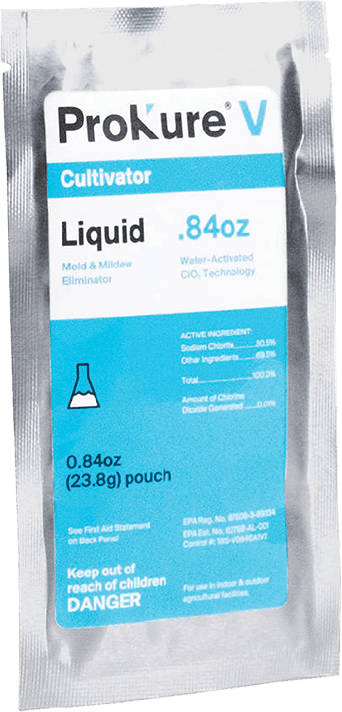
ProKure V is a liquid ClO2 surface disinfectant, EPA Reg. No. 87508-3-89334. Used at an exposure time of 10 minutes at 100 ppm, it disinfects hard, non-porous surfaces, benches, trays, tools, walls, and it leaves no residue. It is suitable for use with plants in the room because it is applied to surfaces, not the crop. That single combination, a hard-surface disinfectant you can use with plants nearby, residue-free, is what bleach and quats cannot offer, and it is why it fits the turnover job. For the full detail, see theProKure V liquid disinfectant pillar.
Where V sits next to G and D
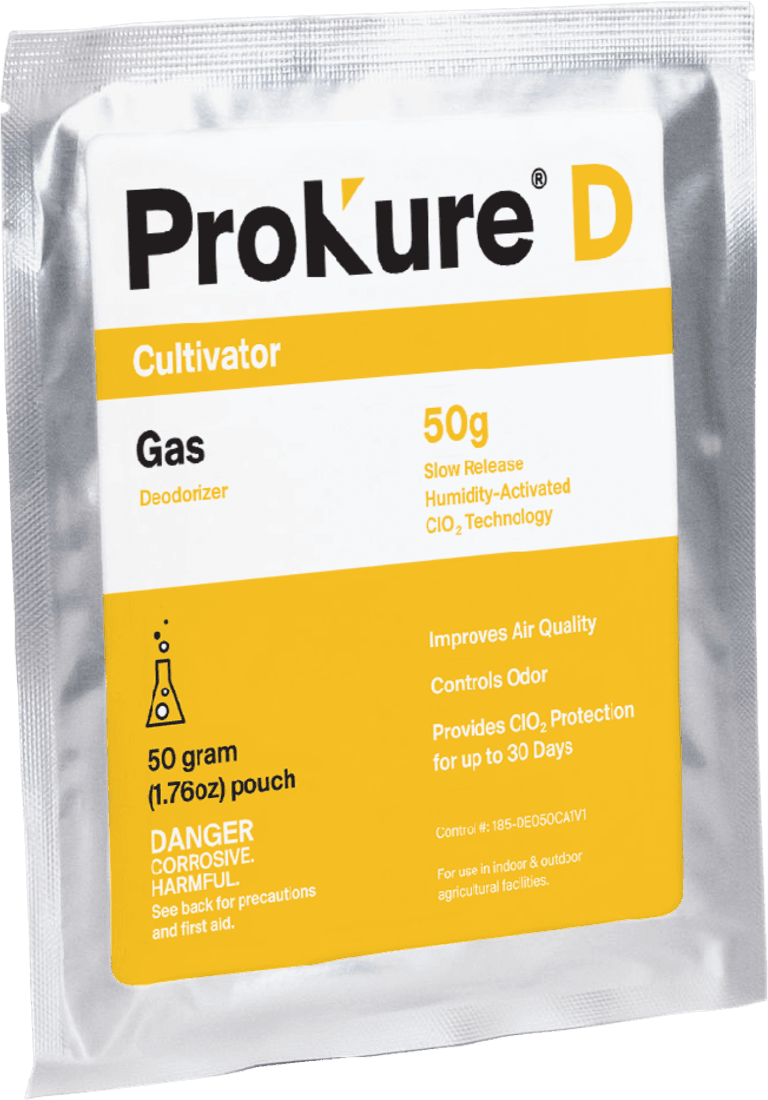
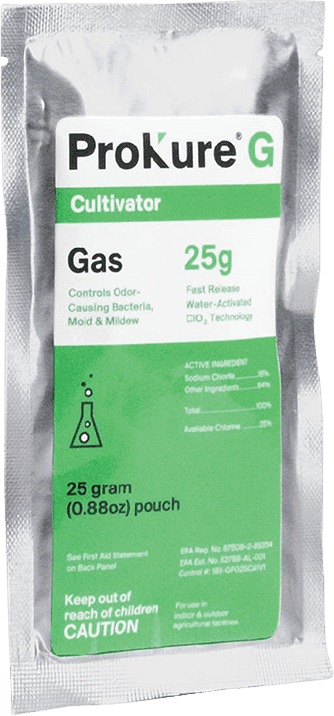
Keep the system straight. ProKure V disinfects surfaces between cycles with plants nearby. ProKure G is the fast-release gas for an empty-room air reset, and its label reads "Not for use with/on plants/crops/feed," so it runs with the room empty of plants. ProKure D is the slow-release gas that holds air quality for up to 30 days with plants in the room. For the empty-room gas step, see theProKure G fast-release reset; for ongoing air, theProKure D slow-release pillar. To order V, go to shop.groclarity.com; for the SDS and EPA label, see prokuresolutions.com.
The downtime cost math
Two days back per turn is not a convenience, it is capacity.
Room-days recovered per year
Count it in room-cycles. A residue-free disinfectant the crew can work around removes the evacuation-and-reclean delay, and every turnover day recovered is a fraction of a harvest you did not previously have room to grow.
Worked example
Four rooms, eight cycles a year each, two days saved per turnover, is 64 room-days recovered annually. Those are days the rooms are growing instead of sitting dark. Put that against the sanitation spend and the trade is not close. For the full owner-side ROI framing, see ourmold prevention protocolsand the air-side program inair-quality management.
The audit trail: proof-of-sanitation
The reset is not done when the room looks clean; it is done when the record exists.
What to log
Capture date, room ID, product and EPA registration number, dilution, contact time, surfaces treated, the tech who signed off, and the re-entry time. For ProKure V that EPA number is 87508-3-89334. That log is what an owner and a state inspector can read.
Verify and tie it to your batch records
Use an ATP swab or an air sample on a set cadence to verify the clean, and tie the sanitation log to your METRC batch records so the reset is connected to the crop that followed it. Verification plus a dated log turns "we cleaned it" into evidence.
How to run your next turnover on this playbook
The short version you can hand a new hire. Strip the biomass. Tear out media and pans. Physically clean every hard surface. Disinfect the hard, non-porous surfaces with a residue-free ClO2 product the crew can work around. Reset the air, verify, and log every step with the EPA registration number attached. Then transplant. If mold keeps hitting the same room cycle after cycle, turnover is not your real problem, and themold prevention protocolsframework is where that gets solved. Built on Science. Backed by Results.
Frequently asked questions
The questions facility managers ask most about between-cycle turnover. Serious Science for Serious Growers.
Related resources