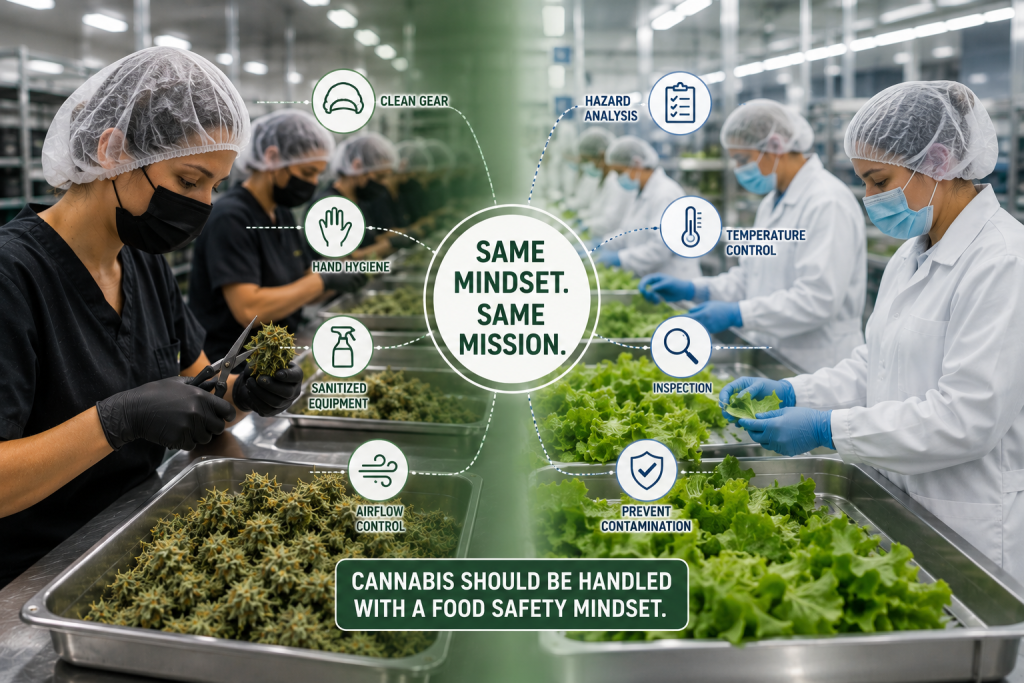
Imagine walking through a modern food processing facility. Employees wash their hands before entering production areas. Gloves are changed routinely. Hairnets, clean uniforms, and sanitized equipment are standard practice. Work surfaces are cleaned on a scheduled basis, and product movement follows carefully designed workflows—all intended to minimize opportunities for cross-contamination.
These practices were not created overnight, nor are they arbitrary. They are the result of decades of research, regulatory oversight, outbreak investigations, and continuous improvement. Every procedure exists because someone, somewhere, learned an important lesson about preventing contamination. The food industry has spent generations refining these systems so they become routine rather than reactive.
Cannabis does not need to reinvent the wheel.
Once flowers leave the cultivation room, they begin a transition from agricultural crop to consumer product. The post-harvest process—including drying, bucking, trimming, inspection, packaging, storage, and distribution—shares many of the same handling risks found in food production.
Trimming: Where Workflow Becomes Biosecurity
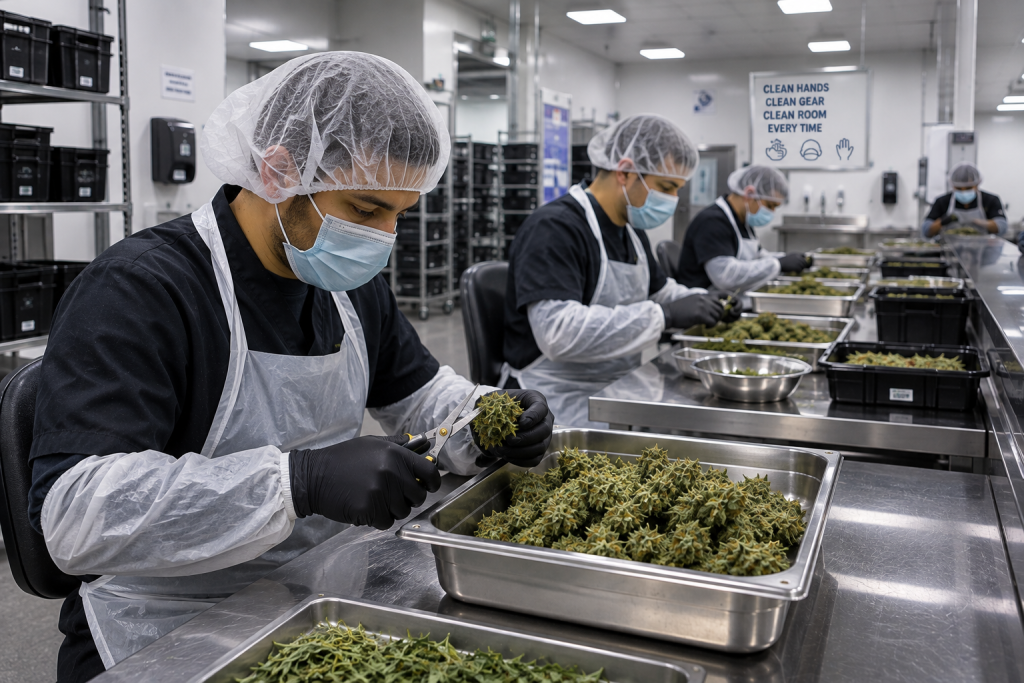
The trimming room is where the transition from cultivation to food safety becomes especially important. Unlike a growing plant that remains in a controlled production environment, harvested flower begins moving through a series of handling steps that involve employees, tools, equipment, and multiple processing areas.
Most commercial cultivation facilities are not designed around a single harvest event. Multiple flower rooms may be harvested throughout a production cycle, while trimming capacity is often concentrated into one processing area. This creates a unique biosecurity challenge: material from multiple cultivation spaces enters a shared workflow.
The concern is not simply where trimming occurs. The concern is whether the process is intentional and controlled.
Some facilities operate dedicated trimming rooms. Others may use temporary trimming stations or even trim in hallways near the harvested flower room. While these approaches may look very different, either can be successful when the workflow is carefully designed and consistently followed.
Biosecurity is not determined by the name of the room. It is determined by the process.
Where does harvested material enter the workflow?
Where do employees move before and after trimming?
Are tools and equipment dedicated, cleaned, or transferred between areas?
Is airflow considered when selecting processing locations?
Are post-harvest activities separated from active cultivation areas?
These questions matter because trimming is not just a product-handling activity—it is also a biological material-handling activity.
The movement of flower, plant debris, dust, and other organic material creates opportunities for microorganisms to move with the process. Mechanical trimming, in particular, can increase the amount of plant material disturbed during processing, making control of airflow, cleaning practices, and room transitions even more important.
The goal is not to eliminate every activity that creates risk. Harvesting, bucking, and trimming are necessary steps in producing a finished product. The goal is to understand where risk is created and establish procedures that prevent that risk from spreading.
A successful post-harvest biosecurity program does not depend on having the perfect room. It depends on having the right process.
Every harvest creates a movement of biological material. The goal is to control that movement rather than allowing it to control the facility.
Every touch is a biosecurity event.