
The top cannabis mold prevention protocols for 2026 are the same handful that have always worked, run with more discipline and better documentation than most operations manage: hold humidity to a stage-specific target, move the air and filter it, sanitize surfaces with an EPA-compliant chemistry, reset the room between cycles, know the species you are fighting, and keep a log that proves all of it. What changes in 2026 is the stakes. State pre-sale yeast and mold limits are the pass-fail line on a six-figure harvest, and EPA registration is the first thing an inspector checks. This playbook ranks the protocols and routes you to the deep dive for each.
One scope note. This is the roundup, not a single deep dive. For the humidity numbers, the species specifics, and the turnover SOP, the links point to the pages that own each. The hub for the whole program is mold prevention protocols, and the cultivation framework behind it is cultivation IPM expertise. If you already have visible mold, you need treatment, not prevention. Everyone building or auditing the 2026 program, read on.
Why 2026 raises the bar for cannabis mold prevention
Two things make this year different from the evergreen advice. First, state-mandated pre-sale total yeast and mold limits, expressed in CFU per gram, are the number the whole program protects, and they vary by state with separate Aspergillus screens in several. A positive test on a mature crop is the event that wipes out a harvest worth six figures. Second, EPA registration has become the audit line: a sanitizer making a hard-surface claim in a licensed facility carries a registration number, and the label governs where it may be used, including whether plants can be present.
The pages ranking for this query mostly miss both. They give good horticulture advice and skip the compliance layer entirely, which is exactly the gap a commercial operator falls into. This playbook keeps the compliance line in view from protocol one, because in 2026 a clean grow that cannot prove it is clean still fails.
The other shift worth naming is that the search results for this kind of query are padded with consumer and hobbyist content: seed-catalog posts, a consumer-health page, a beginner blog. That content is fine for a home grower and useless for a commercial operator who answers to a state lab and an inspector. The protocols below are written for the facility, not the closet grow, which means every one of them assumes a logged reading, a named product, and a compliance bar at the end.
The environmental protocols: humidity, airflow, and filtration
Mold is a math problem before it is a biology problem, so the first three protocols hold the envelope outside the range where spores germinate.
Protocol 1 is stage-by-stage humidity and temperature. A single number is the mistake; the target moves by stage. A commonly cited veg guidance is below 50% relative humidity, late flower runs lower as dense buds hold moisture, and cured-flower storage sits in a different band entirely, around 59 to 63% for the finished product. Hold canopy temperature in range too, because colonies accelerate sharply in the warm band. The stage-by-stage numbers live under mold prevention protocols. The reason the single-number advice is dangerous is that a figure right for veg is wrong for late flower: hold a flowering room at the veg target and you hand dense buds the humidity botrytis wants. Publish one number per stage and the operator reading a meter at 2 a.m. knows instantly whether the room is in range, without doing math or reconciling three articles.
Protocol 2 is airflow and canopy density. Stagnant air builds humid dead zones in corners and inside a dense canopy even when the room reading looks fine, so run circulation that reaches between plants, space the canopy, and time defoliation to open airflow. Moving air is not the same as air reaching every leaf. The daily check here is physical: walk the corners and the undersides of benches, not just glance at a running fan, because a fan aimed right in week one drifts, new equipment creates a dead pocket, and a filling canopy blocks the cross-breeze it had in veg.
Protocol 3 is HEPA air filtration for the airborne spores that circulation alone cannot remove. A true HEPA stage captures the submicron particles where most mold spores live, and the maintenance is the catch: pre-filters change far more often than the HEPA stage, and a neglected filter stops working silently. Pair filtration with the circulation that actually moves room air through it. The air build-out is covered under air quality management.
The reason these three are protocols one through three, ahead of any chemistry, is that they are prevention in the truest sense: hold the environment outside the germination envelope and most of what the later protocols clean up never gets a foothold. A facility that nails humidity, airflow, and filtration is doing the cheap, high-leverage work first. A facility that skips them and leans on sanitation is mopping a floor with the tap running. The environmental protocols are also the ones that fail quietly, a drifting setpoint, a stalled fan, a filter a month past due, which is why they are daily and weekly checks with logged readings, not a one-time setup.
EPA-registered sanitation chemistry
Protocol 4 is the section none of the top-ranking pages write, and it is the one 2026 makes non-negotiable. Surface sanitation between and during cycles is where chemistry choice stops being preference and becomes a documented, compliant decision.
First, read the label. An EPA registration number means the product's disinfection claims were reviewed and the label is enforceable, and the label's site of use tells you whether plants may be present. That single fact sorts the shelf. Bleach off-gasses fumes that force the crew out, corrodes stainless, and leaves residue; quaternary ammonium compounds leave residue too, which is a problem when the next crop's roots and leaves touch the same surfaces. The hidden cost of the harsher chemistries is not just the residue; it is the downtime, because a product that forces an evacuation can only run in an empty room and the room sits while it off-gasses. The comparison that matters for a commercial grow is therefore residue and plant adjacency, not merely whether a product disinfects, since most do at the right concentration and dwell. A sanitizer you cannot use near a crop is a sanitizer that costs you cycle time.
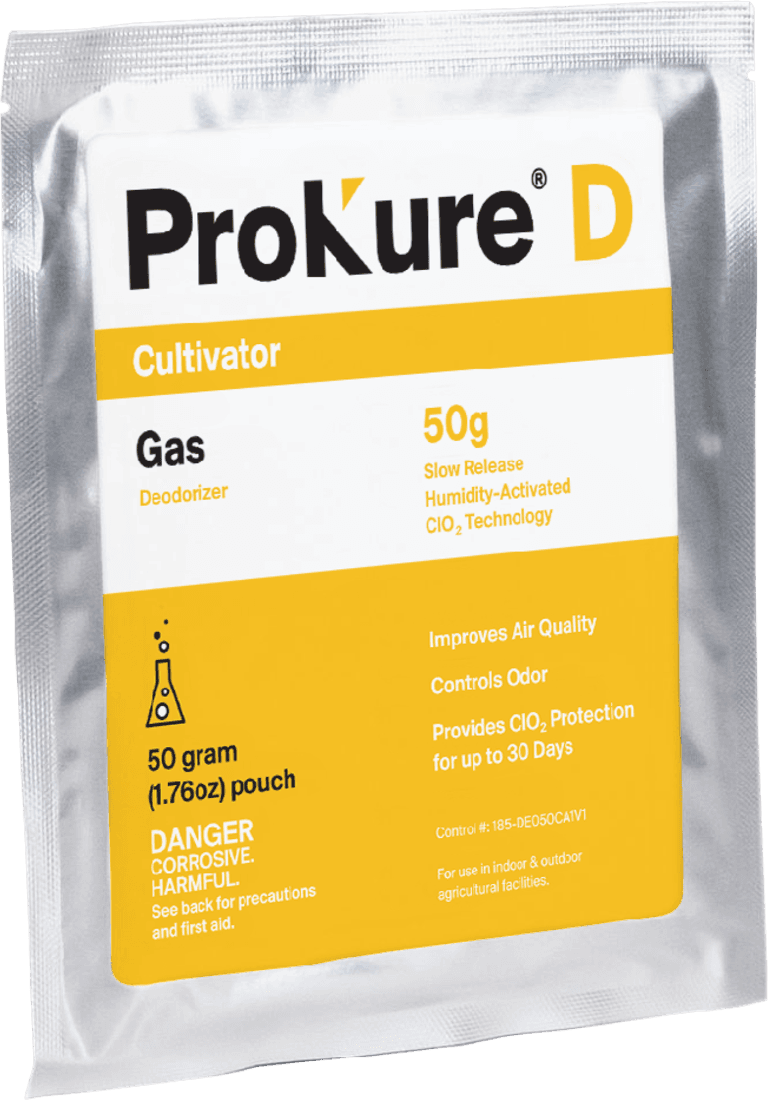
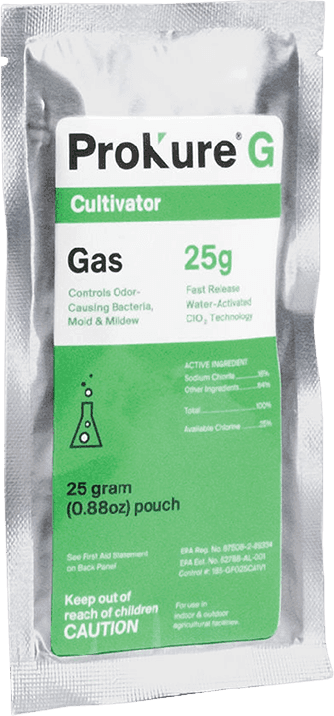
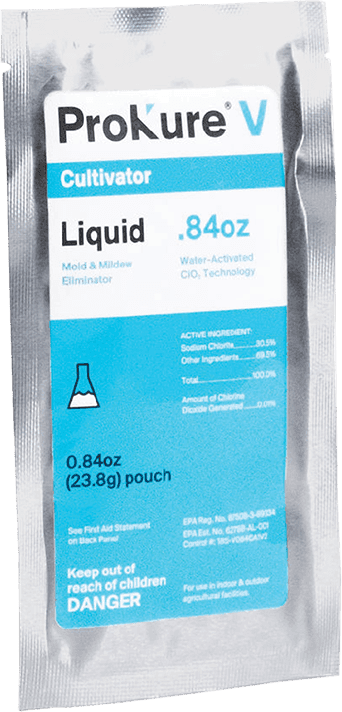
Chlorine dioxide (ClO2) is the chemistry that answers the residue-and-plant-adjacency problem, and it appears as three distinct products. ProKure V is a liquid surface disinfectant (EPA Reg. No. 87508-3-89334) labeled for mold and mildew commonly found in greenhouses and agricultural facilities; it works at 100 ppm for a 10-minute exposure on hard, non-porous surfaces, leaves no residue, and is suitable for use with plants in the room. ProKure G is a fast-release gas deodorizer (EPA Reg. No. 87508-2-89334) that carries the verbatim restriction "Not for use with/on plants/crops/feed" and runs only in an empty room. ProKure D is a slow-release gas that provides ClO2 protection for up to 30 days and runs with plants present, but it is not an EPA-registered product, carries the verbatim disclaimer "Not an EPA-registered product and not labeled for sale as a pesticide under 40 CFR," and makes no kill claim. Name each at its step with its registration status and room condition, and do not attach G's plant restriction to V or D. The specs are at ProKure V liquid surface disinfectant and ProKure G fast-release gas.
The practical model is a two-column sort an operator never has to reason through under pressure. One column holds the products usable with plants present, where V's residue-free surface disinfection and D's ongoing air layer sit; the other holds the empty-room-only products carrying the plants, crops, or feed restriction, where G sits. Pre-sorting every product into its column, with the room condition named in the SOP, turns the single most common compliance error, the right product used at the wrong time, into a checkbox rather than a judgment call at the end of a long shift. Keep the SDS and label for every named product on file, because an inspector who asks for them expects to be handed them, not to watch a search.
The between-cycle room reset
Protocol 5 is the turnover, and it is where a facility either recovers days or loses them. The industry baseline is three to five days lost to a bleach reset, mostly because the crew evacuates for fumes and the steps run end to end. That downtime is pure lost production: a room that is not turning is not growing, and more harvests per year off the same square footage is one of the clearest returns in a cultivation operation. The reset protocol is where a facility manager's biggest pain, the multi-day turn, meets a direct fix.
The sequence that compresses it: clear the room and remove all plant material, gross-clean to lift the soil load (a sanitizer cannot work through dried sap and dust), disinfect the hard surfaces on a logged contact time, dry down, and verify with a swab before the next crop goes in. A residue-free surface step does not require the evacuation a fuming sanitizer does and leaves no rinse before the next crop makes contact, which is what pulls a multi-day turn down toward a same-day one. Where an empty-room air reset is needed, the fast gas step runs in four to six hours plus a one-hour vent. Sequence the slow steps to run in the background while hands-on work continues elsewhere.
Do not skip the HVAC in the reset. The air handler is the spore highway, and a room surface-cleaned while the ducts and the condensate pan still hold spores reseeds itself on the first fan cycle. Clean coils, change filters, address ducts, and sanitize the condensate pan as part of the turn, before the air-phase step, not after. And never combine ClO2 with acids or other cleaners; finish one chemistry, ventilate, then move to the next. A turnover is a scheduling problem as much as a cleaning problem, and the facilities still losing five days are usually the ones running every step in series instead of overlapping the waits.
Know the species, and the biology protocols
Protocols 6 through 9 are the plant-side defenses, and they start with naming the enemy, because a program that inspects for the wrong thing inspects for nothing.
Protocol 6 is species identification. Botrytis (bud rot) grows from inside the cola outward, so the early tell is a yellowing leaf near the bud, not the obvious gray patch. Powdery mildew is a white, chalky film that spreads on airborne spores. Fusarium attacks from the soil and root zone. And the species that matter most for human health, Aspergillus, Mucor, and Cryptococcus, can cause serious infections in people with compromised immune systems, which is part of why the pre-sale test screens for them. Learn to tell trichomes, the sticky, shiny crystals, from the dull gray coating of early mold, because mistaking one for the other costs a crop either way. Train the whole crew on the early signs, not just the obvious late ones, because by the time a cola is visibly rotted or a leaf is dusted white, the program has already failed at prevention. The inspection step is only as good as the worst-trained person running it, so the species protocol is a training protocol as much as a biology one: everyone who walks a room should know what each of the four looks like at its earliest, most catchable stage.
Protocol 7 is water discipline: water at the base rather than overhead so foliage stays dry, and audit for standing water and drainage problems that become reservoirs. Overhead watering leaves films on leaves that are exactly the wet surface powdery mildew and botrytis exploit, and a pooled drain or a dripping line is a humidity source the room reading never shows. Water timing matters too: water when the surfaces have the rest of the lighting period to dry, not right before lights-out, so the canopy does not sit wet through the cooler, higher-humidity dark hours. Protocol 8 is biological inoculants, where beneficial microbes such as Trichoderma against Fusarium and Bacillus subtilis against Botrytis and powdery mildew put up a fight before a chemical step is needed. Like predatory insects, these work best established ahead of pressure rather than applied in a panic once an outbreak is visible, so they belong on the planting and transplant schedule, not in the emergency kit. Protocol 9 is genetics: choosing cultivars with real resistance to the pressures your facility sees lowers the load every other protocol has to carry, which is leverage you buy once and keep every cycle. Trial new genetics under your own conditions before committing a room to them, because a cultivar's resistance on a breeder's sheet is not the same as its performance in your humidity, your airflow, and your pest pressure. The cultivation framework for all of these is cultivation IPM expertise.
The thread through protocols six to nine is that they lower pressure before it reaches the point where chemistry is the only option left. A resistant cultivar watered at the base, backed by beneficial microbes and inspected early for the right species, is a plant that rarely needs a last-resort intervention. That matters especially in cannabis, where the legal chemical options are narrow and the flowering window rules out most foliar sprays. The biology protocols are not the soft, optional half of the program; they are what keep the hard chemical step rare, which is exactly where you want it.
Drying, curing, and storage
Protocol 10 is the post-harvest window, where a clean grow still goes bad if the finish is sloppy. Dry in a sanitized room held in range, then cure with a burping schedule and a hygrometer in the jar so you are managing to a number, not a guess. The dry room is where a small humidity miss turns into surface mold fast, because the biomass is giving up moisture into the air and a crowded, under-ventilated dry space pushes the room above target within hours. Space the hang, verify the dry-room air exchanges, and sanitize the space before anything hangs in it, because retrofitting sanitation around a hung crop is nearly impossible. Finished-flower storage holds a lower, tighter humidity band, commonly cited around 59 to 63%, because the product is done respiring and trapped moisture becomes mold. This is also where a surface-sanitized dry and cure space pays off, since the product is handled most here and contamination at this stage rides straight onto a sellable harvest. The post-harvest specifics are part of mold prevention protocols.
The distinction between grow-room humidity and storage humidity trips people up, and it is worth stating plainly: the numbers are not the same and they are not interchangeable. A grow room runs lower through late flower to keep living, transpiring plants dry; finished-flower storage runs in its own band to hold cured product stable without drying it to dust or trapping moisture. Advice that quotes a single humidity figure for all of cannabis, which several of the ranking pages effectively do, blurs that line and sends a storage number into a grow room or a grow-room number into a jar. The playbook keeps them separate because the failure modes are different at each stage.
The compliance data trail and multi-state standardization
Protocols 11 and 12 are what turn a clean grow into a defensible one.
Protocol 11 is the data trail. Log humidity, temperature, and every sanitation event per room per day, each with a reading and operator initials; retain the SDS and EPA label for every product named in your SOP; and keep the pre-sale lab testing handoff documented. The common failure is a log that goes dark for weeks and resumes before an inspection, which an auditor reads as a period the facility was unmanaged. A continuous log of ordinary, in-range readings is more persuasive than a polished binder with holes, and it is the Head Grower's proof the environment was controlled, not just that it looked clean. The pesticide application log deserves its own rigor, with product, EPA registration number, applicator, PPE, date, location, target pest, and re-entry interval, because a missing field turns a legal application into a documentation violation at audit. Tie each record to the room and the harvest batch so a positive test can be traced back to exactly which room, which product, and which cycle in minutes rather than days.
Protocol 12 is standardization across facilities. A multi-state operator writes one master protocol plus a per-state appendix holding that state's allowed-product list and thresholds, so a rule change updates one appendix rather than the whole document, and procurement consolidates on one sanitation line used consistently across the footprint. That architecture is what a Cultivation Director defends to an auditor who crossed a state line, and it is also what lets a cultivator who transfers between facilities relearn only the appendix, not the whole program. Build the appendix structure from the start even if you operate in one state today, because retrofitting it after several facilities have each drifted into their own version is far more work than designing for it up front.
You now have the twelve, which means you know which protocol your operation is weakest on and where to go deep on it. If you take one thing from the playbook, make it the order: the environmental protocols and the biology do the cheap, high-leverage prevention, the sanitation and reset handle what gets through, and the documentation turns a clean grow into a defensible one. Start with the protocol your operation is weakest on, log what you change, and let the data tell you whether the pressure is actually dropping. The hub for the whole bucket is mold prevention protocols.
Related resources