
How to Build a Cannabis IPM Program: A Step-by-Step Guide for Cultivators
Building a cannabis IPM program is a build in order: assess the site and its pest history, set action thresholds against your state's compliance test, stand up a scouting protocol, select controls with EPA compliance baked in, treat sanitation as a preventive layer, document everything into an audit trail, and train the crew with a sign-off. The reader here has been told by ownership, an inspector, or a new SOP requirement that they need a program on paper. This guide walks the build step by step, so a head grower or cultivation director can take an operation from no formal program to one that prevents crop loss and survives an audit.
What an IPM program is, and what inspectors expect to see
An integrated pest management program is a hierarchy of controls run in a fixed order, prevention and monitoring first, chemical intervention last, built specifically around the constraints cannabis imposes: limited pesticide options, mandatory pre-sale microbial testing, and a high crop value that makes any failure expensive. What an inspector expects to see is not a philosophy but a system: named targets, written thresholds, a monitoring cadence with logs, products matched to their EPA labels, and evidence that the crew was trained against the program. A program that exists only in a head grower's experience passes nothing; a program written down, run, and logged passes.
The practical consequence is that building a program is as much an organizational exercise as an agronomic one. You are not inventing new cultivation science; you are capturing what good practice looks like in a form that a crew can execute the same way every time and an auditor can verify. That framing matters because it tells you when the build is done: not when the document is pretty, but when the daily reality of the grow matches what the program says. The broader discipline this sits inside is cultivation IPM expertise.
Steps 1 and 2: assess the site, and set your thresholds
Site assessment and pest history
The build starts with honest reconnaissance. Walk the facility and catalog what you have: the rooms and their uses, the airflow and HVAC, the entry points and workflow, and above all the pest and pathogen history. Which problems have hit this operation before? Which rooms run hot? Which cultivars struggle? A program built without that history is generic; a program built on it targets the real risks the facility carries. Write down the recurring problems and the conditions that produced them, because those are the risks the rest of the program is designed to control.
The assessment also surfaces the structural constraints the program has to live within. A facility with a shared return plenum, a floor drain in every room, or a crew that moves freely between dirty and clean areas has risks baked into its layout that the program must account for even if it cannot fix them at the design stage. Note those honestly, because a program that pretends the building is ideal will fail at exactly the points the building is not. The output of this step is a short risk register: the handful of specific threats this facility actually faces, ranked by how often they have hit and how much they cost. Everything downstream, thresholds, scouting cadence, control selection, is calibrated to that register rather than to a generic pest list.
Set your action thresholds
With the targets known, set an action threshold for each: the written point at which an observation triggers a response. Thresholds are species-dependent. A fast, destructive, or incurable threat like Fusarium or hop latent viroid sits at a near-zero threshold with immediate removal; a manageable pest like a few thrips sits at a monitored threshold above which you intervene. For the compliance-relevant pathogens, tie the threshold directly to your state's pre-sale yeast and mold test limit, set with margin below it so a room staying under your in-house number stays comfortably inside the number you will be tested against. Writing the thresholds down in advance is what lets a crew respond by protocol rather than by panic, and the state-by-state threshold detail that informs this sits in mold prevention protocols.
The reason to fix the threshold before you need it is that the moment of a finding is the worst time to decide how to react. A crew member who discovers rot or a rising mite count under harvest pressure needs the program to tell them the answer, not to improvise a call that might be too slow for a fast-spreading pathogen or too aggressive for a manageable pest. A written threshold also removes the temptation to rationalize a growing problem as still acceptable, which is how a small infestation becomes a crop loss. Pair each threshold with its escalation response in the document, and the program does the hard thinking in advance so the crew does not have to do it in the heat of the moment.
Step 3: build the scouting protocol
Scouting is how the program senses what is happening, and it is where most informal operations are weakest. Build it as a schedule, not a habit. Specify the cadence by plant stage, weekly or tighter in veg, every few days from early flower, daily late-flower cola inspections, because pressure changes as the crop matures. Assign a named scout, give them a fixed route so no bench is skipped, and define how a finding gets documented and where the log lives.
Specify the tools too: sticky cards for flying insects, a hand lens for mites and mildew, environmental monitoring for temperature, humidity, and vapor pressure deficit, and a cadence for surface swabs and air samples. Environmental monitoring is part of scouting, because a humidity excursion is an early warning of the mold pressure to come, and the air-side monitoring that supports this is covered in air quality management. The test of a good scouting protocol is simple: a new crew member should be able to execute it from the written document, and an auditor should be able to verify it against an actual, dated log. Scouting that lives only in one experienced grower's routine does not survive that person's day off, let alone their departure.
The hardest-to-see threats drive the tool choices. Russet and broad mites are too small to catch without strong magnification and do their damage before they are visible, so a hand-lens check of new growth belongs in the protocol, not just a visual walk. Hop latent viroid shows no reliable early symptoms, so the protocol should specify when lab testing escalates beyond visual scouting. Building those escalation triggers into the scouting section, when a symptom is ambiguous, when a viroid is suspected, when a count crosses a line, is what keeps the program from relying on the naked eye to catch threats the naked eye cannot catch. A scouting protocol that knows its own limits and names when to reach for a lab is stronger than one that assumes a walk-through sees everything.
Step 4: select your controls, with EPA compliance baked in
Controls are the program's response, and they run in a hierarchy: biological, cultural, mechanical, and chemical, least invasive first. Document the biological control agents you use and the pests they target, the cultural and mechanical responses, and only then the chemical interventions. For cannabis, chemical options are limited to products allowed in your state and must be used strictly on label, which makes the first three tiers carry most of the load.
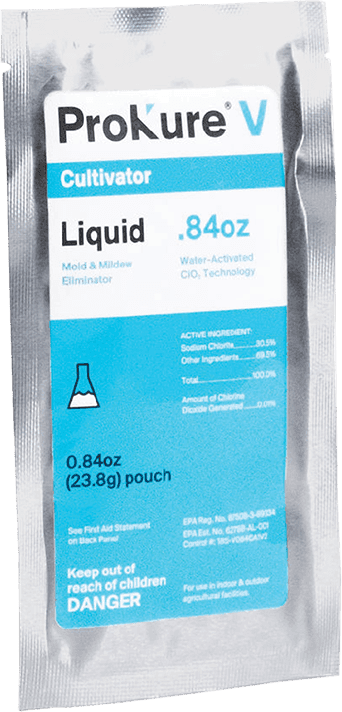
The step the informal programs skip is baking EPA compliance into control selection rather than bolting it on later. Every antimicrobial and pesticide in the program needs its EPA registration number recorded and matched against your state's allowed-product list, because a product being federally registered does not automatically mean it is permitted for cannabis in your state. Spell out the label rule your crews follow: match the product to whether plants are present, and use it only as the label directs. A plant-safe surface disinfectant like ProKure V, EPA Reg. No. 87508-3-89334, is suitable for use with plants in the room and leaves no residue, so it fits surface work with a crop present; a gas product carrying a not-for-use-with-plants disclaimer belongs only in an empty room. Selecting controls with the label and the state list in hand, and appending those labels to the program, is what makes this step audit-ready rather than a liability. The plant-safe surface option is detailed at ProKure V liquid disinfectant, with labels and safety data sheets on prokuresolutions.com.
Within the biological tier, match the agent to the pest you actually scouted rather than releasing generalist predators and hoping. Predatory mites for spider mites and thrips, parasitic wasps for aphids, released on a schedule that keeps the beneficial population ahead of the pest population, do most of the in-cycle work a cannabis program is allowed to do. The common mistake is treating biologicals as a rescue after an outbreak is already large; released preventively and matched to the scouted pest, they hold populations under threshold so the chemical tier is rarely needed. Write the biological program with the same specificity as the chemical one, which agent, for which pest, on what release cadence, and note any compatibility constraints between your biologicals and your sanitation chemistry so a crew does not sanitize away the predators you just paid to release.
Step 5: sanitation as a preventive IPM layer
Sanitation is not a separate chore from IPM, it is one of its most important preventive layers, and the program should treat it that way. The highest-leverage sanitation moments are intake, where incoming clones and tools can carry a pathogen past the perimeter, and between-cycle turnover, where a poorly reset room locks last cycle's spore load into the next crop. Build both into the program: a biosecurity-at-intake protocol with quarantine, testing, and tool sanitation, and a between-cycle turnover sequence of strip, clean, disinfect, verify, reset.
Writing sanitation into the program as a preventive layer, rather than an afterthought, is what closes the loop with the control section. The products named for sanitation carry their label conditions, the dwell and re-entry times are specified, and the residue-free rationale answers the crew-safety and residue concerns a facility manager lives with daily. A program that prevents problems at intake and resets rooms cleanly between cycles needs its control and remediation tiers far less often, which is the whole point of a prevention-first design: the cheapest pest problem is the one that never establishes.
The intake protocol in particular is worth building with care, because it is the highest-leverage preventive step and the one most operations leave informal. Every clone, tool, and visitor is a vector, and hop latent viroid spreads silently through infected material and contaminated tools, often showing no symptoms until yield and potency quietly fall. Write the intake protocol explicitly: where incoming genetics are quarantined, what testing they undergo before joining the main grow, how tools are sanitized between plants, and how crew movement is controlled from dirty areas toward clean ones. A program that closes the intake door keeps out the pathogens that do the most damage with the least warning, and it does so at a fraction of the cost of fighting them once they are inside the crop.
Steps 6 and 7: documentation, audit trail, and staff training
Documentation and the audit trail
The program becomes real when it produces records. Define the logs it maintains: a monitoring and scouting log, a product application log with registration numbers and dwell times, a corrective-action log, and an environmental and air-quality log. For each, specify the fields and the cadence. These logs are the answer to the question an auditor actually asks, which is not did you clean once but can you show the conditions held over time. A program that names its logs and keeps them is a program that passes; one that describes a process but produces no records fails even when the underlying practice was sound. Keeping the logs in one system, so a single room's history reads as one timeline, is also what lets you learn from your own data and improve the program each cycle.
The logs are not just compliance paperwork, they are the feedback loop that makes the program better over time. A scouting log read across several cycles tells you which rooms recur with the same problem and whether a change you made actually reduced it. An application log keyed to results tells you which interventions earned their place. Without the records, every cycle starts from memory and every problem feels like a surprise; with them, the program becomes a dataset you can interrogate. Design the log fields with that use in mind, capture the date, the room, the operator, the finding or product, and the result, so the data supports both the auditor's question and your own continuous improvement.
Staff training and sign-off
The last step is the one that makes the program durable: train the crew against it and assign ownership. Document who was trained, on what, and when, and refresh the training when the program changes. Name a single owner accountable for keeping the program current, and close with a sign-off and revision history showing it is a maintained, living document. A program is only as good as the crew executing it, and an inspector who sees a polished program but no training record has found a gap. Training and sign-off are what turn a document into a practice the whole operation actually follows.
This step is also where the organizational reality of a build shows up. A single-room grower holds the whole program in their head, but the moment an operation adds staff or rooms, the knowledge has to live on paper and travel through training or it does not travel at all. The named components, each with its own cadence, threshold, and log, are what a new crew member can be trained against and held to, which is exactly what an operation needs as it scales from one person doing everything to a team running a facility. The sign-off is not bureaucracy; it is the mechanism that keeps the program current, because a document nobody owns drifts out of date the first time a product, a threshold, or a regulation changes and nobody updates it.
Building across facilities, and when IPM has already failed
The multi-facility build
For a cultivation director standing up programs across several facilities, the build has an extra dimension: consistency across markets whose rules differ. The approach that works is a master program carrying the common structure, assessment, thresholds, scouting, controls, sanitation, documentation, training, with facility-specific and state-specific appendices for the pieces that vary, the pre-sale thresholds, the allowed-product lists, and the local regulatory specifics. That lets a director prove every site runs the same proven program while still meeting each state's rules, which is the standardization a multi-state operator needs to avoid protocol drift between facilities. The multi-site considerations are covered further in multi-state cannabis operator guidance.
The master-plus-appendices structure also makes the program portable to a new facility. When the common sections live in one master document and only the genuinely state-specific pieces sit in appendices, a newly acquired or newly built site inherits the proven program rather than reinventing it, and the director can audit every site against the same yardstick. Build the master to the strictest standard in the footprint and let the appendices add rather than subtract, so no facility ever operates below the baseline. That is how an operator turns a collection of individual grows into one defensible, consistent program that a regulator in any of its markets can inspect and trust.
When the program has already failed
Sometimes the reason a cultivator is building a program is that the lack of one just cost them a crop. If you are here because of an active infestation or a positive test, the immediate work is remediation, not program design: contain the problem, remove infected material, investigate the cause, and reset the affected rooms before you resume normal operation. Remediation is a different workflow with its own forensic and quarantine steps, and it is where the mold-specific response detail lives. Build the program afterward so the failure does not repeat, because a program built in the aftermath of a loss, with the cause fresh and documented, is often the most honest and effective one an operation ever writes.
The discipline is to separate the two jobs cleanly. Remediation is urgent and reactive: stop the spread, remove the infected material, find the cause. Program design is deliberate and preventive: build the system that makes the next occurrence less likely. Trying to do both at once, drafting a program while fighting an active outbreak, produces a rushed document that reflects the panic rather than the lesson. Handle the fire first, then sit down and build the program with the incident as its first case study, writing the threshold, the scouting change, and the sanitation step that would have caught it. A program whose very first revision closes the gap that just cost a crop is a program the whole operation will take seriously, because everyone remembers why it exists.
Frequently asked questions
These are the questions cultivators ask when they sit down to build an IPM program from scratch.
Building a cannabis IPM program is a sequence, not a document you fill in at random: assess the site, set thresholds against your compliance test, build a scouting schedule, select controls with EPA compliance baked in, make sanitation a preventive layer, log everything, and train the crew with a sign-off. Work it in that order and you end with a program that prevents the crop losses it was built to stop and holds up the day an inspector asks to see it. The program is finished not when the binder looks complete, but when the daily reality of the grow matches what the program says, and the logs prove it. Treat it as a living system you maintain each cycle rather than a one-time deliverable, and it keeps earning its place: fewer crop losses, faster audits, and a crew that knows exactly what to do when a problem shows up, because the program already told them.
Related resources