
The best ClO2 product for cannabis cultivation in 2026 is not one product; it is the right one for the job, because chlorine dioxide (ClO2) comes in a liquid surface disinfectant, a fast-release gas, and a slow-release gas, and each is registered and labeled for a different use. A buyer comparing options this cycle needs three things most pages skip: the EPA registration status of each product, the label site of use (surface, air, with or without plants), and the residue profile. This guide ranks the ProKure ClO2 line by job, explains how ClO2 compares to the broader category, and shows how to read a label before you add anything to a purchase order.
If you want the science of what ClO2 is rather than which product to buy, start with cultivation IPM expertise. If your real question is air and odor control, see air quality management; if it is yeast and mold specifically, see mold prevention protocols. Buyers ready to match a product to a job this cycle, read on.
Why this guide exists in 2026
Search "best ClO2 product for cannabis" and the results are thin: a single-vendor profile, a sanitation essay, and a few social posts. One 2026 vendor profile mentions exactly one ClO2 system in one paragraph and never prints an EPA registration number, a contact time, or a cost. No page ranks products on shared criteria, and none surfaces the EPA restriction that should drive the decision. That is the gap this guide fills. The social posts that pad the results promote single products with marketing copy and no specs, which is exactly the kind of thin input a buyer about to spend real money cannot act on. A ranked guide that reads the labels and separates the jobs is the trustworthy answer the current results do not provide.
The non-negotiable criterion is EPA status, because in a licensed facility the label is the law. A product that makes a hard-surface disinfection claim carries an EPA registration number, and the label dictates where and how you may use it, including whether plants can be present. Any buying guide that ranks products without that information is ranking on the wrong axis. So EPA status leads here, not price.
The reader this guide is for is already past the "what is ClO2" stage. They have decided chlorine dioxide is the chemistry and now need a product name they can put on a requisition or into an SOP this cycle. That buyer does not need to be sold on ClO2; they need the labels read for them, the jobs separated, and the compliance surfaced so the choice they make survives an inspection six months later. That is a different job from the category explainer, and it is why this page ranks products while the hub explains the chemistry. Keep that split in mind as you read: the goal here is a defensible purchasing decision you can stand behind, not a chemistry lesson.
How to compare ClO2 products
Rank any ClO2 product on six criteria, in roughly this order of importance for a commercial grow.
First, EPA registration and site of use: is it registered, what is the registration number, and does the label permit surface, air, or plant-adjacent use. Second, the form and point-of-use concentration: liquid or gas, and the ppm or dose the label specifies. Third, contact or dwell time: how long the surface stays wet or the room stays sealed. Fourth, residue profile: does it leave anything the next crop will touch. Fifth, shelf life and handling: how long you can hold it and what the SDS requires. Sixth, cost per treated area, which you calculate from the treated volume and the product needed per event rather than from a sticker price, because the per-bottle number tells you almost nothing about what a room turn actually costs.
Those six are the columns of a real comparison. The sections below apply them to the ProKure line and then to the broader category of alternatives.
Two of the six trip up buyers most. Site of use is first, because a product that disinfects beautifully on a bench but is labeled empty-room only cannot run while a crop is present, and no amount of efficacy changes that. Residue is the other, because the whole reason a cultivator leaves bleach and quats behind is the film those leave on surfaces the next crop touches. A buyer who ranks on price alone will occasionally land on a product that is cheaper per bottle and unusable for the job they actually have, which is the expensive kind of cheap. Rank on fit first, cost last.
The ProKure ClO2 line, ranked for the job
ProKure splits ClO2 across three products with distinct, label-separated jobs. Ranked by how most cannabis facilities use them, here is each one.
1. ProKure V, for surface disinfection
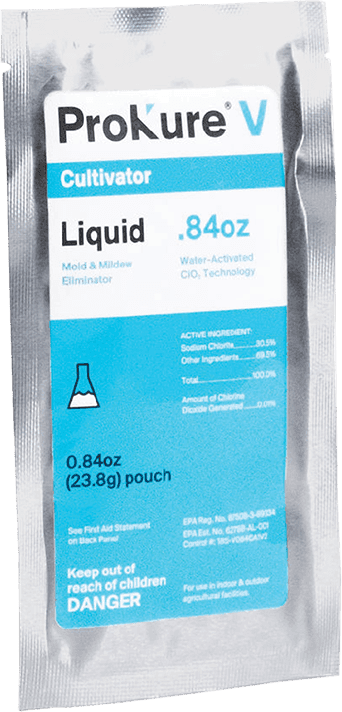
ProKure V is a hospital-type liquid surface disinfectant (EPA Reg. No. 87508-3-89334). You add water to activate it, apply it directly, and it leaves no residue: no wipe, no rinse. On its label kill list, used at 100 ppm for a 10-minute exposure on hard, non-porous surfaces, it disinfects against Fusarium solani (ATCC 36031), Botrytis sp., Penicillium digitatum (ATCC 201167), Aspergillus niger (ATCC 9642), and MRSA (ATCC 33591), among others, and it kills SARS-CoV-2 on hard, non-porous surfaces in 30 seconds. The feature that sets it apart for a grow room is that it is suitable for use with plants in the room, because it treats surfaces, not foliage. That combination, a broad surface kill list plus plant-safe and residue-free, is the thing bleach and quats cannot claim. For the full spec, see ProKure V liquid surface disinfectant; to buy, go to shop.groclarity.com.
The job V is built for is the between-cycle surface turn and any mid-cycle surface sanitation where a crop is nearby: benches, trays, tools, trim-room surfaces, and the hard, non-porous surfaces a room accumulates. Because it activates with water and leaves nothing behind, the surface step does not require evacuating people and plants the way a fuming sanitizer does, and there is no rinse before the next crop makes contact. For a facility manager fighting turnover downtime, that residue-free, plant-tolerant profile is the difference between a surface step measured in minutes of contact time and one measured in days of an empty, off-gassing room.
2. ProKure G, for the fast empty-room reset
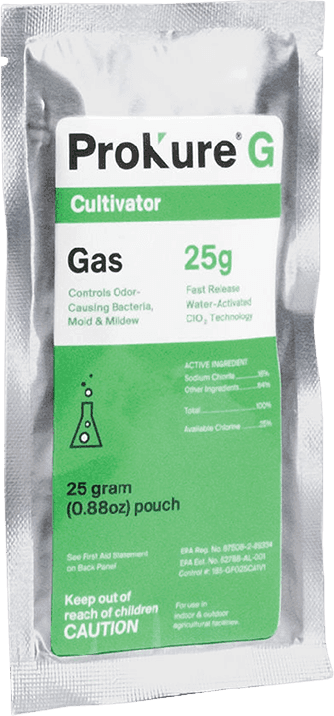
ProKure G is a fast-release gas deodorizer (EPA Reg. No. 87508-2-89334) and the solution for mold and mildew, odor-causing bacteria, and chemical odors between harvests. It is water-activated, delivers a deep-penetrating ClO2 vapor, and works in four to six hours. G carries the verbatim restriction "Not for use with/on plants/crops/feed," so it runs only in an empty room with the crew out, followed by at least one hour of ventilation before re-entry. It is the fast air-and-surface deep clean for a turnover window, not a product you run with a crop present. For the spec, see ProKure G fast-release gas.
G earns its place in the ranking because the gas phase reaches what a wipe cannot: the air volume of a sealed room and the surfaces a cloth misses. When a room has an acute odor event or needs a fast air-quality knockdown between cycles, G does in a few hours what no liquid surface step can do at all. The tradeoff is the empty-room requirement, which is a feature when you plan for it (the turnover window is already an empty room) and a hard stop when you do not (you cannot reach for it mid-grow). Record the treatment and safe re-entry times on a placard, and the gas step slots cleanly into a turnover schedule.
3. ProKure D, for ongoing air quality with plants in the room
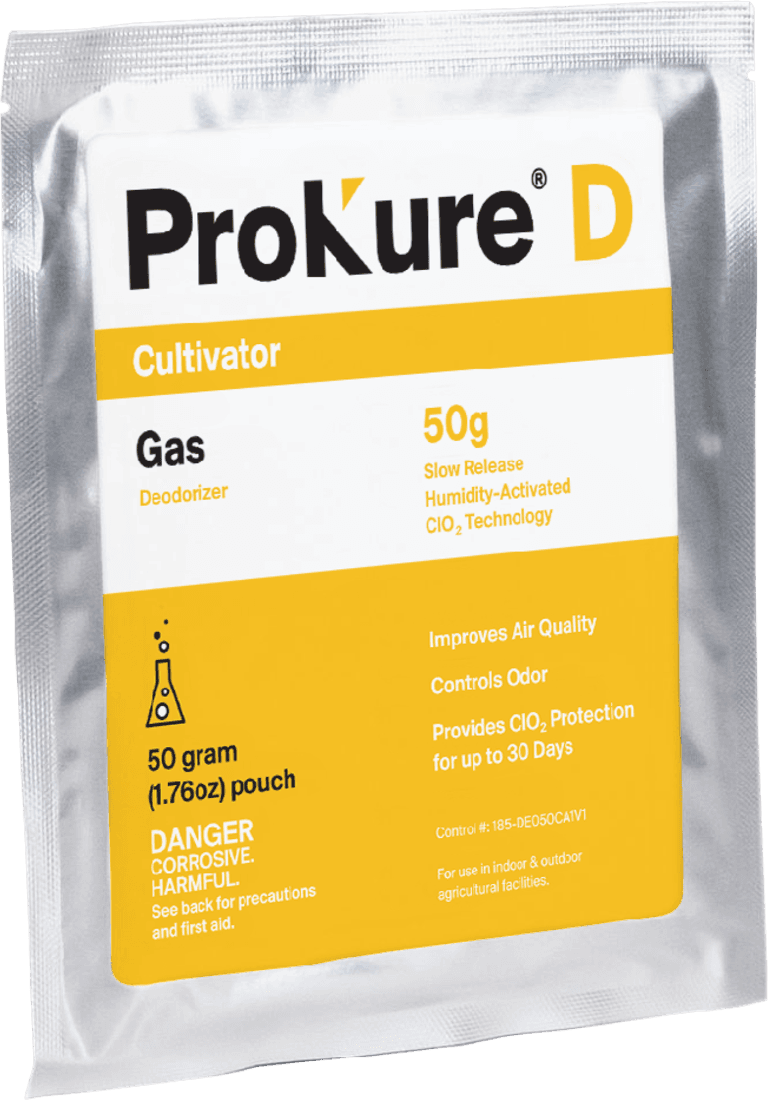
ProKure D is a slow-release gas that improves air quality and controls odors and provides ClO2 protection for up to 30 days. Unlike G, it runs with plants in the room, which makes it the hands-off air-quality layer across a full cycle. Two things to be precise about: D is not an EPA-registered product, so its label carries the verbatim disclaimer "Not an EPA-registered product and not labeled for sale as a pesticide under 40 CFR," and D makes no kill or surface-disinfection claim. It is an air and odor product, not a disinfectant. Do not ask it to do V's job. For the spec, see ProKure D when you need the 30-day air layer rather than a surface or empty-room treatment.
D's value is that it works while the grow is happening, hands-off, with no labor spike and no room evacuation. Where V and G are events you schedule, D is a layer you place and let run, maintaining air quality across the cycle. Keep the "up to 30 days" qualifier exactly as the label states it, and do not read a kill claim into an air-quality product. If a buyer is choosing between D and G, the question is simple: is the room occupied by a crop (D) or empty for a turnover (G). They are not substitutes; they cover opposite halves of the cycle.
The pattern across the three: V disinfects surfaces with plants allowed, G resets an empty room fast, D holds air quality for up to 30 days with plants present. Weighting the choice toward the air products (G and D) matches how most facilities actually spend, while V covers the surface disinfection the other two do not claim.
The mistake to avoid is treating the three as interchangeable because they share a chemistry. They do not share labels, and the label is what governs use. Asking D to disinfect a surface is asking an air-quality product to do a job it makes no claim to do and is not registered for. Running G with plants present breaks a federal label restriction. Using V as an air treatment wastes a surface product on a job the gas products do better. The ClO2 is the same molecule; the delivery form, the registration, and the labeled use are what you are actually buying, and they are not transferable between the three.
EPA compliance before you buy any ClO2 product
This is the part a cannabis operator has to get right before anything else, and it is the part the ranking pages omit entirely.
An EPA registration number means the product's disinfection claims were reviewed and the label is enforceable. The label's site of use tells you what you may treat: hard, non-porous surfaces, air, or water, and critically whether plants may be present. That is why "Not for use with/on plants/crops/feed" appears on some ClO2 SKUs and not others: it marks an empty-room product (ProKure G), and running it with a crop present is a violation even if nothing visibly goes wrong. A product with no EPA registration, like ProKure D, cannot make a disinfection claim at all and must carry its 40 CFR disclaimer; it is sold for air quality and odor, not sanitation.
The practical takeaway for a purchase order: record each product's EPA registration status, its site of use, and its plant-adjacency condition before it goes on the list, and keep the SDS and label on file. A state inspector who asks for the label of a product named in your SOP expects to be handed it. Verify any registration number yourself in the EPA's product label database rather than taking a vendor's word for it, since a registration number is a fact you can check in a minute and a claim you should never take on trust.
This is also where a multi-state operator has to be careful. Federal EPA registration is one layer; a state cannabis program can add its own allowed-product list on top, so a ClO2 product registered federally still has to clear the state rule where each facility operates. The clean way to handle it is one product line used consistently, with a per-state note on what each state additionally requires, rather than a different sanitizer in every market that nobody can keep synchronized. The air-quality side of that program lives under air quality management.
How ClO2 compares to the category, and the cost math
Buyers researching ClO2 are usually comparing it against the other things on the sanitation shelf, so here is the category-level picture without naming specific competing brands.
Bleach (sodium hypochlorite) disinfects but off-gasses fumes that force the crew out, corrodes stainless over time, and leaves residue, which is why a bleach turnover costs days of empty-room downtime. Quaternary ammonium compounds (quats) also leave a residue, a problem when the next crop's roots and leaves touch the same surfaces. Hypochlorous acid (HOCl) products are gentler on residue but vary widely in stability and point-of-use concentration. UV-C systems treat air and some surfaces but do not reach shadowed surfaces or penetrate the way a liquid contact step does, and they do nothing for a surface the light never touches. Hypochlorous-based sprays can be useful but are sensitive to how fresh and how concentrated the solution is at the moment of use, which adds a variable a busy crew does not always control. Against that field, ClO2's edge is specific: a residue-free, plant-safe surface disinfectant (V) you can use with a crop present, plus gas-phase options (G for the empty-room reset, D for ongoing air) that a liquid alone cannot match.
The honest caveat is that no single chemistry wins every job, and a good program often runs more than one tool. The reason ClO2 earns the center of a cannabis sanitation program is coverage across the three jobs a grow actually has, surface, fast air reset, and ongoing air, with a plant-safe option in the mix that the harsher chemistries cannot offer. A facility that standardizes on it is not buying a miracle; it is buying a line whose pieces are labeled for the rooms a cultivator actually works in, which is worth more than a cheaper product labeled for a room you do not have.
The cost comparison that matters is per room turn, not per bottle, and you calculate it rather than read it off a label. Take the room's treated volume (length times width times ceiling height in cubic feet for a gas treatment, or total surface area for a liquid step), work out how much product a single event requires at the label dose, multiply by events per cycle, and you have a per-turn and per-year figure you can set against the cost of one failed pre-sale test on a six-figure harvest. We do not publish invented per-unit prices here; pull current pricing from shop.groclarity.com and run the volume math for your own rooms, because a real number for your facility beats a rounded figure for an average one.
The reason the per-turn framing changes the decision is that it reconnects sanitation spend to the thing it protects. A product that looks expensive per bottle can be cheap per room turn if a little treats a lot, and a cheap bottle can be expensive per turn if you burn through it. Set the per-turn and per-year figure against the real downside: one failed pre-sale yeast and mold test on a mature, six-figure harvest, plus the insurance and compliance costs that outlive the lost crop. Framed that way, a prevention program is a small recurring line against a single catastrophic one, which is the argument an owner actually funds.
Matching the right product to the job, and what to ask a vendor
The decision tree is short once the labels are clear, and it comes down to two questions: what are you treating (a surface or the air), and is the room occupied by a crop or empty. Answer those two and the product picks itself. If you are disinfecting hard surfaces and plants may be in the room, that is ProKure V. If you are resetting an empty room fast between cycles, that is ProKure G, with the crew out and the ventilation window honored. If you want ongoing air quality and odor control across the cycle with plants present, that is ProKure D, understanding it makes no disinfection claim. Most facilities use more than one, because the jobs are different and no single SKU covers all three. A typical program runs V on the surface turn between cycles, G for the fast empty-room reset when a room needs it, and D as the ongoing air layer while the crop is in. That is not upselling; it is three jobs that genuinely need three labeled tools, and trying to force one product across all three is how a facility ends up out of compliance or short on coverage.
Before you place an order with any ClO2 vendor, ask for the same things an auditor will later: the EPA registration number (or the 40 CFR disclaimer for a non-registered air product), the current SDS, the label PDF, the shelf life stamped on the lot, and the reorder lead time so a turnover is never held up by a stockout. Confirm the current SDS and handling requirements with the supplier rather than assuming them. A vendor that can hand you that document pack on request is a vendor whose product will survive an inspection, which, for a licensed cannabis facility, is the whole point.
Supply reliability belongs on the checklist alongside the chemistry, because the best product is useless if it is not on the shelf when a room turns. Ask about reorder lead time and stock depth, and set a reorder trigger tied to your turnover schedule rather than to the moment someone notices the stockroom is empty. For procurement standardizing across several facilities, one account and one product line beats a patchwork of local suppliers whose SDS and labels never quite match. The broader program these products plug into lives under cultivation IPM expertise, and the choice you make here should slot into that program, not sit beside it as a one-off purchase.
Related resources