Drying Removes Water. Curing Redistributes What Remains.
For most of the cultivation cycle, we are trying to keep a plant alive. We manage light, nutrients, irrigation, temperature, humidity, airflow and countless other variables to create an environment where the plant can thrive.
Then we harvest it.
At that moment, our objective changes. We are no longer trying to create the best environment for a growing plant. We are now handling it much more like a raw agricultural commodity, one that must be harvested, dried, trimmed, conditioned and stored while preserving quality and controlling biological risk.
Biologically, however, that transition is not as abrupt as cutting the stem makes it appear. Water continues to move. Plant tissues continue to change. Microorganisms and fungal material accumulated during cultivation remain associated with the harvested material. Physical handling can move that biological material from the plant into the surrounding environment and potentially from one part of the process into another.
Drying, trimming, curing and storage are therefore more than a sequence of production steps. They are a continuation of the biological story that began during cultivation.
Harvest Leaves a Biological Fingerprint
We have been collecting environmental spore-trap samples during commercial cannabis harvests, and a pattern has started to emerge.
During harvest, airborne fungal counts increase dramatically. That is not particularly surprising. Harvest is one of the largest disturbance events inside a cultivation facility. Plants are cut, trellis is removed, branches are handled and material is transported. Fungal spores and fragments that were previously associated with plant material can become airborne during those activities.
What happens afterward is more interesting.
When we sampled the dry room after harvested material had been moved into it, airborne counts were substantially lower than during harvest, while many of the same fungal types remained represented. When the emptied flower room was subsequently cleaned, counts fell to very low or non-detectable levels.
A spore trap does not measure the total fungal burden of a crop. It tells us what is suspended in a particular volume of air at a particular moment. Spores can settle, be removed through filtration, deposit onto surfaces or remain attached to plant material. A lower airborne count does not necessarily mean the biological material has disappeared.
But snapshots taken intentionally throughout a process can begin to tell a story.
Instead of asking only whether a number is high or low, we can ask what happened. Was biological material released during harvest? Did the same fungal profile follow the crop into drying? Did sanitation return the production room toward baseline? Eventually, how does that environmental history compare with the microbial results of the finished product?
Repeated over multiple harvests, these measurements can establish what a normal biological cycle looks like within a facility.
The final compliance test tells us something about where we ended up. Environmental monitoring can help explain how we got there.
Follow the Water
At the same time this biological story is unfolding, water is moving through and out of the harvested material.
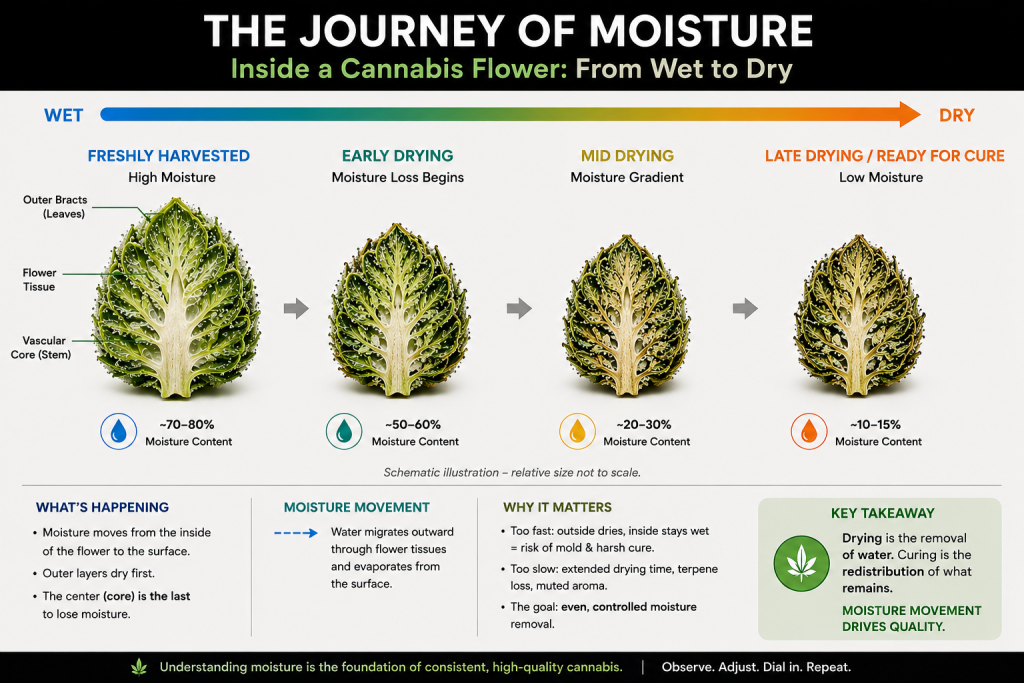
Fresh cannabis flower contains water throughout its tissues, but that water does not leave every part of the inflorescence at the same rate. Water near exposed surfaces has a shorter path to the surrounding atmosphere than water deep within a dense flower. As drying progresses, moisture gradients develop. Exposed leaves and peripheral tissues become drier while relatively more moisture remains internally.
This gives us a useful way of thinking about drying and curing.
Drying primarily removes water from the harvested material. Curing primarily redistributes the water that remains.
They are not really independent processes. They are different stages of the same movement toward equilibrium.
This concept is not unique to cannabis. Dried fruits, herbs, hops and other botanical commodities continue exchanging and redistributing moisture after the initial drying step. Other agricultural industries often refer to a period of moisture equilibration as conditioning. Cannabis curing can be viewed through a similar physical lens.
Of course, moisture redistribution is only part of curing. Curing is also a period of continued physical and biochemical change that can influence aroma, flavor, color, cannabinoids, terpenes and ultimately the sensory quality of flower. Some cultivators intentionally extend aging in pursuit of an optimal quality window. Those changes deserve a discussion of their own. Here, however, we are following the movement of water and the microbial ecology surrounding it.
Then We Interrupt the Process
Between drying and curing, many operations introduce another major disturbance.
We trim the flower.
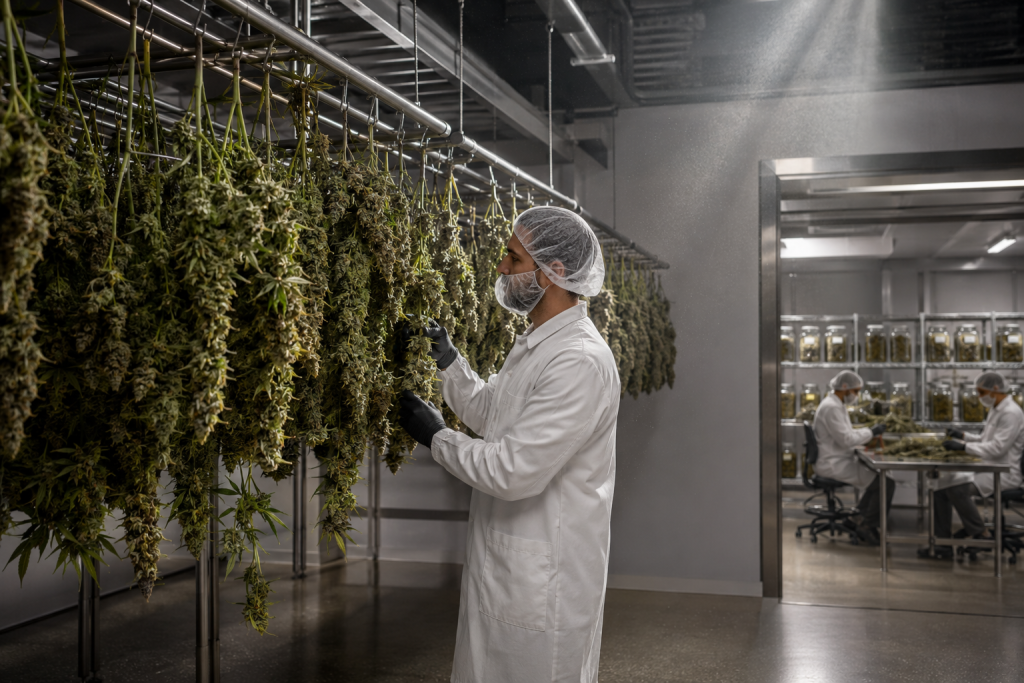
By this point, the plant is physically very different from when it entered the dry room. Exposed leaves and peripheral tissues are among the driest portions of the harvested material. Sugar leaves become brittle and some plant material crumbles from relatively minor handling.
Then, after the crop has spent days progressively drying, we deliberately disturb it again. Branches may be bucked, flowers handled, leaves cut away and material passed through mechanical trimming equipment.
From an environmental-monitoring perspective, this can be an enormous biological event. We have measured very large increases in airborne fungal material during cannabis trimming, with mechanical trimming producing particularly substantial airborne loads.
At first glance, that sounds like trimming is making the microbial situation worse.
But consider what is being removed.
Sugar leaves and other peripheral tissues have spent months exposed to the cultivation environment. They have encountered facility air, dust, irrigation aerosols, workers, equipment, beneficial organisms and fungal spores. Those exposed tissues are then dried until they become some of the most brittle material on the harvested plant.
Trimming physically removes a portion of them.
That raises an interesting question: could trimming increase the airborne microbial burden of the processing room while simultaneously removing some microbial material from the flower that will become the finished product?
Those outcomes are not contradictory.
The biological material has to go somewhere. It may leave with trim waste, remain on equipment, deposit onto surfaces, become airborne or potentially transfer onto other flower.
Seen this way, trimming is more than a cosmetic step. It is another redistribution event within the post-harvest ecology of the facility. Where that material goes becomes a question of airflow, filtration, equipment sanitation, worker movement, room design and workflow.
What Goes Into the Cure?
After trimming, what enters the curing container is not simply “dried cannabis.”
The material has lost substantial amounts of water. Its exterior tissues dried faster than its interior. Some of those dry peripheral tissues have now been removed. The remaining flower has undergone another significant mechanical disturbance.
Then we close the container.
Moisture remaining deeper within the flower begins redistributing toward drier regions as the product moves toward equilibrium. No new water necessarily needs to be introduced. It is the water already present within the flower changing location.
The microorganisms do not necessarily move with that water.
A fungal spore associated with plant material does not need to migrate through the flower during curing. Instead, the environment surrounding that organism changes as water redistributes.
The water moves around the biology.
That distinction is important because proper drying and curing do not sterilize cannabis. Fungal spores, fragments and other microorganisms can remain associated with the product. What changes dramatically is the environment available to them.
Presence is not the same as activity.
Microorganisms require suitable environmental conditions to grow. Water availability is one of the most important, along with temperature, nutrients, time and the biology of the organism itself. Drying progressively changes those conditions. Curing redistributes the remaining moisture, and storage attempts to maintain the stability that has been created.
The most important microbial control step in cannabis is therefore not necessarily the test at the end. It is preventing environmental conditions that allow microorganisms to transition from presence to activity.
That does not diminish the importance of microbial testing or the legitimate health risks associated with certain fungal organisms and metabolites. Testing and process control simply answer different questions.
A finished-product test asks what was detected in the material sampled at the end.
Process monitoring asks what happened along the way.
Learn What Normal Looks Like
Imagine deliberately collecting environmental information at consistent points throughout the post-harvest process: before harvest, during harvest, during dry-room loading, during drying, during trimming and following sanitation. Then compare that history with the microbial results of the finished flower.
One harvest would not establish much.
Twenty harvests might.
Patterns could begin to emerge. Perhaps a particular fungal group repeatedly appears during harvest but rarely follows the product downstream. Another might consistently appear during cultivation, harvest and trimming. Mechanical trimming might routinely create enormous airborne releases without producing a corresponding increase in finished-product counts. An unusual dry-room profile might occasionally precede an unusual finished-product result.
We should not assume those relationships exist. We should measure them.
Cultivators already approach almost every other production variable this way. Irrigation, nutrients, temperature, humidity, lighting, yield and cannabinoid concentration are tracked across crop cycles. The biological environment can be treated the same way.
Instead of asking whether one environmental result is “high,” we can ask a much more useful question:
Is this normal for this facility, at this point in the process?
That is how environmental monitoring begins to become environmental understanding.
Is the Harvested Plant Finished Being a Plant?
There is one final question worth considering.
A harvested cannabis plant does not instantly become completely inert when its stem is cut. In other horticultural industries, cut stems can continue taking up water through their vascular system after harvest. The cut-flower industry intentionally takes advantage of this by placing stems into water or conditioning solutions.
That raises some fascinating questions for cannabis.
How long does meaningful hydraulic transport continue after harvest? How much water can a mature harvested branch draw through its cut stem? Do attached leaves contribute to that movement through residual transpiration? Could that short period of remaining vascular function someday be used intentionally as part of a post-harvest conditioning or microbial-control process?
Those are research questions, not recommendations.
But they illustrate what happens when we stop treating drying and curing as isolated cannabis traditions and begin looking at harvested flower through the broader sciences of plant physiology, agricultural commodities and microbial ecology.
The Harvest Has an Ecology
During cultivation, nearly everything we do is intended to support biological activity. We provide water, nutrients, light and environmental conditions that allow a plant to grow.
At harvest, that objective reverses.
Water leaves. Moisture redistributes. Plant tissues physically change. Harvest releases biological material into the air. Trimming creates another disturbance and redistribution event. Curing allows remaining moisture to move toward equilibrium. Storage attempts to maintain the stability we have created.
The microorganisms have not necessarily disappeared.
Their environment has changed.
Environmental monitoring gives us an opportunity to watch portions of that story unfold and learn what normal looks like at each stage of the process.
The final test tells us where we ended up.
The process tells us how we got there.
Every cultivation facility has an ecology.
The harvest does too.