
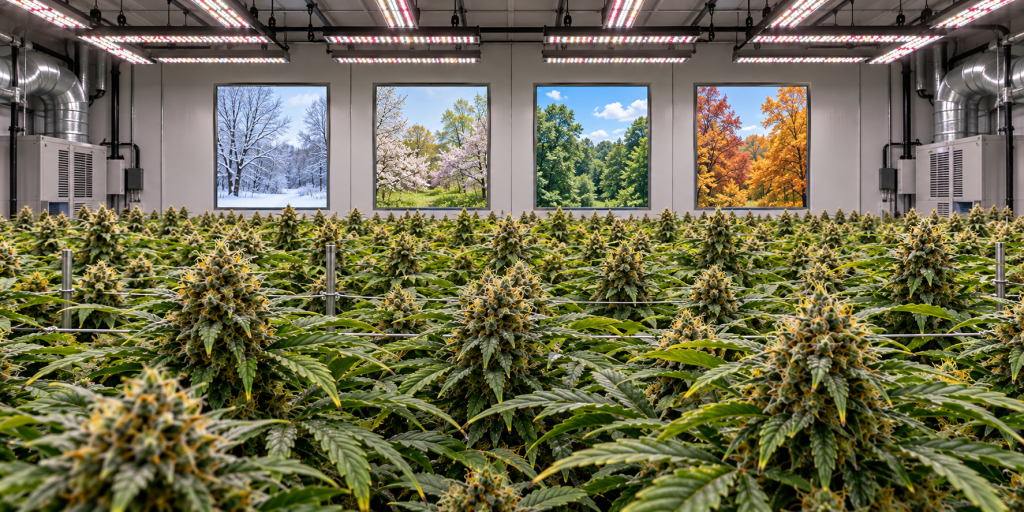
What Croptober Can Teach Us About Indoor Powdery Mildew
October has a special meaning in cannabis cultivation. Croptober is harvest season. Across much of the country, outdoor cannabis and hemp plants are reaching maturity just as the environment around them begins to change. Days are getting shorter, nights are getting cooler, and the difference between daytime and nighttime temperatures can become larger. Plants are mature, canopies are dense, and moisture behaves differently within those canopies than it did earlier in the season.
It is also powdery mildew season. That isn’t particularly surprising outdoors. Powdery mildew is commonly a late-season concern in field-grown cannabis and hemp. As environmental conditions change toward the end of the growing season, the conditions within the plant canopy change with them.
But I’ve been noticing something else. Over the past several months, I’ve watched environmental spore-trap data from multiple indoor cannabis cultivation facilities. Beginning around July, Oidium-type spore counts began increasing. Through August and into September, powdery mildew pressure became increasingly apparent in the air samples. Now, as September comes to an end, those counts are beginning to trend downward.
These aren’t outdoor fields. They are controlled indoor cultivation facilities. So why should an indoor grow have a powdery mildew season? That question gets much more interesting than simply asking how to kill powdery mildew.
The Outside Environment Still Matters Indoors
We sometimes talk about indoor cultivation as though the building separates the crop from the outside environment. It doesn’t. It buffers it. A flower room may be programmed for the same temperature and relative humidity in January, April, July and October. The lights follow the same schedule. Irrigation can follow the same strategy. The grower may be running the same cultivars under essentially the same production protocols. But the building containing that room is experiencing four very different environments.
Think about what an HVAC system is being asked to accomplish on a mild spring afternoon compared with a hot summer day followed by a cooler night. The setpoint may not have changed, but the load certainly has. As outdoor temperatures rise and fall, HVAC and dehumidification equipment must continually compensate. Greater differences between outdoor and indoor conditions mean more energy must be moved, more moisture must be managed, and the environmental control system has to respond to larger changes.
That doesn’t necessarily mean the cultivation room suddenly becomes hot or excessively humid. A well-controlled room may still look excellent on an environmental dashboard. The more interesting question may be how stable that environment remains.
The Average Can Hide the Event
Imagine two flower rooms that both report an average temperature of 78°F and an average relative humidity of 55%. On paper, they look identical. Room A, however, remains very close to those conditions throughout the day, while Room B repeatedly moves above and below them as lights change, HVAC equipment cycles, irrigation occurs, plants transpire and outdoor conditions change. The averages may be the same, but the biology isn’t necessarily experiencing the same environment.
Powdery mildew doesn’t experience the room average; it experiences the microclimate on the leaf. A temperature change also changes relative humidity even if the absolute amount of water vapor in the air hasn’t immediately changed. As temperature falls, relative humidity rises. Now move from the room sensor into a mature cannabis canopy. Leaves transpire, air movement is restricted, leaf temperatures can differ from room temperature, and large flowers and dense foliage create protected spaces where temperature, humidity and airflow can differ substantially from the conditions measured several feet away by an environmental sensor.
The room might be at 55% RH, but that doesn’t mean every leaf surface is experiencing 55% RH. This is where seasonal environmental changes outside the building can become biological changes inside the canopy.
Croptober Gives Us the Outdoor Version
Outdoor cannabis makes this relationship easier to see because there is no building buffering the crop from seasonal change. As summer transitions into fall, daytime and nighttime temperatures change, day length decreases, humidity patterns change, nights become longer, and canopies are mature and dense. Powdery mildew pressure often becomes increasingly obvious during this late-season period.
The pathogen didn’t suddenly appear because someone flipped the calendar to October. The environment changed.
Indoor cultivation gives us a more complicated version of the same relationship. The HVAC system sits between the outdoor environment and the plant, attempting to maintain the conditions we have selected, but controlled does not mean isolated. Outdoor cannabis experiences seasonal environmental change directly. Indoor cannabis experiences seasonal environmental change through the building and its environmental-control systems.
One way to think about the pathway is: outdoor environmental change affects building load; building load affects HVAC response; HVAC response can affect room variability; room variability influences canopy microclimates; and those microclimates influence powdery mildew biology. The building reduces the magnitude of the environmental change. It does not necessarily eliminate it.
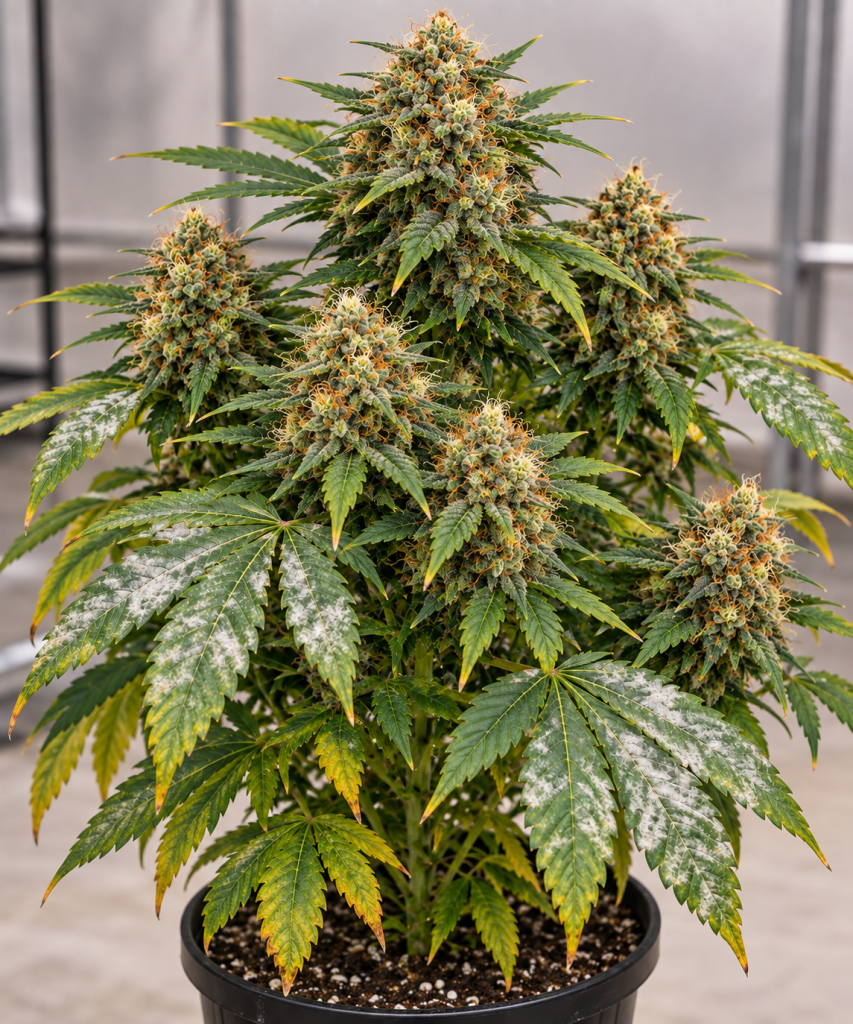
Where Did the Powdery Mildew Come From?
This is another important distinction. When we detect certain fungal spores inside a cultivation facility, the outside environment can be an obvious potential source. Alternaria is a good example, as are basidiospores. We routinely find these types of spores outdoors. When their concentrations change inside a facility, it can make sense to investigate outside-air introduction, building pressure, doors, filtration, HVAC maintenance or nearby agricultural activity.
Oidium behaves differently in the environmental data I see. In outdoor reference samples I’ve collected around cultivation facilities, I have not typically detected Oidium-type spores, yet we can detect substantial Oidium concentrations inside cultivation rooms. That changes the question.
Instead of assuming the season is bringing powdery mildew into the building, consider another possibility: the powdery mildew is already there. It may exist at very low levels on plants, persist within the production cycle, or exist somewhere within the facility ecology without producing enough disease or airborne spores to attract attention. The seasonal change doesn’t necessarily introduce the organism. It may simply change the organism’s opportunity to succeed.
That distinction changes the way we think about management.
Presence Is Not the Same as Disease
Cultivation is never going to occur in a biologically empty environment. Plants arrive with microorganisms. People carry microorganisms. Water contains microorganisms. Air carries microorganisms, and surfaces accumulate them. The objective of cultivation isn’t sterility. The objective is preventing organisms capable of damaging the crop from becoming dominant.
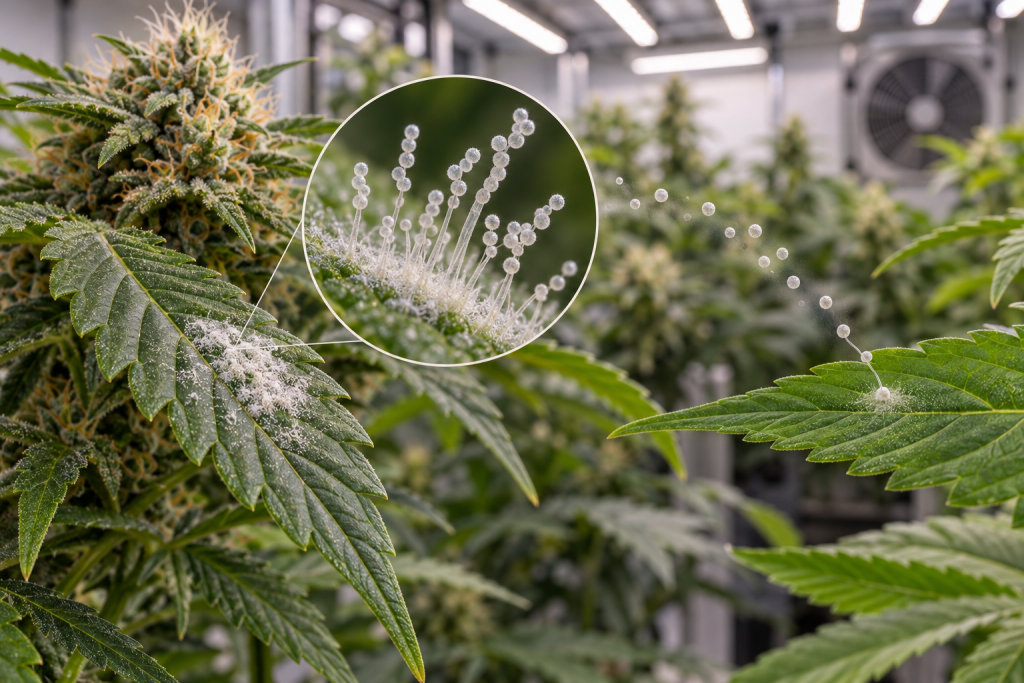
Powdery mildew provides a good example. There can be a tremendous difference between the presence of a small amount of fungal material and a canopy actively supporting powdery mildew growth and sporulation. Once conditions favor growth, a small biological presence can become an amplification event. Colonies grow, conidiophores develop, spores are produced, those spores mature and are released, and air movement carries them to additional plant surfaces. Under suitable conditions, another cycle begins.
More colonies create more spores, and more spores create more opportunities for establishment. Eventually, an environmental spore count isn’t merely telling us that Oidium exists. It may be telling us that the cultivation environment is allowing Oidium to amplify.
That is why an increasing spore count matters. The number isn’t the answer; the change in the number is information.
Fungi Have Life Cycles Too
This is where I think cultivation can borrow something from traditional insect IPM. When growers manage insects, they think about life cycles. Eggs, immature stages, adults, reproduction and dispersal all matter. An intervention that works very well against one stage may be much less effective against another. Timing can be as important as the product itself. We don’t simply ask what kills the insect; we ask when the insect is most vulnerable.
Why shouldn’t we approach fungi the same way?
Powdery mildew has a biological cycle. Colonies grow, conidiophores develop, spores are produced and mature, and changing environmental conditions influence their release. Spores disperse and deposit onto new plant surfaces where, under favorable conditions, germination and additional growth can follow. Instead of thinking only about killing powdery mildew, we can ask a more useful question: What part of that cycle are we trying to interrupt?
The answer may be different depending on the problem we’re trying to solve.
Known PM and PM Season Are Different Problems
Suppose I already know I have an active powdery mildew problem. There are established colonies producing fungal material. My immediate concern isn’t simply that PM exists; it is that today’s fungal growth can become tomorrow’s inoculum distributed throughout the room. In that situation, I may want to think about intervention relative to the next dispersal event.
Powdery mildew sporulation and dispersal are influenced by changes in temperature, humidity, light and air movement. In an indoor cultivation facility, the lights-on transition can produce several of those changes at once. That creates an interesting management question: If I already have PM, can I intervene before today’s inoculum gets distributed through the room?
An appropriately labeled treatment applied late in the dark period, before the lights-on environmental transition, may target a very different biological moment than the same treatment applied hours later after dispersal has occurred. The point isn’t that a particular time on the clock is universally correct. The point is to understand what biological event we are trying to interrupt and then consider whether the timing of the intervention can improve our chances of doing so.
Now consider a different situation. I don’t have a significant PM problem yet, but years of experience, environmental monitoring or previous crop data tell me that I’m entering the part of the year when PM pressure typically increases. That’s not a knockdown problem. It’s a prevention problem.
In this situation, the objective may be to establish protection before the environmental period most favorable for fungal establishment and growth. Instead of asking when spores are going to disperse, I might ask when the organism is about to receive the environmental conditions it needs to succeed.
These are two different reasons to treat. With a known PM problem, we may be trying to interrupt an active cycle before the next significant dispersal event. When PM season is approaching, we may instead be trying to prevent establishment and amplification before the next favorable growth period. It is the same pathogen, but the objective and the point in the life cycle we are targeting are different.
This doesn’t mean there is one universal hour when every powdery mildew treatment should be applied. Different products have different modes of action, labels and use requirements. The principle is more important than the clock: don’t just match the product to the pathogen. Match the timing to the biology.
Monitoring Should Change What We Do
This is where environmental monitoring becomes much more valuable than simply documenting contamination. For years, I was cautious about putting too much weight on individual spore-trap results. One air sample represents one place during one period of time, and there are obvious limitations to what we can conclude from a single measurement.
Repeated measurements are different. Once we collect data consistently, we can begin looking for patterns. Is Oidium pressure increasing or decreasing? Does it increase at approximately the same time each year? Does the increase correspond with greater temperature or RH variability? Does it follow lights-off or lights-on environmental excursions? Do multiple facilities experience similar seasonal changes?
Now the spore trap isn’t simply telling us whether a fungal structure happened to pass through the air sampler. It becomes another sensor for understanding the ecology of the facility.
Ultimately, monitoring should change what we do. If historical data tell us PM pressure usually begins increasing during a particular seasonal transition, why wait until visible disease tells us the same thing again? We aren’t simply collecting numbers. We’re learning when to act.
Look at Variability, Not Just Setpoints
If seasonal powdery mildew pressure is partly being driven by environmental variability, we may also be looking at the wrong environmental metrics. Growers understandably watch temperature and relative humidity averages, but perhaps we should also ask how large the temperature and RH swings were, how high RH peaked, how long an excursion lasted, what happened immediately after lights-off and lights-on, what happened after irrigation, how frequently the HVAC equipment cycled, and whether certain parts of the canopy behaved differently from the rest of the room.
Perhaps the most interesting question is whether environmental variability increased before the Oidium count increased.
That’s a testable question. Instead of simply comparing powdery mildew counts against average RH, we can compare them against the magnitude, frequency and duration of environmental excursions. We may discover that average environmental conditions barely changed while the variability around those averages changed substantially.
That would explain something growers already know intuitively: some times of year are simply harder to manage than others.
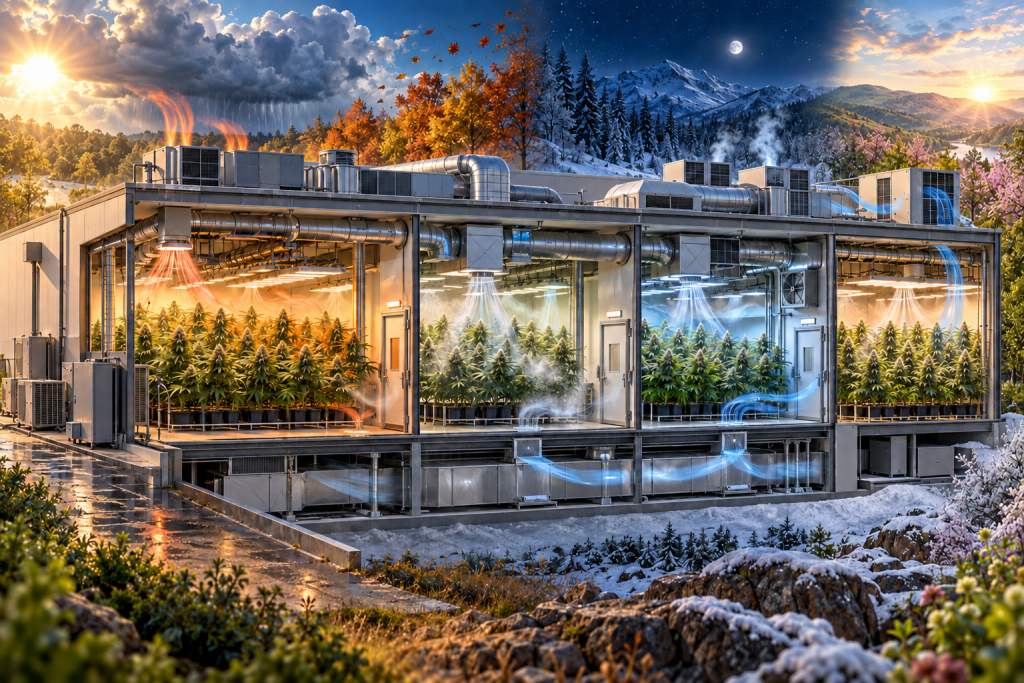
The Facility Has Seasons
Indoor growers experience this even though we don’t always describe it as seasonality. Summer puts different demands on HVAC equipment than winter. Periods of high outdoor humidity create different challenges than dry conditions. A cold night followed by a warm day creates a different building load than a week of relatively stable temperatures.
Those changes can influence dehumidification, pressure relationships, air movement, temperature gradients and microclimates throughout a facility. The plants experience the consequences, and so do the microorganisms living with them.
This is why a cultivation facility shouldn’t be viewed as a collection of independent rooms operating at fixed environmental setpoints. It is a biological system contained within a mechanical system contained within a much larger outdoor environment. Each layer influences the next.
Powdery Mildew Management Is About Opportunity
If powdery mildew is already present somewhere within the production system, complete exclusion becomes an unrealistic management strategy. That doesn’t mean outbreaks are inevitable. It means management becomes a question of limiting opportunity.
Sanitation reduces reservoirs. Environmental control reduces favorable growth conditions. Air movement reduces problematic microclimates. Canopy management changes the environment surrounding leaves and flowers. Environmental monitoring tells us whether fungal pressure is increasing or decreasing. Preventive treatments can reduce the opportunity for establishment, while mitigation treatments can interrupt an active cycle. The timing of those interventions can then be selected based on what biological event we’re trying to prevent.
None of these controls needs to create sterility. Together, they can keep a small biological presence from becoming an amplification event. That’s a very different strategy from waiting until white colonies appear and then asking what will kill them.
What Croptober Can Teach Indoor Growers
Outdoor growers don’t need convincing that seasons matter because they can watch the environment change around their plants. Indoor cultivation makes those changes less obvious. Walls, HVAC systems, lights and environmental controllers create the appearance of separation from the outside world, but the separation is incomplete.
The same seasonal forces affecting an outdoor crop are pushing against the building containing the indoor crop. The difference is that indoor cultivation has machinery standing between the season and the plant. That machinery gives us tremendous control, but it doesn’t make the season disappear.
So as Croptober arrives and outdoor powdery mildew pressure becomes obvious, it may be worth looking at indoor environmental data differently. Don’t just ask what the average temperature or RH was. Ask how much it moved, when it peaked and how long the excursion lasted. Don’t just ask whether powdery mildew was detected. Ask whether the pressure is increasing or decreasing.
And don’t just ask what product controls powdery mildew. Ask where the organism is in its life cycle and what part of that cycle you’re trying to interrupt. If you already have an active problem, perhaps the objective is to reduce viable fungal material before the next dispersal event. If historical data tell you PM season is approaching, perhaps the objective is to intervene before the next favorable period of establishment and growth.
We already think this way when managing insects. Fungi have life cycles too.
The season doesn’t necessarily bring powdery mildew into your facility. The season may simply change the opportunity for powdery mildew already there. That opportunity is something we can measure, anticipate and manage.
Your grow room has seasons—even if your setpoints don’t.